
Turn this into a daily habit — free to start in the MindLift app:
He took four hours to reply and you've already rehearsed the breakup. Or things are actually going well — really well — and instead of relief you feel a low hum of dread you can't explain. You reread the last message. You check if he's been online. You catch yourself drafting a "is everything okay?" text and you know, even as you type it, that sending it won't help for long.
Here's the part that makes it feel crazy-making: often none of this is happening because something is wrong with your relationship. It's happening because an alarm system inside you is doing exactly what it was built to do — just at the wrong volume, at the wrong time.
Understanding what that system is, and why it fires hardest when things are good, is most of the way to turning it down.
What relationship anxiety actually is
Relationship anxiety is persistent worry and doubt about a relationship — your partner's feelings, your own feelings, whether it'll last — that shows up even when there's no real evidence anything is wrong.
The key word is evidence. Relationship anxiety isn't information about your relationship. It's a threat-detection system misfiring. It feels like insight — I just have a bad feeling — but a feeling of dread is not the same as a fact about your partner, no matter how loud it gets.
This matters because the anxious brain does something specific: it treats the feeling as proof. I feel like he's pulling away, therefore he's pulling away. The alarm goes off, and instead of asking "is there a fire?" you start looking for smoke to justify the sound you're already hearing.
Why it spikes exactly when things are good
This is the part that confuses people most, and it's where the psychology gets genuinely useful.
A lot of relationship anxiety traces back to attachment — the system, first mapped by John Bowlby, that governs how safe we feel depending on closeness to the people we rely on. People who lean anxiously attached have a threat-detector that's turned up: highly sensitive to any sign of distance, quick to read a neutral text or a quiet evening as the first sign of abandonment.
And here's the cruel logic: the closer you get to someone, the more there is to lose — so the alarm gets louder, not quieter, precisely as the relationship deepens. Feeling securely close is the exact condition that triggers the fear of losing it. That's why the dread can arrive right in the good moments and feel like it came from nowhere.
This isn't a rare quirk. Insecure attachment is a substantial minority of the population, and meta-analyses link it to a higher risk of adult anxiety. If this is you, you're not broken and you're not overreacting on purpose. You're running a survival system that was tuned early and hasn't updated.
The distortions running the loop
Relationship anxiety doesn't spiral on its own. It runs on a handful of predictable thinking errors — the same ones CBT has been naming for decades. Spot them and the spiral loses a lot of its grip:
- Catastrophizing — "He was short with me. This is the beginning of the end." One data point, fast-forwarded to disaster.
- Mind reading — "She's gone quiet, she's losing interest." A guess about someone's inner state, treated as confirmed. Catching this one is the same repair as catching yourself before you defer to a guess about what someone else thinks — the guess is doing the deciding, not the evidence.
- Emotional reasoning — "I feel anxious, so something must be wrong." The feeling becomes the evidence.
- Fortune telling — "They're going to leave eventually, they always do." A predicted future used to justify present panic.
None of these are character flaws. They're an anxious threat-detector narrating in real time. But narration is not news — and learning to catch the sentence as it forms is where the change actually happens.
The reassurance trap
Here's the counterintuitive one, and it's the single most useful thing to understand about relationship anxiety.
When the anxiety spikes, the obvious move is to seek reassurance — ask "do you still love me?", fish for a compliment, check their location, reread old messages for proof. And it works. For about an hour. The relief is real.
Then it wears off, the doubt comes back a little stronger, and you need a slightly bigger hit of reassurance to get the same relief. Researchers who study relationship-related obsessive worry find the same pattern that shows up in OCD: reassurance-seeking is a compulsion. Every time you relieve the anxiety from the outside, you teach your brain that the anxiety was a real emergency that needed handling — which makes it fire faster next time.
You can't reassure your way out of relationship anxiety, because reassurance is what keeps it alive.
Reassurance-seeking works for about an hour, then teaches the brain the alarm was a real emergency — so it fires sooner next time.
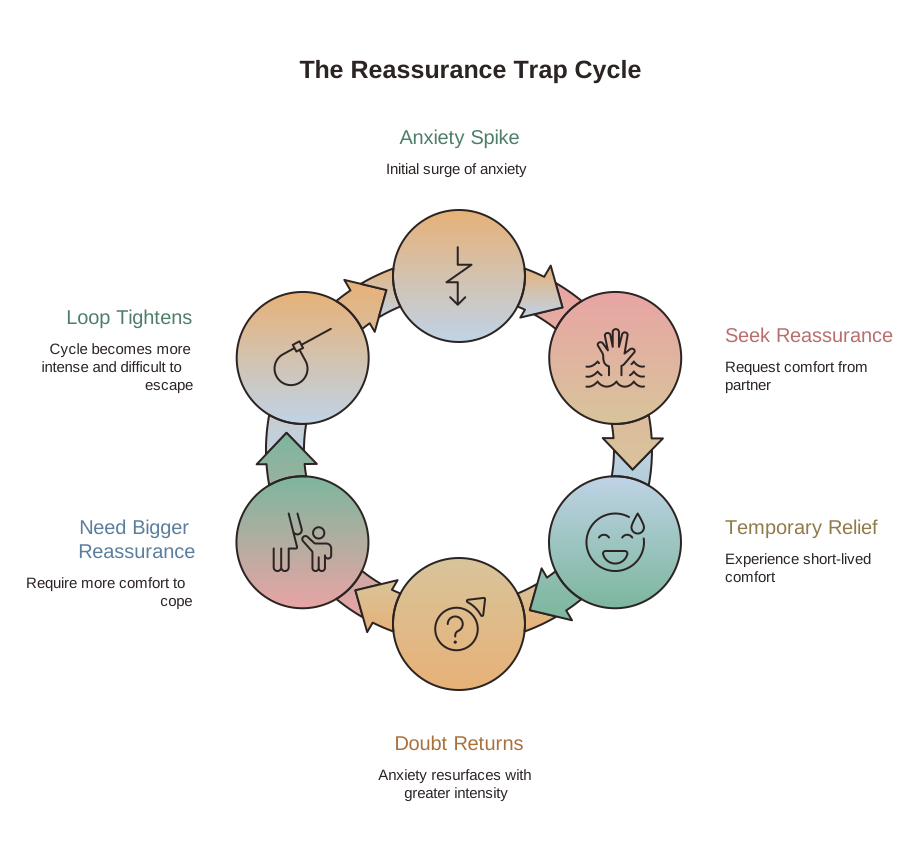
So the thing that feels like the solution is quietly the fuel. You can't reassure your way out of relationship anxiety, because reassurance is what keeps it alive.
What actually helps — and one important caveat
First, the caveat, because it matters: none of this means every doubt is anxiety. Sometimes a bad feeling is information — about genuine incompatibility, dishonesty, or a relationship that isn't safe. Reframing is not for talking yourself out of real problems or staying somewhere you shouldn't. This is about the anxiety that fires inside a fundamentally okay relationship, where the alarm is louder than the facts warrant. If you're not sure which one you're in, that's worth exploring with a therapist, not with a technique.
For the anxiety-misfiring kind, what helps isn't more certainty. It's learning to hold the uncertainty without immediately acting on it:
- Noticing the spike and not reaching for reassurance — letting the alarm ring without answering it, so your brain learns it wasn't an emergency.
- Catching the specific thought ("he's pulling away") and reframing it toward what you actually know ("he's been quiet for three hours; I'm mind-reading; nothing has actually happened").
- Telling the difference, each time, between an alarm going off and a fact coming in.
The hard part is that relationship anxiety moves fast — the spike-to-spiral-to-"is everything okay?" text can happen in under a minute. By the time you'd journal about it, you've already sent the text. You need something at the moment of the spike, not hours later.
That's the gap MindLift was built for. When the thought hits — "four hours, no reply, he's done with me" — you type it in as it's actually running, and within about a minute you get three grounded reframes back, each tagged with the distortion driving it (that one's fortune-telling stacked on mind-reading). It's not reassurance and it's not a mantra — it's a way to answer the thought instead of the person, so the loop starves instead of feeds. Mental first aid for the 2am spiral, when the alarm is loudest and there's no one to text who'd actually help.
The one thing to take with you
The dread that shows up when things are good isn't a message about your relationship. It's an old alarm, tuned a long time ago, doing its job at the wrong volume.
You don't have to obey it and you don't have to argue it into silence. The next time it fires — four unanswered hours, one quiet evening, one "we should talk" — catch the thought before it becomes a text, and answer that instead.
Catch the spiral before it sends the text. Try MindLift — one thought in, three grounded reframes back.
Frequently asked questions
Is relationship anxiety a sign I'm in the wrong relationship?
Not by itself. Anxiety fires based on your threat system, not on your partner's behaviour — which is exactly why it can spike hardest when things are good. A steady bad feeling that persists regardless of what your partner does is more likely anxiety than a verdict. A specific, repeating concern grounded in real events is worth taking seriously.
Why do I feel more anxious as we get closer?
Because closeness raises the stakes. The more you'd lose, the louder your attachment alarm gets — so deepening intimacy can trigger the fear of losing it. It's counterintuitive but extremely common.
Why doesn't reassurance fix it?
Because reassurance relieves the anxiety from the outside, which teaches your brain the anxiety was a genuine emergency — so it fires again, sooner. Relief in the moment, stronger loop over time.
Can you actually reduce relationship anxiety?
Yes — but usually by changing your relationship to the thoughts, not by collecting more certainty about your partner. Catching and reframing the anxious thought, and resisting the reassurance reflex, does more than any amount of checking.
Like what you're reading?
Build kinder inner dialogue
The way you talk to yourself shapes every relationship. MindLift helps you soften that voice.


Free to start · premium optional