
Turn this into a daily habit — free to start in the MindLift app:
Cognitive behavioral therapy is one of the most evidence-based treatments in psychology. It's also expensive, time-limited, and inaccessible to most people who could benefit from it. AI-powered CBT apps aim to bridge that gap — delivering CBT techniques at scale, available anytime, without a waitlist or insurance requirement.
Here is what that actually means, what the research shows, and how to evaluate whether an app is genuinely CBT-based or just using the label.
What CBT Actually Is (Before the AI Part)
Cognitive behavioral therapy is a structured, evidence-based psychological treatment that works on the connection between thoughts, feelings, and behaviors. The core premise: your thoughts about events — not the events themselves — primarily determine how you feel and behave in response.
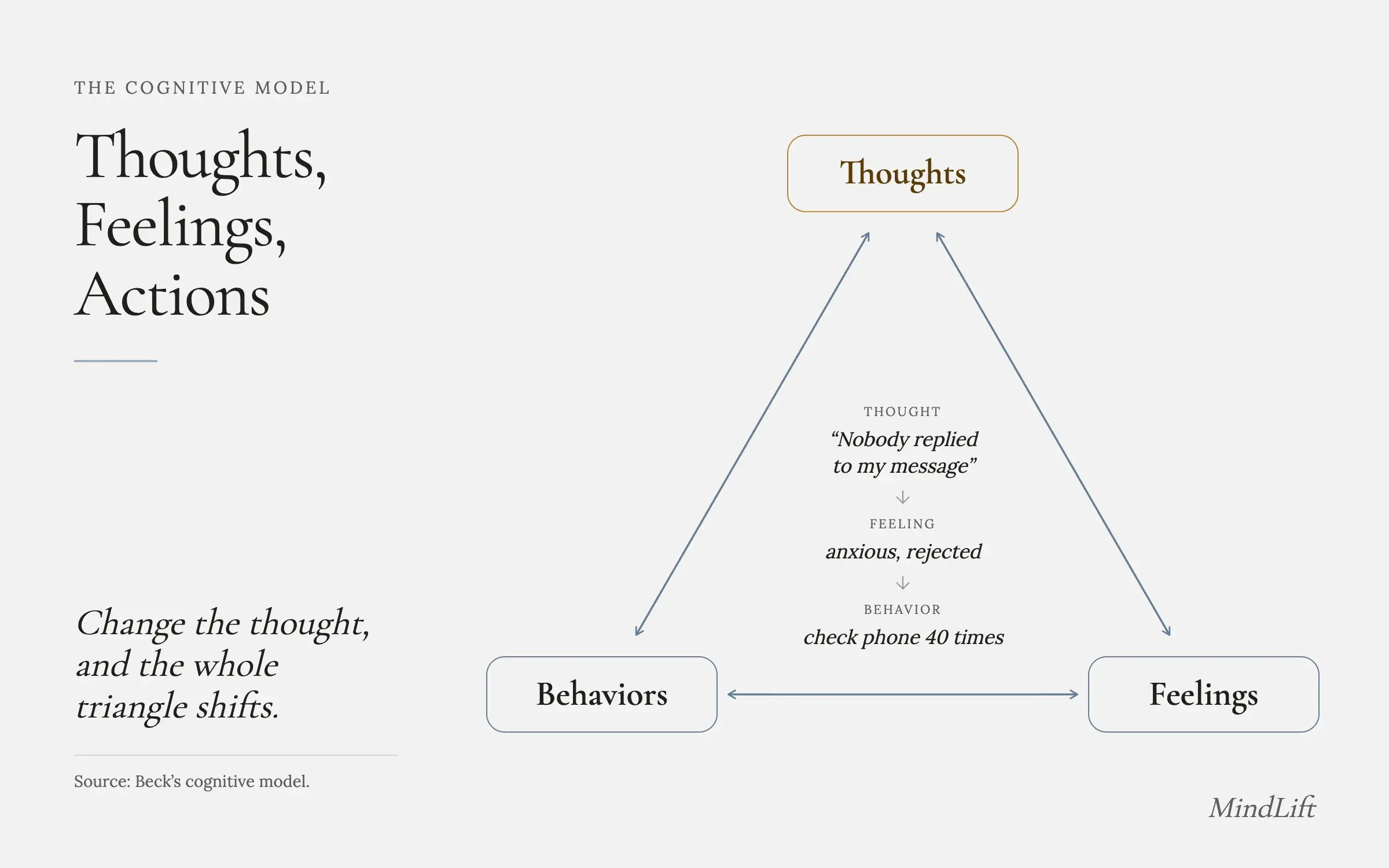
The main CBT techniques include:
- Cognitive restructuring — identifying and challenging distorted thoughts, generating more accurate alternatives
- Behavioral activation — increasing engagement in meaningful activities to break depression/avoidance cycles
- Exposure therapy — gradual, systematic approach to feared situations to reduce avoidance
- Problem-solving — structured approach to real-world problems driving distress
- Thought records — structured written examination of a difficult thought
Traditional CBT involves a trained therapist guiding this process, usually in weekly sessions over 8–20 weeks. The AI version attempts to replicate the guidance without the human.
How AI Makes CBT Personal
The problem with CBT workbooks and worksheets is that they're generic. They give you a framework — "identify the distortion, examine evidence, write a reframe" — but the specific thought is yours, and the reframe needs to be tailored to your situation to feel believable.
AI addresses this by analyzing your specific input and generating a response calibrated to what you actually said. Instead of "here's a general thought challenging worksheet," an AI CBT app can say "given what you wrote about the presentation, here's a specific reframe for that thought."
This is the core value proposition of AI in CBT: personalization at scale. Not a trained therapist's nuanced clinical judgment, but something meaningfully better than a static worksheet.
What the Research Shows
The evidence base for digital CBT (a broader category that includes app-based and computer-based CBT, not just AI) is substantial and growing:
- A 2019 meta-analysis of 66 randomized trials of smartphone apps (Linardon et al.) found that apps significantly outperformed control conditions for depression and generalized anxiety symptoms, with larger effects for CBT-based apps that offered professional guidance.
- A 2018 meta-analysis of trials that compared the two formats directly (Carlbring et al.) found that guided internet-based CBT and face-to-face CBT produced equivalent overall effects.
- An early randomized trial of a chatbot-based CBT tool (Fitzpatrick et al., 2017) found that users reduced their depression symptoms over the study period, while an information-only control group did not.
Important caveats: most research is on digital CBT broadly, not specifically AI-generated reframes. The research base is newer and smaller for AI-specific tools. Selection bias matters — people who download mental health apps differ from those seeking therapy.
What "AI-Powered CBT" Usually Means in Practice
Not all apps that claim "AI" or "CBT" are equivalent. There's a spectrum:
- Genuine CBT technique delivery: Apps that apply actual CBT methods — cognitive restructuring, thought records, Socratic questioning — using AI to personalize them to user input. MindLift's Mini-Reframe is an example: it applies CBT cognitive restructuring to the specific thought you type.
- CBT-informed conversation: Chatbot-style apps (Wysa, Youper) that guide you through CBT-structured conversations. Valuable, but less immediately applicable in the moment than a direct reframe tool.
- Generic affirmation generators: Apps that use "AI" to generate positive statements but don't apply CBT logic. These may feel good but don't address the underlying thought distortion.
- "CBT-inspired" wellness apps: Apps that include some CBT elements (mood tracking, journaling prompts) but don't apply cognitive restructuring as a core feature.
How to Evaluate an AI CBT App
Before choosing an app, ask:
- Does it specifically identify thought distortions, or just validate feelings?
- Does it generate reframes tailored to your specific input, or provide generic responses?
- Is the reframe believable (accurate and grounded) or just positive?
- Is the CBT technique it uses named and explained, or is it a black box?
- Does it require you to articulate the actual thought, or does it work in generalities?
A genuine AI CBT tool should be doing something with what you type — identifying the distortion type, applying a specific reframe technique, generating a response that addresses your thought's specific logic rather than offering a generic "you've got this."
When AI CBT Is the Right Tool
AI-powered CBT is well-suited for:
- Mild-to-moderate anxiety, overthinking, or self-critical thought patterns
- Real-time intervention — in the moment, when a thought is running
- Building CBT skills between therapy sessions (as a supplement)
- People who can't access therapy due to cost, availability, or preference
It is not the right tool for:
- Severe depression, suicidal ideation, or crisis situations
- Complex trauma (PTSD) — requires specialized trauma-informed therapy
- Personality disorders or complex presentations requiring long-term relational work
- Any situation where safety is a concern — always contact a crisis service or emergency services
Related Reading
- Cognitive Reframing Techniques: 8 CBT Methods
- Best Free CBT App 2026
- How to Stop Overthinking Immediately
- CBT Techniques Guide
Frequently asked questions
What is AI-powered CBT?
AI-powered CBT (cognitive behavioral therapy) uses artificial intelligence to deliver CBT techniques — like cognitive restructuring, thought challenging, and behavioral activation — in a personalized way, without requiring a human therapist. The AI analyzes your input and generates a response tailored to your specific thought or situation, rather than a generic one.
Is AI CBT as effective as therapy?
For mild-to-moderate symptoms, digital CBT (including AI-powered apps) shows significant effectiveness in controlled trials. A 2018 meta-analysis of trials comparing the two directly found guided internet-based CBT and face-to-face CBT produced equivalent overall effects. For severe anxiety, depression, trauma, or complex presentations, in-person therapy with a licensed therapist remains the standard of care.
What is the best AI CBT app?
The best AI CBT app for you depends on what you need it for. MindLift focuses on real-time cognitive reframing — you type the thought you're stuck on and get a CBT-based reframe in 60 seconds. Other apps (Wysa, Youper) offer broader CBT-informed conversation; Woebot, long the default answer here, withdrew its consumer app on 30 June 2025. The key differentiator is whether the app applies actual CBT technique or just provides general support.
Can an app replace therapy?
For mild symptoms and self-directed skill building, CBT apps can be genuinely effective. They cannot replace therapy for severe mental health conditions, complex trauma, relationship issues, or situations requiring professional risk assessment. Think of CBT apps as a self-help tool that fills the accessibility gap — available 24/7, no waiting list, no cost barrier — rather than a replacement for clinical care.
Like what you're reading?
Continue your wellness journey
Reframe negative thoughts in 60 seconds — free to start in the MindLift app.


Free to start · premium optional