
Turn this into a daily habit — free to start in the MindLift app:
Cognitive reframing is the core skill that makes CBT work. The goal isn't to feel better by pretending things are fine — it's to think more accurately about what's happening, because distorted thinking is what makes ordinary difficulties feel catastrophic.
MindLift is a CBT app built for rapid cognitive reframing: you type the harsh thought as it arrives and get back a kinder, realistic reframe in your own words in about 60 seconds. The techniques below are the same skill, done by hand and at full depth.
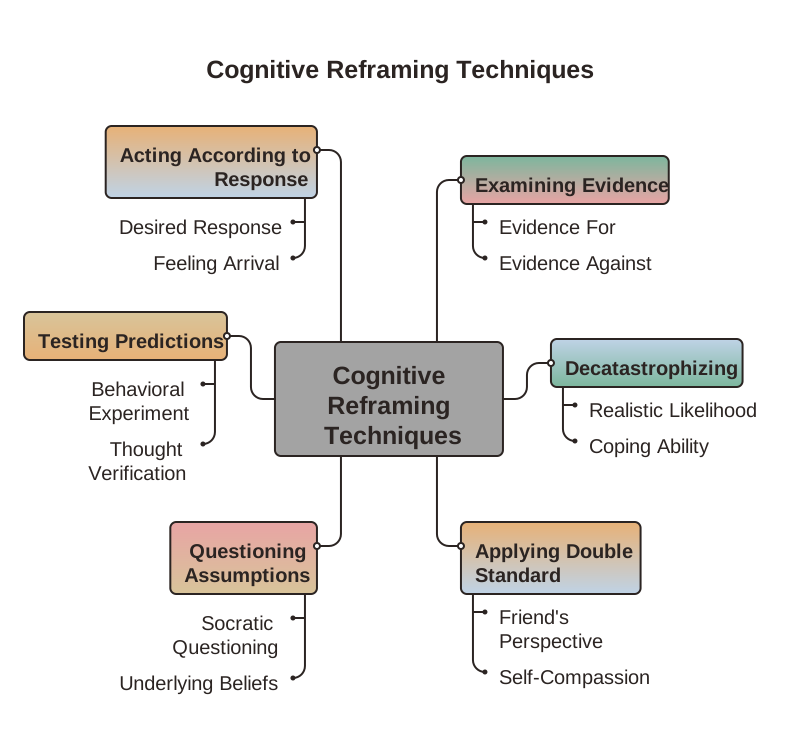
There are eight main reframing techniques in CBT. Each is suited to a different type of distortion. Here's what they are, when to use them, and concrete examples of each.
Before You Reframe: Name the Distortion
The most common mistake with cognitive reframing is jumping straight to "what's a more positive way to see this?" A reframe built on the wrong foundation won't land.
First, identify what type of distortion the original thought is. Common types:
- Catastrophizing — assuming the worst possible outcome
- All-or-nothing thinking — seeing things in black and white, no middle ground
- Mind-reading — assuming you know what others think
- Fortune-telling — predicting the future as if it's certain
- Emotional reasoning — "I feel like a failure, therefore I am one"
- Personalization — blaming yourself for things outside your control
- Should statements — rigid rules that generate shame when violated
- Overgeneralization — one bad event means everything is bad
Once you've named it, choose the technique below that fits that distortion type.
8 Cognitive Reframing Techniques
1. Evidence Examination
Best for: Fortune-telling, catastrophizing, emotional reasoning
The distorted thought: "This presentation is going to be a disaster. I know I'm going to blank."
The reframe: "I've had presentations go better than expected before. I know this material. Blanking briefly is recoverable."
- Write the thought exactly as it appears.
- List all the evidence FOR the thought (what actually supports it).
- List all the evidence AGAINST the thought (what contradicts it or provides alternative explanations).
- Write a reframe based on the actual evidence, not the feeling.
2. Decatastrophizing (What If Down the Scale)
Best for: Catastrophizing, anxiety spirals
The distorted thought: "If I fail this interview, my career is over."
The reframe: "If I don't get this job, I'll be disappointed, and then I'll apply to others. It's a setback, not an ending."
- Identify the worst case scenario you're imagining.
- Ask: what is the actual probability of this worst case?
- Ask: if it did happen, what would you actually do? Could you cope?
- Write the most realistic outcome (not worst, not best).
3. The Double Standard Technique
Best for: Self-criticism, personalization, 'should' statements
The distorted thought: "I should have handled that better. I'm so weak for falling apart."
The reframe: "If my best friend handled it the same way, I would not call them weak. I'd understand. I can apply the same standard to myself."
- Write what you are saying to yourself.
- Imagine a close friend came to you saying the exact same thing about themselves.
- Write what you would actually say to them.
- Apply that response to yourself.
4. The Survey Method
Best for: Mind-reading, all-or-nothing thinking
The distorted thought: "Everyone in that meeting thought I was incompetent."
The reframe: "I don't actually know what they thought. Some may have found it fine. I'm reading in a reaction I can't verify."
- Identify the assumption you're making about how others perceive you.
- Ask: do I have direct evidence of this, or am I inferring?
- Consider: what's the range of reactions people might actually have had?
- Write a thought that acknowledges uncertainty rather than false certainty.
5. Best Case / Worst Case / Realistic Case
Best for: Catastrophizing, anxiety about outcomes
The distorted thought: "This is definitely going to go wrong."
The reframe: "The worst case is bad but manageable. The best case is good but unlikely. The realistic case is somewhere in the middle — and I've navigated that before."
- Write the worst case outcome you're afraid of.
- Write the best case outcome.
- Write the most realistic outcome, based on what you know.
- Ask: am I acting as if the worst case is the most likely?
6. Socratic Questioning
Best for: Any distortion — especially entrenched beliefs
The distorted thought: "I never do anything right."
The reframe: "'Never' is the word worth examining. What did I do right last week? Am I applying one event to everything?"
- Take the thought and ask: is this absolutely true, or is it partly true?
- Ask: what evidence do I have that contradicts this?
- Ask: am I using extreme language (always, never, everyone, no one)?
- Ask: what's a more precise and accurate version of this thought?
7. The Behavioral Experiment
Best for: Avoidance, fortune-telling, social anxiety
The distorted thought: "If I speak up in the meeting, people will think I'm stupid."
The reframe: "Let me test that. I'll make one comment and observe what actually happens — rather than what I predict will happen."
- Identify the prediction your thought is making.
- Design a small, low-stakes experiment to test the prediction.
- Run the experiment and record what actually happened.
- Compare the outcome to the original prediction.
8. Acting As If
Best for: Avoidance, paralysis, low confidence
The distorted thought: "I don't feel confident enough to start."
The reframe: "I don't need to feel confident first. I need to act as if I were confident — and let the feeling follow the action."
- Identify the feeling you are waiting to have before you act.
- Ask: what would someone who had that feeling actually do right now?
- Do that one small action, without waiting for the feeling first.
- Notice whether the feeling begins to follow the action.
A Note on Believability
The most important criterion for a good reframe is not that it's positive — it's that it's believable. A thought you can't actually accept won't shift anything. "I'm going to be amazing" said to someone who just made a significant error is not believable and will feel hollow.
"I made a mistake. I can understand what went wrong and do something about it" — that's believable. That's what actually creates a shift.
MindLift's Mini-Reframe is built on this principle: it generates a reframe from the exact words you type, using CBT logic, in a form that tends to be believable because it's specific to your thought rather than generic.
Practice Consistency Over Perfection
The goal is not to perform a perfect reframe every time. The goal is to interrupt the automatic believing — to insert a pause between the thought and the acceptance of it as fact. That pause is what changes over time.
With consistent practice (one reframe per day, when a difficult thought arises), many people find their default response to hard thoughts begins to shift. The distorted thought still comes — it just doesn't pull as hard.
Related Reading
- How to Stop Overthinking Immediately
- Negative Self-Talk Examples and Reframes
- Thinking Traps and Cognitive Distortions
- How AI-Powered CBT Works
Frequently asked questions
What is cognitive reframing?
Cognitive reframing is a CBT technique for changing the perspective you hold on a thought, situation, or experience — not by forcing positivity, but by finding a more accurate, balanced, or useful interpretation. It is one of the core skills in cognitive behavioral therapy.
Is cognitive reframing the same as positive thinking?
No. Positive thinking replaces a negative thought with a positive one, regardless of accuracy. Cognitive reframing replaces a distorted thought with a more accurate one — which may still be challenging or difficult, but is grounded in evidence rather than wishful thinking.
How long does cognitive reframing take to work?
In the moment, many people notice a shift within a few minutes of a good reframe. Building the habit of reframing so it becomes automatic takes consistent practice, and the timeline varies from person to person.
What is the difference between reframing and rationalizing?
Reframing generates a more accurate interpretation of reality. Rationalizing generates a more comfortable interpretation that avoids accountability. The test: does the reframe acknowledge what is actually true, or does it explain away something you would rather not face?
Like what you're reading?
Continue your wellness journey
Reframe negative thoughts in 60 seconds — free to start in the MindLift app.


Free to start · premium optional