
Turn this into a daily habit — free to start in the MindLift app:
You know that person who will research a restaurant for 45 minutes, read 87 reviews, compare menus, check Instagram photos of the food…
and then just order takeout because they couldn't decide?
That's not indecisiveness.
That's analysis paralysis.
And it's not about needing more information.
It's about being scared to commit.
Because when you can't make a wrong choice, you never have to deal with regret.
Understanding Analysis Paralysis
1. Analysis Paralysis Looks Like Research, But It's Actually Avoidance
Let's be clear about what's happening:
- You tell yourself you need more data
- You make pro/con lists that go nowhere
- You ask 12 people for advice and then ignore it
- You keep "exploring options" indefinitely
But here's the truth: you're not gathering information — you're delaying a decision.
CBT calls this cognitive avoidance — your brain uses "analysis" as an excuse to avoid the discomfort of choosing.
Because as long as you're still deciding, you haven't failed yet.
2. What Analysis Paralysis Is Really Protecting You From
Beneath all that research and deliberation, here's what you're actually afraid of:
- Regret — "What if I pick the wrong thing and wish I'd chosen differently?"
- Responsibility — "If I choose, I'm accountable for the outcome."
- Loss — "Choosing one option means losing the others forever."
- Judgment — "What if people think I made a bad choice?"
- Finality — "Once I decide, I'm locked in."
So instead of choosing, you stall.
And stalling feels safer than risking any of the above.
3. The PhD Part: How Smart People Make It Worse
Here's the kicker:
If you're good at building arguments, you can get very good at justifying your avoidance.
You tell yourself:
"I'm being thorough."
"I'm considering all angles."
"I'm making an informed decision."
And it sounds so reasonable.
But if you've been "deciding" for weeks (or months), you're not being thorough — you're stuck in a fear loop disguised as diligence.
This is what I mean by "fear with a PhD" — your anxiety has learned to dress up like logic.
Practical Solutions
4. How to Tell If You're Problem-Solving or Just Stalling
Ask yourself:
- Am I gathering new, useful information? If you're re-reading the same reviews or asking the same questions, you're stalling.
- Would more information actually change my decision? If not, you already know what to do — you're just scared to do it.
- Am I waiting for a "perfect" option to appear? It won't. Perfect clarity is a myth.
- Am I trying to eliminate all risk before choosing? Also impossible. Risk is part of deciding.
If you answered yes to any of these, you're in analysis paralysis — not problem-solving mode.
5. How to Break the Loop (Without "Just Deciding")
Okay, so you're stuck. Now what?
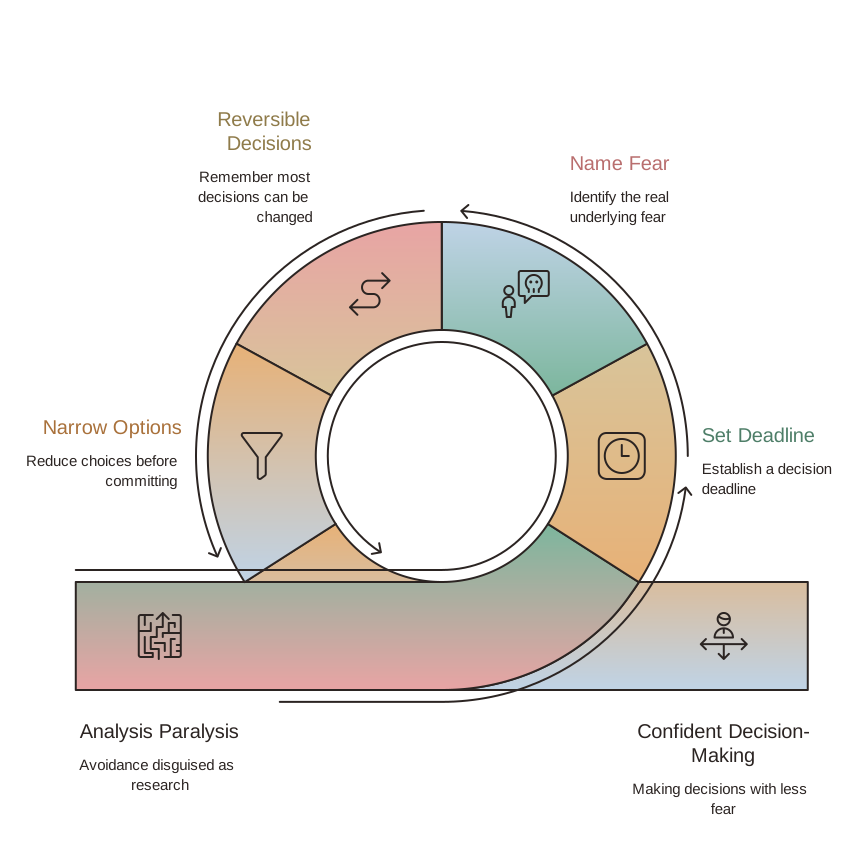
1. Set a decision deadline
Give yourself a time limit: "I'll decide by Friday."
Your brain will panic. That's fine.
Panic means it's working.
2. Name the real fear out loud
"I'm not indecisive — I'm scared of regretting this."
"I'm not gathering info — I'm avoiding committing."
Once you name it, it loses some power.
3. Accept that most decisions are reversible
Unless you're getting a face tattoo or adopting a child, most choices can be changed.
You can switch jobs, move again, try a different approach.
Nothing is as permanent as your fear thinks it is.
4. Limit your options to 3 max
Too many choices = paralysis.
Narrow it down to 3 solid options and pick from those.
If they're all good enough, any choice will work.
5. Choose, then commit to making it work
Here's the secret: the "right" choice is often just the one you commit to.
People who decide quickly aren't smarter — they're just willing to make something work instead of waiting for perfection.
6. The Uncomfortable Truth About Deciding
Here's what no one tells you:
- You won't always choose correctly
- You will occasionally regret your decisions
- You might miss out on something better
- People might judge your choice
And all of that is fine.
Because the cost of never deciding is higher than the cost of deciding imperfectly.
Analysis paralysis keeps you safe from failure.
But it also keeps you stuck.
Final Thought
Analysis paralysis isn't a thinking problem.
It's a fear problem.
And the only way out is to decide before you feel ready.
Because "ready" never comes.
You just choose anyway and figure it out as you go.
Frequently asked questions
What is analysis paralysis and why does it happen?
Analysis paralysis is when overthinking prevents any decision from being made. It happens because the brain frames the decision as higher-stakes than it is — often driven by fear of making the wrong choice. Gathering more information feels safer than choosing, while the anxiety keeps building, creating a feedback loop.
Is analysis paralysis a form of anxiety?
Yes. Analysis paralysis is closely linked to anxiety and perfectionism. It's the brain's avoidance mechanism dressed up as rational caution — the appearance of being thorough while actually avoiding the discomfort of committing.
How do you break out of analysis paralysis?
The most effective approach is setting a decision deadline — giving yourself a defined window to gather information, then committing regardless of certainty. CBT techniques like identifying the worst realistic outcome (not worst imaginable) also help deflate the perceived stakes.
What is the difference between careful thinking and analysis paralysis?
Careful thinking has a point of diminishing returns that you can identify and act on. Analysis paralysis keeps moving the goalposts — no amount of information feels sufficient. The test: ask whether more information would actually change your decision, or whether you're just delaying.
Like what you're reading?
Accelerate your growth journey
Reframe the patterns that hold you back — and watch your Top Pattern change over time.


Free to start · premium optional