
Turn this into a daily habit — free to start in the MindLift app:
ADHD-friendly affirmations are self-talk statements designed for neurodivergent brains—short, emotionally engaging, and built around how ADHD minds actually work rather than demanding they work like neurotypical ones.
"Just focus." "Try harder." "Use a planner." You've heard it all—and none of it works the way people say it should.
Because your brain isn't broken. It's different. And generic self-help advice—including most affirmations—isn't built for how your mind operates.
This guide provides ADHD-specific affirmations that work WITH your brain, not against it.
Why Regular Affirmations Don't Work for ADHD
Standard affirmations fail ADHD brains for predictable reasons:
- Too boring: Low-dopamine content = brain checks out
- Too slow: Repetitive = tuned out instantly
- Too vague: "I am calm" when you're bouncing off walls
- Too demanding: Requires sustained focus you don't have
Key insight: ADHD attention is interest-based, not effort-based. You can't willpower your way into focusing on boring affirmations any more than you can willpower your way through a textbook.
What Makes Affirmations Dopamine-Friendly
ADHD brains need affirmations that provide what they're seeking:
- Novelty: Fresh, unexpected phrasing
- Emotional punch: Something that FEELS something
- Relevance: Directly addresses ADHD experience
- Brevity: Short enough to hold attention
- Permission: Reduces shame instead of increasing pressure
25 ADHD Affirmations That Actually Work
For executive function struggles:
- "My brain works differently, not worse."
- "Starting is the hardest part. I just need to start."
- "I can't focus on demand, but I can create conditions for focus."
- "Forgetting doesn't mean I don't care."
- "My working memory is a feature, not a flaw—I just need external support."
For shame and self-criticism:
- "I'm not lazy. My brain needs different fuel."
- "Struggling with 'easy' things doesn't make me broken."
- "I've been running on hard mode this whole time. No wonder I'm tired."
- "Shame makes ADHD worse. I choose self-compassion as a strategy."
- "My effort counts, even when results don't show it."
For time blindness:
- "I can't feel time, so I build external time."
- "Being late doesn't mean I don't care—time is invisible to me."
- "Alarms and reminders aren't crutches. They're my brain's GPS."
- "I'm not irresponsible. I'm working around a genuine challenge."
For rejection sensitivity:
- "This feeling is intense, but it's not the whole truth."
- "My brain amplifies rejection. I can acknowledge that without believing every alarm."
- "I can feel devastated AND know it will pass."
- "Other people's reactions aren't always about me."
For celebrating the ADHD brain:
- "My brain makes connections others miss."
- "Hyperfocus is a superpower when I can direct it."
- "My creativity comes from the same place as my chaos."
- "I think in webs, not lines. That's valuable."
- "The world needs minds like mine."
For the hard days:
- "Today I'm in survival mode. That's okay."
- "One thing counts. I can do one thing."
- "Rest is productive for my brain."
How to Actually Use These (ADHD-Style)
Forget daily morning routines. Here's what actually works:
- Sticky notes: Put them where you'll actually see them
- Phone wallpaper: Rotate weekly for novelty
- Voice memos: Record yourself saying them—hearing is different than reading
- Crisis moments: Keep 2-3 ready for when shame spikes
- Body doubling: Say them to someone else or in ADHD community spaces
ADHD hack: Don't try to remember these. Put them where you can't ignore them. External systems beat internal willpower every time.
Frequently asked questions
Why don't regular affirmations work for ADHD?
Regular affirmations often fail for ADHD brains because they require sustained focus, feel boring (low dopamine), and use slow, repetitive language that the ADHD brain tunes out. Effective ADHD affirmations need to be short, novel, emotionally engaging, and acknowledge the reality of executive function challenges.
What is dopamine-seeking in ADHD?
Dopamine-seeking in ADHD refers to the brain's tendency to chase stimulation due to lower baseline dopamine levels. This explains why ADHD brains gravitate toward novelty, urgency, and high-interest activities—they're seeking the dopamine that neurotypical brains produce more consistently.
How can affirmations help with ADHD paralysis?
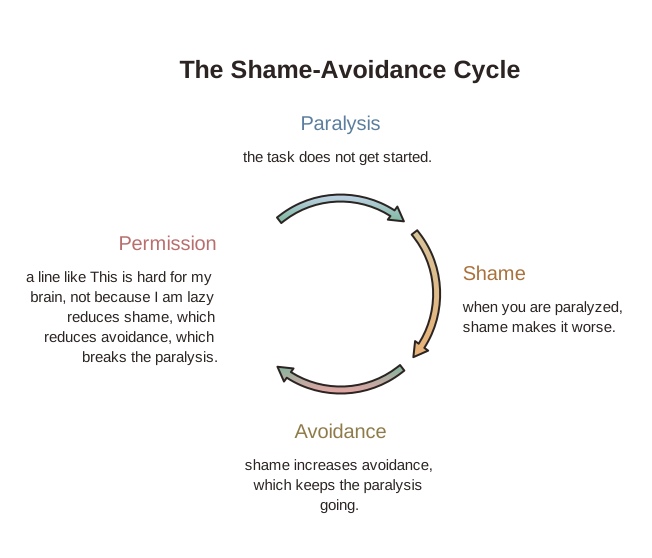
Affirmations help ADHD paralysis by breaking the shame-avoidance cycle. When you're paralyzed, shame often makes it worse. Affirmations that validate the struggle ('This is hard for my brain, not because I'm lazy') reduce shame, which reduces avoidance, which breaks the paralysis.
What is rejection sensitive dysphoria (RSD)?
Rejection sensitive dysphoria (RSD) is an intense emotional response to perceived criticism or rejection, common in ADHD. It causes overwhelming emotional pain from real or imagined rejection that feels disproportionate to the situation. It's not officially in the DSM but is widely recognized by ADHD specialists.
Are ADHD brains actually creative?
Research shows ADHD brains often demonstrate higher divergent thinking (generating multiple solutions), pattern recognition across unrelated domains, and comfort with ambiguity. The same traits that cause distraction can enable creative connections that linear thinkers miss.
Like what you're reading?
Take control of your mental wellness
Reframe the thought that started it — personalized CBT reframes in the MindLift app.


Free to start · premium optional