
Turn this into a daily habit — free to start in the MindLift app:
The Bottom Line
When anxiety hits, your breath is both the first thing affected and your fastest path back to calm. Box breathing works for panic attacks, 4-7-8 for sleep anxiety, and the physiological sigh for instant 5-second relief. Give any technique 2-3 minutes to work.
When anxiety hits, your breath is the first thing to go. Shallow, rapid, tight — your body is in fight-or-flight mode.
The good news? Your breath is also your fastest path back to calm.
6 Breathing Techniques for Anxiety Relief
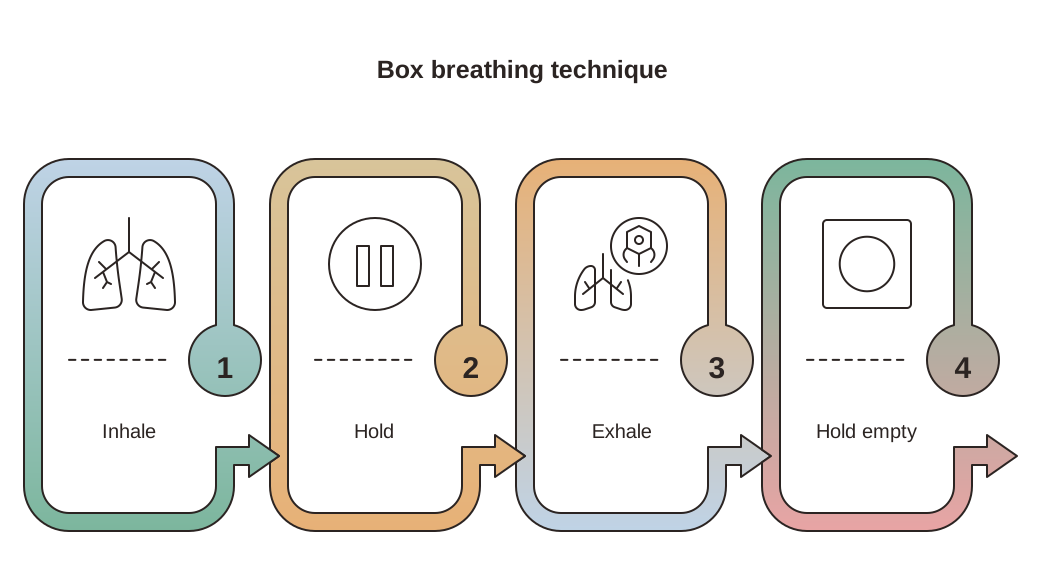
Box Breathing (4-4-4-4)
Best for acute anxiety and panic attacks. Inhale 4 seconds, hold 4, exhale 4, hold 4. Repeat for 3-5 minutes.
4-7-8 Breathing
Best for falling asleep and nighttime anxiety. Inhale 4 seconds, hold 7, exhale 8. Repeat 4 times.
Diaphragmatic Breathing
Best for general stress and muscle tension. Place hand on belly, inhale deeply letting belly rise, exhale slowly letting it fall.
Physiological Sigh
Best for quick 5-second stress relief. Deep inhale, second shorter inhale, full exhale. Repeat 1-3 times.
Alternate Nostril Breathing
Best for mental clarity and pre-sleep. Close right nostril, inhale left. Close left, exhale right. Alternate for 5-10 rounds.
Resonance Breathing (about 6 breaths a minute)
Best as a daily practice for lowering baseline stress. Inhale for about 5 seconds, exhale for about 5 seconds, smooth and unforced. Continue for 5-10 minutes.
In a month-long trial comparing brief daily breathing practices with mindfulness meditation, exhale-focused cyclic sighing produced greater improvement in mood.
— Balban et al., 2023
When Each Technique Works Best
The five techniques above serve different purposes, and using the wrong one in the wrong moment is the most common reason people feel like breathing exercises "don't work for them." This quick reference helps you match method to moment:
🟦 Box Breathing — for acute anxiety and high alertness
Best when anxiety is peaking, your thoughts are racing, or you're in a high-stakes situation (a difficult conversation, a presentation, a panic spike). The symmetrical count structure gives the mind something concrete to track, which interrupts catastrophizing.
Not ideal before sleep — the hold phases can be activating.
🟣 4-7-8 Breathing — for falling asleep and nighttime anxiety
The extended exhale (8 counts) is the most powerful parasympathetic trigger in breathwork. Use this when lying awake with ruminating thoughts, or when anxiety peaks at night.
Can cause mild lightheadedness — sit or lie down first.
🟢 Diaphragmatic Breathing — for chronic stress and daily tension
The foundation technique. Best practiced daily, not just during acute moments. Shallow chest breathing is a learned habit in anxious individuals — diaphragmatic breathing retrains the default. In one study, 8 weeks of diaphragmatic breathing training lowered cortisol levels in healthy adults (Ma et al., 2017).
Takes the most practice to do naturally — use your hand on the belly as a biofeedback cue.
⚡ Physiological Sigh — for immediate stress relief
Quick to use almost anywhere. The double inhale fully inflates the lungs, and the long, slow exhale does the calming work. Use mid-meeting, between tasks, or any time you notice your shoulders near your ears.
Works in 1–3 repetitions — you don't need a long session.
🌬️ Alternate Nostril — for mental clarity and pre-focus states
Some people find alternate nostril breathing helps them settle into focus. Use before creative work, study sessions, or when you need to transition out of an anxious state into focused problem-solving.
Less effective during acute anxiety — use box breathing first, then transition.
What is resonance breathing, and why 6 breaths a minute?
Resonance breathing means breathing slowly and evenly at about 6 breaths per minute, roughly 5 seconds in and 5 seconds out. At around that pace, for most adults, heart rate rises and falls in step with the breath, which makes heart rate variability (HRV) swing as widely as it can and exercises the reflexes that steady blood pressure[3].
That matters for anxiety because higher HRV is linked to more flexible stress regulation. A systematic review of slow-breathing studies found that breathing below about 10 breaths a minute was associated with higher HRV, more relaxation and lower anxiety and arousal[2]. Most people breathe 12 to 20 times a minute at rest, so the shift is bigger than it sounds.
- Sit upright with your feet on the floor and one hand on your belly.
- Breathe in through your nose for a count of 5, letting the belly rise.
- Breathe out gently for a count of 5. Don’t push the air out; let it go.
- Keep going for 5 to 10 minutes. A breathing-pacer app or a slow mental count both work.
Your exact best rate may sit anywhere from about 4.5 to 7 breaths a minute, which is what HRV biofeedback clinics measure. If 5 and 5 feels like air hunger, try 4 in and 5 out, and lengthen slowly over a week. Unlike box breathing, resonance breathing is not a crisis tool; its value comes from daily practice, so the calm is easier to reach when anxiety does spike.
Tips for mindful breathing exercises
Mindful breathing adds one thing to any technique above: you notice the breath and the thoughts around it, instead of just counting. These tips keep it simple and stop it from turning into another task you can fail at.
- Nose in, belly out. Breathing through the nose and into the belly slows the rate naturally. If your shoulders rise, the breath is too high.
- Exhale at least as long as you inhale. The out-breath is the calming half.
- Don’t force it. Dizziness or tingling means you are breathing too deep or too fast. Ease off and breathe normally for a few rounds.
- Count, then drop the count. Counting helps at first. Once the rhythm settles, just feel the air moving at the nostrils or the belly rising and falling.
- Treat wandering as part of the exercise. When a thought pulls you away, note it (“planning”, “worrying”) and return to the next breath.
- Practise when calm. A technique you have rehearsed on ordinary days is the one your body will reach for on bad ones.
If breathing makes you more aware of your body in an uncomfortable way, switch to an outward anchor such as the 5-4-3-2-1 grounding technique. For short ways to fit breathing and noticing into a normal day, see how to practice mindfulness daily.
After your body settles: deal with the thought
Breathing calms the body, but the thought that set off the anxiety is often still there when you finish. Once your breathing has slowed, take one more minute: write the thought down, name the pattern (catastrophizing and mind reading are common), and write a more accurate version. The anxiety hub has more CBT tools for this step.
Common Mistakes to Avoid
- Breathing too fast: Slow equals calm—count deliberately
- Chest breathing only: Focus on belly expansion for full effect
- Holding tension: Soften shoulders and jaw while breathing
- Expecting instant magic: Give it 2-3 minutes to work
Frequently asked questions
What is the best breathing technique for anxiety?
Box breathing (4-4-4-4) is most effective for acute anxiety and panic attacks. Inhale for 4 seconds, hold for 4, exhale for 4, hold for 4, and repeat for 3-5 minutes. For nighttime anxiety, the 4-7-8 technique works better as it emphasizes the longer exhale that activates your parasympathetic nervous system.
How does 4-7-8 breathing reduce anxiety?
The 4-7-8 technique works by extending your exhale, which activates the parasympathetic nervous system (rest-and-digest). The long exhale signals to your brain that you're safe.
What is resonance breathing?
Resonance breathing is slow, even breathing at about 6 breaths per minute: roughly 5 seconds in and 5 seconds out. At that pace, heart rate and breathing tend to rise and fall together, which increases heart rate variability, a marker linked to calmer stress regulation. Practise it for 5 to 10 minutes.
What are some tips for mindful breathing exercises?
Breathe through your nose if you can, let the belly move rather than the shoulders, make the exhale at least as long as the inhale, and do not force the breath. Count if it helps you focus. When your mind wanders, notice where it went and come back to the next breath without judging yourself.
What breathing exercises calm you down instantly?
The physiological sigh is the fastest—just 5 seconds. Take a deep inhale, then a second shorter inhale to fully expand your lungs, followed by a long exhale. Repeat 1-3 times. In a 2023 Stanford study, daily cyclic sighing improved mood more than mindfulness meditation.
Like what you're reading?
Continue your wellness journey
Reframe negative thoughts in 60 seconds — free to start in the MindLift app.


Free to start · premium optional