
Turn this into a daily habit — free to start in the MindLift app:
Weekly therapy in the US commonly runs $100–$200 a session — call it a car payment, every month, indefinitely. So you do the math, close the tab, and add a quiet second story on top: I'm probably not bad enough for it anyway. Two problems, and only one of them is about money. Let's take both seriously.
What actually helps if you can't afford therapy?
Four real routes: sliding-scale or community mental health services (often far cheaper than list price), university training clinics, group therapy, and evidence-based self-help — meta-analyses find guided self-help CBT comparable to face-to-face therapy for mild-to-moderate anxiety and depression. The most portable piece is the core CBT skill itself: catching a distorted thought and reframing it with evidence. In crisis situations, skip cost triage and use crisis lines or emergency services.
Cuijpers et al. (2010); Carlbring et al. (2018)
Are you really "not bad enough" for therapy?
"Not bad enough for therapy" deserves a reframe before we talk logistics, because it quietly cancels every option below. Notice its structure: it compares your struggle to an imagined worse one and rules yours out of bounds. That's a distortion — minimizing — and the test for it is simple. If a friend told you they were losing sleep to the same loops, would you tell them they hadn't earned help yet? There is no admissions committee. Costs you peace → qualifies.
Where can you find lower-cost therapy?
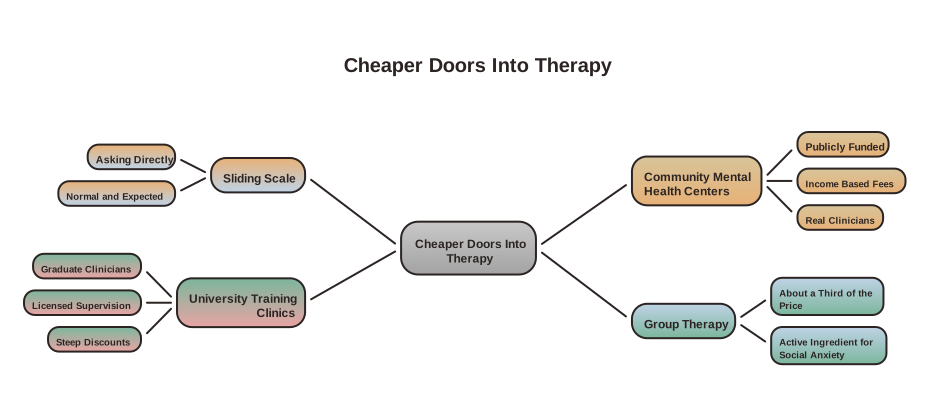
Sliding scale. Many therapists hold a few reduced-rate spots and don't advertise them. Asking directly — "do you offer sliding-scale rates?" — is normal and expected. Directories let you filter for it.
Community mental health centers. Publicly funded, income-based fees, real clinicians. Waitlists exist; being on one costs nothing.
University training clinics. Graduate students in clinical programs see clients under licensed supervision at steep discounts. You get someone current on the research with an experienced clinician reviewing the work.
Group therapy. Often a third the price of individual sessions, and for some problems — social anxiety in particular — the format is an active ingredient, not a compromise.
Does self-guided CBT work as well as therapy?
Here's the finding that should change how you think about the interim: a meta-analysis by Pim Cuijpers and colleagues compared guided self-help — workbooks and structured programs with light human support — against face-to-face psychotherapy for depression and anxiety. The outcomes were comparable. A later review of 20 head-to-head trials found the same for internet-delivered CBT (we've unpacked the full evidence picture in Does CBT Actually Work?).
Two honest caveats travel with that result. It applies to mild-to-moderate symptoms — severe depression, trauma, and crisis situations need professional care, full stop. And the effect belongs to people who practice: self-help works like a gym membership, not like a prescription.
Which CBT skill can you practice on your own tonight?
Strip CBT to its most portable component and you get a loop you can run tonight, free, on paper: catch the thought verbatim ("I'm going to lose this job"), name the distortion (catastrophizing), test it against evidence (what has your manager actually said?), and rewrite it into something you'd believe ("one tense meeting isn't a termination notice"). That loop is the active ingredient your brain practices in a large share of therapy sessions — the neuroscience of what it changes is well mapped.
Can MindLift replace therapy? Where it honestly fits
MindLift is not therapy, and we won't dress it up as therapy. It's the daily reps: you type the thought that's attacking you, and it walks you through the catch–name–test–rewrite loop in about 60 seconds. Free to start, no account, no card — because the people who need the reps most are often exactly the people doing this math. If therapy becomes affordable later, the skill transfers; therapists assign this exact practice as homework. If it doesn't, you still get the most portable piece.
One line we mean literally: if you're having thoughts of harming yourself, that is not a cost-optimization problem or an app-sized problem — call or text a crisis line (988 in the US) now. For everything below that threshold: pick a door above, and start the reps tonight. The loops don't wait for your budget, and neither should the skill.
Frequently asked questions
What can I do if I can't afford therapy?
Several real options: ask therapists about sliding-scale rates (many reserve spots), check community mental health centers and university training clinics (supervised trainees at steep discounts), consider group therapy, and use evidence-based self-help — CBT workbooks, structured worksheets, or CBT-based apps. Meta-analytic research shows guided self-help CBT can match face-to-face outcomes for mild-to-moderate anxiety and depression. If you are in crisis, use crisis lines and emergency services first — cost triage is for later.
Does self-help CBT actually work without a therapist?
For mild-to-moderate anxiety and depression, the evidence says yes. A meta-analysis by Cuijpers and colleagues (2010) found guided self-help produced effects comparable to face-to-face psychotherapy, and reviews of internet-delivered CBT reach similar conclusions (Carlbring et al., 2018). The consistent catch is engagement: the techniques work for people who actually practice them. Severity matters too — self-help is not a substitute for professional care in severe or crisis situations.
Am I "not bad enough" for therapy?
There is no admission threshold. "Not bad enough" is usually a thought distortion doing gatekeeping — comparing your struggle to an imagined worse one and dismissing it. If a pattern costs you sleep, peace, or relationships, it qualifies. And the skills that help (like cognitive reframing) work at every severity level; you do not need a diagnosis to practice them.
Is MindLift a replacement for therapy?
No — and it is not designed to be. MindLift teaches and drills one core piece of CBT: catching a negative thought and reframing it with evidence, in about 60 seconds. Think of it as the daily reps between sessions, or a starting point if therapy is out of reach right now. It is free to start. If your symptoms are severe, persistent, or involve thoughts of self-harm, please reach a professional or a crisis line — that is not an app-sized problem.
Like what you're reading?
Take control of your mental wellness
Reframe the thought that started it — personalized CBT reframes in the MindLift app.


Free to start · no account required
- Cuijpers P, Donker T, van Straten A, Li J, Andersson G (2010). Is guided self-help as effective as face-to-face psychotherapy for depression and anxiety disorders? A systematic review and meta-analysis of comparative outcome studies. Psychological Medicine, 40(12), 1943–1957. — DOI (opens in a new tab)
- Carlbring P et al. (2018). Internet-based vs. face-to-face cognitive behavior therapy for psychiatric and somatic disorders: an updated systematic review and meta-analysis. Cognitive Behaviour Therapy. — DOI (opens in a new tab)
CBT & Self-Talk Researchers
MindLift content is grounded in cognitive behavioral therapy principles and designed to help you shift harsh self-talk in real time. Our guides focus on practical, evidence-based techniques you can use in the moment.
Was this article helpful?