
Turn this into a daily habit — free to start in the MindLift app:
Stress isn't evenly distributed. Where you live shapes how much of it you carry — your commute, your job security, how many hours you sleep, whether you can afford to see a doctor when something's wrong. Every year, WalletHub ranks all 50 states by a composite stress score built from 40 separate metrics. The 2026 edition is out, and the results aren't the ones most people would guess. It's not New York. It's not California. It's not even close.
What is the most stressed state in America in 2026?
Louisiana, with a stress score of 62.86 out of 100 in WalletHub's 2026 ranking of all 50 states across 40 work, money, family, and health metrics. Kentucky, New Mexico, West Virginia, and Arkansas round out the top five. The famous high-pressure states rank far lower — New York 18th, California 12th — because economic security and healthcare access predict stress better than pace of life. South Dakota ranks least stressed.
WalletHub, Most & Least Stressed States 2026 (data as of February 2026)
The 2026 ranking: top 10 most stressed states
- Louisiana — stress score 62.86/100
- Kentucky
- New Mexico
- West Virginia
- Arkansas
- Nevada
- Oklahoma
- Oregon
- Mississippi
- Alabama
Louisiana tops the list driven largely by economic hardship: the state has the highest poverty rate in the country, and roughly 16% of residents report skipping medical care in the past year because of cost. It also ranks among the ten worst states for both self-reported poor mental health and diagnosed depression — compounded by having fewer psychologists per capita than most of the country — and it holds the lowest job-security score of any state.
Kentucky, at No. 2, is a largely financial story: one of the highest bankruptcy rates in the country and a median credit score among the lowest nationally.
The most counterintuitive part of the ranking is who isn't near the top. New York lands at No. 18. Illinois comes in at No. 30. California — despite its reputation for high-pressure, high-cost living — ranks 12th. Nevada, a popular travel destination, ranks 6th, driven by high unemployment and the second-highest divorce rate in the country. As LSU family stress researcher Cassandra D. Chaney put it in WalletHub's release, stress tends to track with economic security and healthcare access more than with the pace of daily life.
Least stressed: South Dakota ranks as the least stressed state overall, followed by Utah, Minnesota, New Hampshire, and Vermont — states that consistently score well on economic stability, healthcare access, and work-life balance.
Sources: WalletHub's "Most & Least Stressed States 2026" study, as reported by Statista and Business Insider. Data collected as of February 23, 2026 — a single annual snapshot.
Why these particular states
The pattern across the top 10 isn't random — it clusters around a few consistent pressure points:
Economic instability. Louisiana, Kentucky, Mississippi, and Arkansas all rank among the worst states for poverty, unemployment, or bankruptcy. When the baseline is financial insecurity, everything downstream gets harder — healthcare becomes a luxury, and family stability becomes harder to protect.
Healthcare access. States with fewer psychologists and physicians per capita — Louisiana and West Virginia among them — show measurably worse outcomes on self-reported mental and physical health, because untreated problems compound instead of resolving. (If cost is the barrier where you live, we've written honestly about what helps when you can't afford therapy.)
Family instability. Nevada's high divorce rate and New Mexico's family instability metrics show up directly in the data; WalletHub weights family-related stress as one of its four core dimensions for a reason — relationship strain doesn't stay contained to home life.
Work conditions. Texas — 15th overall — is a useful case study: it leads the nation in job security, but ranks near the bottom on average weekly work hours, showing that even a stable job doesn't buffer against a workload that leaves no room to recover.
None of these are personality flaws. They're structural conditions. But here's what the data doesn't fully capture: two people in the exact same state, facing the exact same economic pressure, can have very different internal experiences of that pressure — because of what their mind does with the stress once it shows up.
The common thread: it's not the state, it's the loop
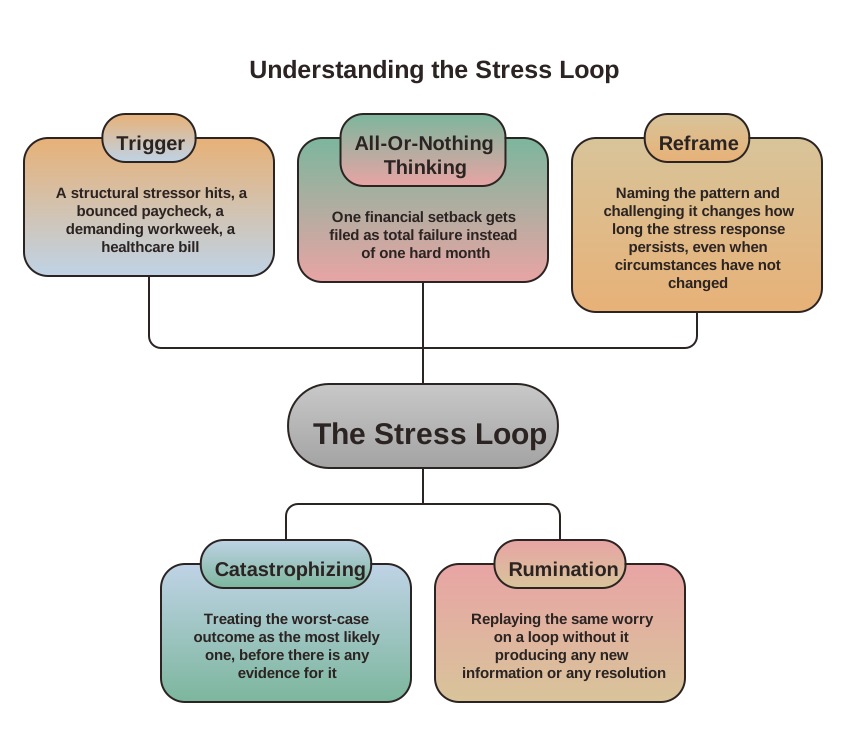
Economic and structural stressors explain a lot. But they don't explain everything — because stress itself isn't just what happens to you. It's what your mind does with what happens to you, on repeat, after the fact.
This is where cognitive behavioral therapy's research on thought patterns becomes relevant regardless of zip code. The same handful of distortions show up whether the trigger is a bounced paycheck in Louisiana or a 60-hour workweek in Texas:
Catastrophizing — treating the worst-case outcome as the most likely one, before there's any evidence for it.
All-or-nothing thinking — one financial setback gets filed as total failure instead of one hard month.
Rumination — replaying the same worry on a loop without it producing any new information or any resolution.
Structural stress creates the trigger. The distortion determines how long the stress stays — and it's the second part that's actually within someone's reach to change, even when the first part isn't.
Curious which thought pattern is running your stress?
Take the 30-second quiz →Free · No email · Instant result
What actually breaks the loop
Most tools built for stress ask you to already be calm before they're useful. Meditation apps assume a baseline of stillness you don't have at 11pm after a bad day. Journaling gives the thought somewhere to go, but doesn't do anything to challenge it — you can write the same catastrophizing thought in a journal for a year and it will still be catastrophizing on day 365. Therapy works, but it's an hour a week. The other 167 hours are where the loop actually runs.
This is the gap MindLift is built for. You type the exact thought you're stuck on — not a generic prompt, your actual words — and within 60 seconds you get three structured reframes:
Realist — challenges the hidden assumption in the thought directly, without softening it into empty reassurance.
Growth — a concrete next step, built from your specific situation.
Compassionate — acknowledges the difficulty without validating the distortion underneath it.
Each reframe is tagged with the actual cognitive distortion driving the thought, so the pattern becomes visible instead of invisible — which matters, because a distortion you can name is a distortion you can catch earlier next time. (Here's exactly what that looks like, second by second.)
If your state is on this list, that's real — the structural pressure is not in your head. But the loop that pressure triggers doesn't have to run unchallenged.
Bottom line
Stress has a geography — but it also has a mechanism, and the mechanism is the part you actually have leverage over. Wherever you live, the thought loop that keeps a stressful day running past midnight is the same handful of patterns showing up again and again. Naming it is the first step. Reframing it, in your own words, in the moment it's happening, is the part most tools skip. MindLift is free to start on iOS and Android.
Frequently asked questions
What makes a state "stressed" in this ranking?
WalletHub's methodology scores all 50 states across 40 metrics grouped into four categories: work-related stress, money-related stress, family-related stress, and health-and-safety-related stress, using data from sources including the U.S. Census Bureau, the CDC, and the Bureau of Labor Statistics. The 2026 edition reflects data collected as of February 2026.
Why isn't New York or California at the top of the list?
Despite their reputation for fast-paced living, both states rank comparatively low — New York at 18th and California at 12th — because the ranking weighs economic security and healthcare access more heavily than pace of life, and both states score relatively well on those dimensions.
Does living in a "less stressed" state guarantee lower personal stress?
No. State-level rankings reflect population averages and structural conditions, not individual experience. Two residents of the same state can have very different stress levels depending on their personal circumstances — and on what their mind does with stressful events after they happen.
Can changing your thought patterns actually reduce stress if the underlying cause hasn't changed?
Cognitive behavioral therapy research shows that while thought-pattern work doesn't remove external stressors, it changes how long a stress response persists and how much it compounds — which is why CBT is a standard, evidence-based approach for stress and anxiety even when circumstances haven't changed.
Like what you're reading?
Take control of your mental wellness
Reframe the thought that started it — personalized CBT reframes in the MindLift app.


Free to start · premium optional