
Turn this into a daily habit — free to start in the MindLift app:
Somewhere between the vision board on TikTok and the friend who swears she "manifested" her apartment, you typed the honest version of the question into a search bar: does any of this actually have evidence behind it? Here is the answer, with the studies attached. MindLift, a software-only CBT app that helps you reframe negative self-talk, wrote this guide, so it reads manifestation as mindset and action rather than magic. Read about MindLift, or find your own pattern with the negative self-talk test.
Does manifestation work, according to science?
No — there is no peer-reviewed evidence that thoughts attract outcomes, and the APA has never endorsed the law of attraction. Studies in APA journals find the opposite: positive fantasizing predicts less effort and worse results. The real, proven effects behind manifestation's success stories are goal clarity, expectancy, and attention — all of which you can use without the metaphysics.
Oettingen & Mayer (2002), JPSP; Dixon et al. (2023), PSPB
What the APA actually says (and doesn't)
Short version: the American Psychological Association has no position statement, practice guideline, or endorsement supporting the law of attraction or manifestation. None. If a manifestation coach implies "APA-backed," they are borrowing a credential that was never issued.
What does exist in APA-published research is less flattering to the vision board. In a series of studies in the Journal of Personality and Social Psychology — an APA flagship journal — psychologist Gabriele Oettingen and colleagues followed people who indulged in positive fantasies about a desired future: graduates fantasizing about landing the job, students about the exam, patients about recovery after surgery. Across studies, the more people fantasized about already having the outcome, the less effort they invested and the worse they did — fewer applications sent, lower grades, slower recovery. A follow-up line of research found a likely mechanism: imagining the wish as already fulfilled measurably relaxes you (lower systolic blood pressure), and that relaxation drains exactly the energy the goal still requires.
Your brain, in other words, partially banks the imagined win — and then sees less reason to go earn the real one.
The 2023 study manifestation influencers don't quote
In 2023, researchers Dixon, Hornsey, and Hartley published the first validated scale of manifestation belief in Personality and Social Psychology Bulletin. About a third of people they sampled endorsed some level of manifestation belief. Strong believers did report feeling more successful — but they were also more drawn to risky investments, including cryptocurrency, more likely to have experienced bankruptcy, and more prone to unrealistic expectations of how quickly success would arrive.
That pattern is what you'd predict if manifestation changes your confidence without changing your odds. The belief feels like traction. The ledger says otherwise.
Why it still seems to work for some people
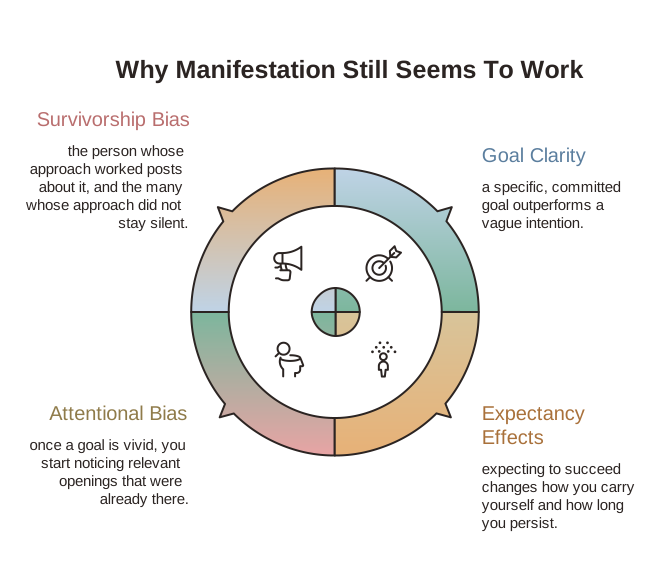
The success stories aren't all lies, and you don't need "frequencies" to explain them. Four boring, well-documented mechanisms do the work:
- Goal clarity. Fifty years of goal-setting research (Locke & Latham) shows specific, committed goals outperform vague intentions. Writing "senior designer role, $95k, by March" on a board is goal-setting with glitter on it.
- Expectancy effects. Expecting to succeed changes how you carry yourself in the interview and how long you persist after a no. The other party responds to the behavior, not the vibration.
- Attentional bias. Once a goal is vivid, you notice relevant openings — the job post, the intro, the listing — that were always in the feed.
- Survivorship bias. The one person whose board "worked" posts the video. The thousands whose boards didn't don't make content about it. You only ever see the numerator.
Notice what every one of those has in common: the effect runs through something the person did. Which is good news, because actions are the one part of this you control.
What to keep: the evidence-based core of "manifesting"
Strip the metaphysics and a usable protocol is left standing — one with actual trials behind it:
Keep the vivid goal, add the obstacle. Oettingen's answer to her own fantasy findings is mental contrasting (popularized as WOOP: Wish, Outcome, Obstacle, Plan). Picture the outcome — then immediately picture the concrete obstacle in your way and pre-decide your response to it. In study after study, this beats positive fantasy alone on follow-through. It's the vision board plus the part the vision board skips.
Rewire through practice, not declaration. Here's the irony: manifestation borrows the language of "rewiring your brain," and that part is real science — just not the way it's sold. Neuroplasticity means the thought patterns you practice get physically easier to fire, and neuroimaging work on cognitive reappraisal shows that training yourself to reinterpret a thought recruits prefrontal control regions and dials down the amygdala's alarm response over time. What strengthens circuits is the repeated act of reframing — catching a thought and reworking it — not repeating a finished outcome you don't believe. We've covered how rewiring negative thinking actually works and what science says about law-of-attraction self-talk specifically.
Work on the blocking thought, not the universe. Under most manifestation habits is a real, worthy impulse: the sense that your own thinking is what's in the way. That instinct is correct — it's just that the fix with evidence behind it is cognitive reframing, not repetition of outcomes. "It won't happen for someone like me" is a thought you can examine, test, and rewrite — and each time you do, you're running the one rewiring mechanism the research actually supports. That process has decades of CBT trials behind it.
The honest bottom line
Manifestation, as a mechanism, has no evidence: no APA endorsement, no peer-reviewed support for thoughts attracting outcomes, and APA-journal research showing pure positive fantasy actively undercuts effort. Manifestation, as a package of habits, accidentally contains three real tools — specific goals, confident expectation, and directed attention — wrapped in a story that also carries real costs: risky financial choices, self-blame when the universe doesn't deliver, and waiting where acting was needed.
Keep the clarity. Keep the ambition. Trade the cosmic middleman for the two steps that survive contact with the research: plan around the obstacle, and reframe the thought that keeps you from moving.
MindLift is a free-to-start app that turns the exact thought blocking you into three structured, CBT-based reframes — in your own words, within 60 seconds. Try MindLift — free to start →
Frequently asked questions
Is manifestation scientifically proven?
No. There is no peer-reviewed evidence that thinking about an outcome attracts it through any energetic or vibrational mechanism, and that claim has never been supported by controlled research. What is proven are adjacent psychological effects: expectations shape behavior, specific committed goals improve performance, and practicing cognitive reframing measurably changes how the brain responds to a thought over time. Those effects come from what you do after the thought — not from the thought broadcasting anything.
Does the American Psychological Association endorse the law of attraction?
No. The APA has no guideline, position statement, or endorsement supporting the law of attraction or manifestation. Research published in APA journals actually complicates the claim: Oettingen and Mayer's studies in the Journal of Personality and Social Psychology found that people who indulged in positive fantasies about a desired future went on to invest less effort and achieve less — in job searches, exams, romantic interests, and recovery from surgery.
Why does manifestation seem to work for some people?
Four well-documented mechanisms explain the success stories without any cosmic delivery system. Clear goals focus attention and effort (goal-setting research). Expecting success changes how you act in interviews and negotiations (expectancy effects). Writing down what you want makes you notice relevant opportunities you'd have scrolled past (attentional bias). And survivorship bias does the rest: the person whose vision board "worked" posts about it; the thousands whose boards didn't stay quiet.
So is visualization useless?
Not useless — mis-aimed. The research distinction is between outcome fantasies (imagining already having the result, which relaxes you and drains motivation) and process visualization plus mental contrasting (imagining the steps and the obstacle in the way). Oettingen's mental-contrasting work shows that pairing the wish with the real obstacle — the WOOP method — reliably outperforms positive fantasy alone. Picture the thing, then picture what's in the way.
What is the evidence-based alternative to manifestation?
Keep the goal clarity, replace the magic with mechanisms that have trials behind them: set specific goals, use mental contrasting to plan around the obstacle, and use CBT-style reframing on the thought that actually blocks action ("it won't work for someone like me"). That last step is what MindLift is built for — you type the blocking thought in your own words and get a Realist, Growth, and Compassionate reframe in about 60 seconds. Free to start, premium available.
Like what you're reading?
Continue your wellness journey
Reframe negative thoughts in 60 seconds — free to start in the MindLift app.


Free to start · premium optional