
Turn this into a daily habit — free to start in the MindLift app:
You answered every email today. You were funny in the meeting. Someone probably described you as "on top of it." And tonight you will spend forty-five minutes cross-examining one sentence you said at 11:30, prosecuting yourself with evidence no jury would admit. Both of these people are you. That's not a contradiction — it's the most common arrangement there is. Nobody's inner monologue sounds like their LinkedIn.
Can you look fine and still be spiraling inside?
Yes — and it's the norm, not the exception. Research shows people systematically underestimate how often others experience negative emotions, because distress happens in private while composure is what gets displayed. 'High-functioning' describes your output, not your inner process. The fix isn't pretending the loop doesn't exist — it's building a faster exit from it, one reframed thought at a time.
Jordan et al. (2011)
The composure illusion
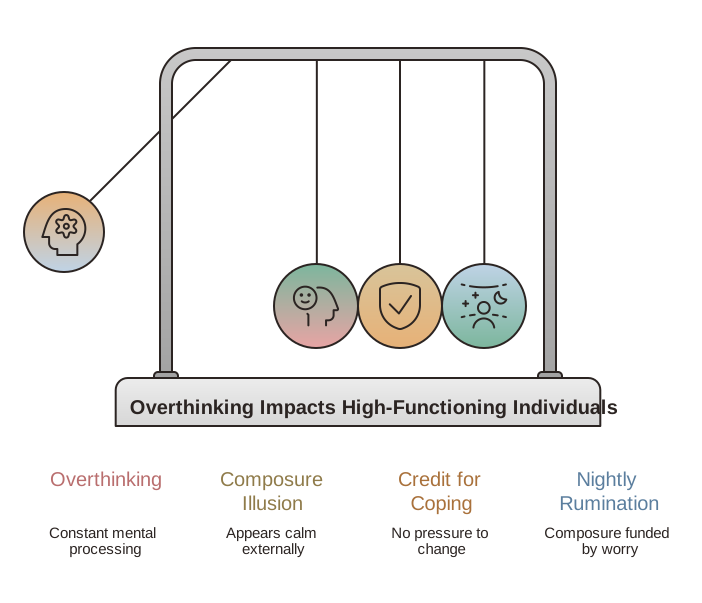
Here's the study worth knowing on a bad night. Alexander Jordan and colleagues asked people to estimate how often their peers felt lonely, down, or stressed — then compared the guesses to what those peers actually reported. The guesses came in consistently, dramatically low. We underestimate everyone else's struggles for a structural reason: sadness happens at home, spirals happen at 2am, and composure is what leaves the house in the morning.
Which means the comparison your brain runs — everyone else has it together, what's wrong with me — is rigged at the data level. You have full access to your inside and only the trailer for everyone else's. The calm people in your life are not having calmer thoughts. They're having the same thoughts, with better staging.
What "high-functioning" actually buys you
Functioning is real — the deadlines met, the friendships kept. But it creates a trap of its own: the better you perform, the less permission you feel to call the loops a problem. I'm fine. Other people have real problems. So the spiral never qualifies for help; it just gets managed, privately, indefinitely.
Two things can be true. You are genuinely capable, and the way your mind talks to you after a normal Tuesday is costing you sleep and peace it doesn't have to cost. You don't need to fail publicly to earn the right to fix a private pattern. (If you're curious where you sit, the free high-functioning anxiety self-check takes about three minutes.)
The bar for tonight is one sentence
The mistake high performers make with their own minds is scoping the fix like a work project: overhaul self-talk, Q3. That plan fails in a week, and the failure gets fed back into the loop as more evidence.
The version that works is embarrassingly small. Tonight, catch one harsh sentence as it goes by — "you handled that all wrong" — and ask a single question: would I say this to a friend? Then say what you'd say to the friend, and mean it enough to believe it. "You handled a hard thing imperfectly, like everyone does." That's the whole rep. Done daily, it's how the exit gets faster — the loop still shows up, and you're out in one minute instead of forty-five.
Same person, kinder process
The goal was never to become someone who doesn't overthink — that person forgets things and misses details you'd never miss. The goal is to keep the mind and lose the self-prosecution. If you want the fuller toolkit for the loops themselves, start with how to stop overthinking and negative thoughts. And when tonight's cross-examination starts, MindLift will walk you from the harsh sentence to one you'd actually say to a friend — in about 60 seconds, free to start, no account. The composed people would never know. They're busy with their own replays anyway.
Frequently asked questions
Can you be high-functioning and still be an overthinker?
Yes — the two commonly coexist. Holding a job, keeping friendships, and hitting deadlines says nothing about what your inner monologue is doing at 11pm. Many people who look composed are privately replaying conversations, rehearsing worst cases, and cross-examining a sentence they said hours ago. Functioning describes your output; overthinking describes your process.
Why does everyone else seem to have it together?
Because you only see their output. Research by Jordan and colleagues (2011) found people reliably underestimate how often others experience negative emotions — precisely because distress mostly happens in private while composure is what gets displayed. You are comparing your inside to their outside, and the inside always loses that comparison.
Is overthinking a mental illness?
Overthinking itself is not a diagnosis — it is a thinking habit (often rumination or worry) that can exist on its own or alongside anxiety and depression. If the loops significantly disrupt sleep, work, or relationships, or come with persistent low mood, talking to a professional is worth it. If they are the background noise of an otherwise-working life, they are a trainable pattern.
How do I stop the spiral when I seem fine but am overthinking everything?
Shrink the target. You do not have to fix how you talk to yourself by Friday. The rep is: catch one harsh sentence, ask "would I say this to a friend?", and rewrite it into something you would actually believe. One thought, once a day. The skill compounds — and it fits inside a life that looks fine from the outside because it takes about 60 seconds.
Like what you're reading?
Take control of your mental wellness
Reframe the thought that started it — personalized CBT reframes in the MindLift app.


Free to start · no account required
- Jordan, A. H., Monin, B., Dweck, C. S., Lovett, B. J., John, O. P., & Gross, J. J. (2011). Misery Has More Company Than People Think: Underestimating the Prevalence of Others' Negative Emotions. Personality and Social Psychology Bulletin, 37(1), 120–135. — DOI (opens in a new tab)
Mental Wellness Writers
The MindLift Wellness Team writes evidence-based content on CBT, self-talk, and everyday mental health tools.
Was this article helpful?