
Turn this into a daily habit — free to start in the MindLift app:
Eileen Gu is known for doing something that seems almost impossible: winning Olympic medals in freestyle skiing while also studying at Stanford University and maintaining a global career. MindLift, a software-only CBT app that helps you reframe negative self-talk, wrote this guide, so it looks at her story through the thought patterns anyone can practise, not brain scans or devices. Read about MindLift, or find the pattern to rewire first with the cognitive distortion quiz.
But behind the medals and headlines is something far more interesting from a psychology perspective:
Her brain is constantly training itself to learn faster.
This ability is connected to a powerful concept in neuroscience called neuroplasticity.
And the good news is: it's not reserved for elite athletes. Your brain can do it too.
What Is Neuroplasticity?
Neuroplasticity is the brain's ability to change and reorganize itself through experience.
Every time you learn a skill, practice a habit, or repeat a thought, neural pathways become stronger.
Think of it like a path in a forest. The more you walk the path, the clearer and easier it becomes.
The same principle applies to:
- Learning skills
- Building confidence
- Changing habits
- Shifting negative thinking
Why Athletes Like Eileen Gu Are a Perfect Example
Elite athletes constantly train their brains in three ways:
1. Repetition
Freestyle skiing tricks require thousands of repetitions. Each attempt strengthens neural circuits responsible for coordination, balance, and timing.
The brain literally rewires itself to perform the movement more efficiently.
2. Mental Visualization
Athletes often visualize the trick before performing it.
Research shows that visualizing an action activates many of the same neural networks as actually performing it. This strengthens neural pathways even before the physical movement happens.
3. Fast Feedback
When a trick fails, the athlete immediately adjusts.
This rapid feedback loop accelerates brain learning. Instead of seeing mistakes as failure, the brain treats them as data for improvement.
The Hidden Mental Skill: Learning From Failure
Freestyle skiing is a sport where falling is guaranteed.
What separates elite athletes is how they interpret those failures.
Instead of thinking:
"I'm bad at this."
They think:
"What adjustment should I try next?"
This shift in thinking is powerful because the brain responds differently to curiosity than to self-criticism. It's the same move we use in supportive coach self-talk.
Negative thinking patterns can trap people in rigid beliefs about themselves, while questioning those thoughts opens space for change and learning.
Neuroplasticity Isn't Just About Skills
The same mechanism applies to your thoughts.
If your brain repeatedly practices:
"I'm not good enough."
That pathway becomes stronger.
But if you gradually introduce more balanced thoughts like:
"I'm learning."
"I can improve."
"I'm figuring this out."
New neural pathways begin forming.
This is exactly the principle used in cognitive-behavioral approaches to mental training. Our thoughts influence emotions and behavior in a continuous loop, meaning changing thinking patterns can gradually change emotional responses. For a practical starting point, see how to reframe negative thoughts.
4 Ways to Train Your Brain Like an Athlete
You don't need skis or Olympic training. You can apply neuroplasticity to everyday life.
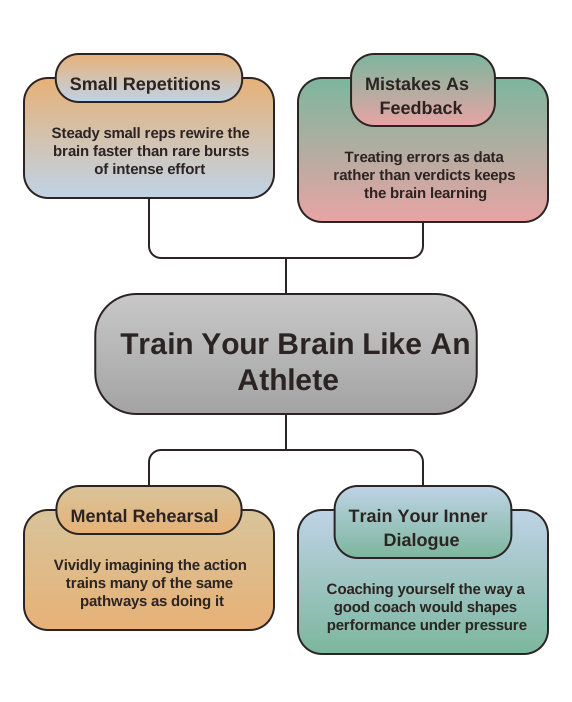
1. Practice Small Repetitions
Instead of trying to change everything at once, repeat small actions. For example:
- A daily 5-minute reflection
- Noticing one negative thought
- Reframing one stressful moment
Consistency rewires the brain.
2. Use Mental Rehearsal
Imagine handling a situation differently. For example:
- Speaking confidently in a meeting
- Responding calmly during conflict
- Letting a stressful thought pass
Visualization strengthens neural preparation.
3. Treat Mistakes as Feedback
Your brain learns fastest when mistakes are analyzed, not criticized.
Try asking:
"What can this teach me?"
Curiosity activates learning systems.
4. Train Your Inner Dialogue
Athletes often develop strong internal coaching voices. Instead of harsh self-criticism, their inner voice becomes more like a guide.
Examples:
- "Reset and try again."
- "Focus on the next step."
- "You're improving."
This kind of inner dialogue builds mental resilience.
The Real Lesson From Eileen Gu
The biggest takeaway isn't about skiing.
It's about how the brain changes through practice.
Talent matters. But the brain's ability to adapt matters even more.
Every skill, habit, and mindset is shaped through repetition.
How MindLift Supports Brain Training
MindLift applies the same principle of neuroplasticity to thought patterns.
The app helps users interrupt negative thinking loops and replace them with short, believable reframes based on cognitive psychology.
Over time, repeating supportive thoughts can strengthen healthier mental pathways.
Just like physical training strengthens muscles, mental training strengthens your thinking patterns.
Final Thought
Neuroplasticity means your brain is never finished evolving.
Every new thought, habit, and experience leaves a trace.
The question isn't whether your brain is changing. It always is.
The real question is:
Which pathways are you practicing most often?
Frequently asked questions
What is neuroplasticity?
Neuroplasticity is the brain's ability to change and reorganize itself through experience. Every repeated thought, skill, or habit strengthens specific neural pathways.
Can you train your brain like an athlete?
Yes. The same principles — repetition, visualization, and feedback — that athletes use to build skills can be applied to thought patterns, confidence, and emotional resilience.
How does visualization help the brain?
Research shows that visualizing an action activates many of the same neural networks as actually performing it, strengthening pathways before the physical action happens.
Can neuroplasticity help with negative thinking?
Yes. If you gradually introduce more balanced thoughts, new neural pathways begin forming. This is the principle behind cognitive-behavioral approaches to mental training.
Like what you're reading?
Take control of your mental wellness
Reframe the thought that started it — personalized CBT reframes in the MindLift app.


Free to start · premium optional