
Turn this into a daily habit — free to start in the MindLift app:
Quick Answer
What is overthinking actually doing to my brain?
Overthinking activates the brain's Default Mode Network (self-referential thinking) and amygdala (threat detection) simultaneously. The brain interprets unresolved uncertainty as danger and keeps looping — not to harm you, but because it believes more processing will find a solution.
Have you ever replayed a conversation in your head for hours?
Or imagined every possible outcome of a situation until your mind felt exhausted?
That experience is called overthinking, and it's far more common than people realize. If you want the practical companion to this science, read 10 ways to calm your mind from overthinking.
Neuroscience shows that when the brain enters an overthinking loop, specific neural systems become highly active. Understanding how these systems work can help explain why overthinking happens — and how to calm it.
What Is Overthinking?
Overthinking is a pattern of repetitive thinking where the mind repeatedly analyzes a problem, event, or possibility without reaching resolution.
Instead of producing clarity, it often creates:
- anxiety
- mental fatigue
- difficulty making decisions
- emotional stress
Two common forms of overthinking are:
Rumination
Replaying past events or mistakes.
Worry
Imagining possible future problems.
Both activate powerful brain networks.
Which Part of Your Brain Is Driving the Overthinking?
One of the key systems involved is the Default Mode Network (DMN).
This network becomes active when the brain is not focused on an external task and instead turns inward.
The DMN is responsible for:
- self-reflection
- imagining the future
- remembering the past
- thinking about social situations
This network is essential for planning and self-awareness. But when it becomes overactive, it can create cycles of repetitive thought. That loop often gets reinforced by predictable thinking distortions.
Instead of helping solve problems, the mind begins looping through the same thoughts repeatedly.
Why Does Your Brain Treat a Worried Thought Like a Real Threat?
Another brain system involved in overthinking is the amygdala, a region responsible for detecting threats.
In early human history, the brain evolved to quickly identify danger in the environment. Today, however, the brain often interprets social or psychological situations as threats.
Examples include:
- worrying about how others perceive us
- imagining worst-case outcomes
- anticipating criticism or rejection
The brain responds to these imagined scenarios similarly to real danger. This activates stress responses that make thoughts feel urgent and difficult to stop.
In short: Your brain can't tell the difference between an imagined threat and a real one — so it reacts to worried thoughts with the same urgency as actual danger.
Why Does Your Brain Keep Repeating the Same Thought?
From the brain's perspective, repetition is an attempt to solve a problem. If something feels unresolved, the brain keeps returning to it in search of an answer.
But certain thinking patterns can make this loop worse. Psychology research describes these patterns as cognitive distortions, which include:
- catastrophizing
- mind-reading
- overgeneralizing
- negative filtering
These distorted interpretations can reinforce stress when repeated frequently. Instead of resolving the issue, the mind becomes stuck analyzing it.
In short: Your brain repeats thoughts because it thinks repetition will find a resolution — but unresolvable thoughts just loop indefinitely.
The Good News: Your Brain Can Change
One of the most important discoveries in modern neuroscience is neuroplasticity.
Neuroplasticity means the brain can reorganize itself through experience and repetition. Every time you repeat a thought or behavior, you strengthen the neural pathway associated with it.
That means:
- repeated negative thinking strengthens those pathways
- repeated healthier thinking strengthens new ones
Thoughts, emotions, and behaviors influence each other in a continuous feedback loop. Changing one part of that cycle can gradually influence the others.
This is why small mental habits can have a powerful long-term effect.
What Actually Calms an Overthinking Brain? (5 Approaches That Work)
Neuroscience suggests several strategies that can interrupt rumination loops.
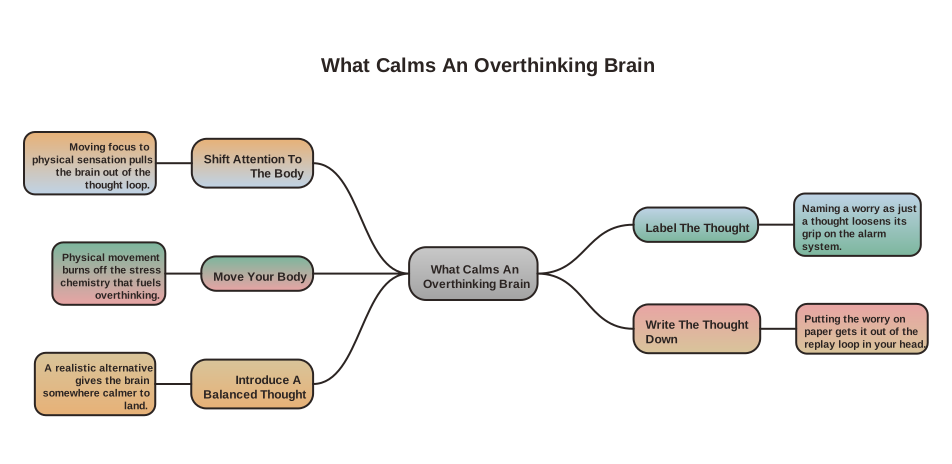
1. Shift Attention to the Body
Physical sensations activate brain regions involved in present-moment awareness. Try noticing:
- breathing
- feet touching the ground
- sounds around you
This reduces activity in rumination networks.
2. Label the Thought
Instead of believing every thought, try identifying it.
"That's a worry thought."
"That's a replay thought."
Labeling thoughts creates psychological distance.
3. Move Your Body
Physical movement activates brain circuits involved in emotional regulation. Even short movement can help reset mental loops.
- walking
- stretching
- light exercise
4. Write the Thought Down
Writing externalizes repetitive thoughts. Seeing the thought on paper often reduces its intensity.
5. Introduce a More Balanced Thought
Instead of forcing positive thinking, try something realistic.
Instead of: "This will go terribly."
Try: "I don't know how it will go yet."
Balanced thoughts help calm the brain's threat system.
Why Does Overthinking Feel So Convincing?
One reason overthinking is difficult to interrupt is that the brain interprets thoughts as meaningful signals.
"If I keep thinking about this, it must be important."
But thinking more does not always produce better answers. Sometimes the brain simply needs a pause from the loop.
How MindLift Helps Interrupt Overthinking
MindLift is designed to help people notice and shift unhelpful thinking patterns.
Instead of letting the mind repeat stressful thoughts automatically, the app offers short cognitive reframes inspired by psychological research.
These small mental shifts can help users:
- notice negative thinking patterns
- create distance from stressful thoughts
- introduce more balanced internal dialogue
Over time, repeating healthier mental responses can strengthen new neural pathways.
Final Thought
Your brain evolved to solve problems and protect you from danger. Overthinking is often the brain trying too hard to do both.
But the same brain that creates these loops also has the ability to change.
Every time you pause, question a thought, or shift your perspective, you are training your mind in a new direction.
And with practice, those new pathways can become stronger than the old ones.
Frequently asked questions
What happens in the brain during overthinking?
Overthinking activates the Default Mode Network (DMN) — brain regions that become active when you're not focused on an external task. The DMN generates self-referential thought and mental time travel (ruminating on past events or catastrophizing future ones). When the amygdala also fires, the overthinking takes on an anxious, threatening quality.
What is the Default Mode Network and why does it cause overthinking?
The DMN is a network of brain regions that activates during rest, mind-wandering, and self-reflection. It's not inherently harmful — it's how we plan, empathize, and process experience. But chronic DMN over-activation, especially combined with amygdala stress responses, produces ruminative overthinking loops.
Can overthinking physically change your brain?
Chronic overthinking and stress can reduce gray matter density in the hippocampus and increase amygdala reactivity over time. However, the brain is neuroplastic — practices like mindfulness and CBT can reverse these changes by strengthening the prefrontal cortex's regulatory capacity.
How do you interrupt the neuroscience of overthinking?
The most effective interrupts are physical (movement, cold water, breathing patterns) because they shift autonomic nervous system state, reducing amygdala activation. Cognitive techniques like grounding or CBT thought-challenging work better once the initial stress response has been downregulated.
Like what you're reading?
Stop the spiral in real time
MindLift gives you a gentle CBT-based reframe the moment your thoughts start looping.


Free to start · premium optional