
Turn this into a daily habit — free to start in the MindLift app:
You wake up and your brain is already running.
The thing you said yesterday. The email you haven't answered. The thought that snuck in from nowhere that feels like it might be true. Before you've had coffee, you're already behind — not in your schedule, but in your head.
Overthinking and negative thoughts aren't the same thing, but they tend to travel together. Overthinking is the process — the looping, the replaying, the worst-case scenario building. Negative thoughts are the content it keeps returning to. Together, they create a mental environment where it's genuinely hard to feel okay, even when your life, objectively, is fine.
This guide explains what's actually happening when you spiral, why standard advice ("just think positive") fails, and what CBT-backed approaches actually work — not to achieve some permanent state of calm, but to interrupt the pattern when it's happening and build a different relationship with your own mind over time.
What's Actually Happening When You Overthink
Most people treat overthinking as a thinking problem. It isn't. It's a regulation problem.
When you overthink, your brain has registered something as threatening — a social interaction, an uncertain outcome, a mistake, a memory — and activated its threat-response system. The prefrontal cortex, which handles reason and perspective, tries to resolve the threat through analysis. The problem is that most of the things we overthink aren't solvable through more information. They're inherently uncertain, or already in the past, or about other people whose inner lives we can't access.
So the analysis loops. It generates new angles. It considers new scenarios. It mistakes activity for progress. And because the threat signal never gets a resolution, it keeps running.
Neuroscience has a name for the network driving this: the Default Mode Network (DMN). It's most active when you're not focused on a specific task — when your mind wanders, reflects, or ruminates. For people prone to overthinking, the DMN tends to be overactive and to pull toward negative, self-referential content. This isn't a moral failing. It's a pattern that developed for reasons, and patterns can be interrupted and retrained.
Why Negative Thoughts Feel More True Than Positive Ones
There's a reason the bad thoughts stick and the good ones slide off: your brain is built to prioritise negative information.
Psychologists call this negativity bias — the tendency to weight threats, losses, and failures more heavily than equivalent gains and successes. Evolutionarily, it made sense. Missing a threat was more costly than missing an opportunity. The brain that paid more attention to what could go wrong stayed alive longer.
The result, in daily life, is asymmetry. One critical comment outweighs five compliments. One thing that went badly overshadows ten that went well. A single anxious thought at 11pm can undo a genuinely good day.
Understanding this doesn't neutralise it — but it does shift the frame. When a negative thought feels more real, more urgent, and more credible than a positive one, that's not your brain accessing truth. That's your brain following its default weighting system. The thought isn't true because it feels true. It feels true because negative content gets priority processing.
The Overthinking Loop: How It Sustains Itself
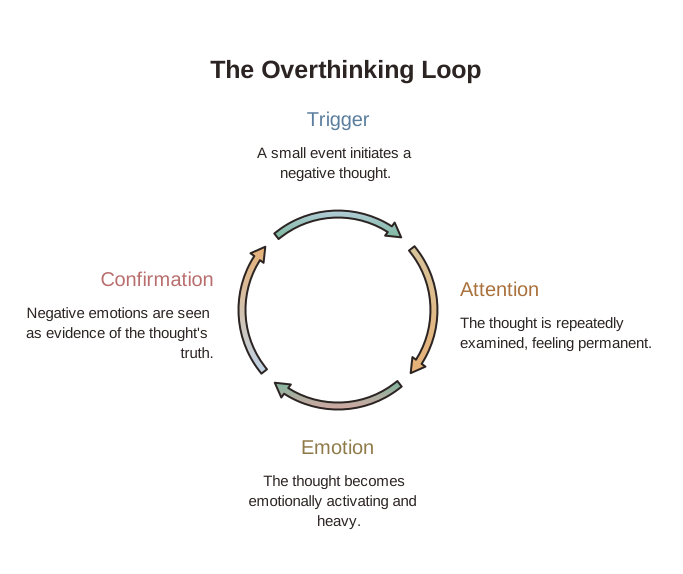
Overthinking is self-reinforcing. Here's the cycle:
1. A trigger activates a negative thought. Could be external (a message, a situation, feedback) or internal (a memory, a feeling, waking up).
2. The thought gets attention. Instead of passing through, it gets examined — turned over, analysed, attached to other thoughts.
3. Attention generates emotion. The more you focus on the thought, the more emotionally activating it becomes.
4. Emotion confirms the thought. "I feel terrible, so this thought must be important/true/dangerous." This is emotional reasoning — one of the most common cognitive distortions in overthinking.
5. The heightened emotion generates more thoughts. Which get more attention. Which generate more emotion. Which confirm more thoughts.
This is why trying to logic your way out of a spiral mid-spiral rarely works. You're using the same system that's maintaining the loop. What's needed isn't more thinking — it's disruption.
The 8 Cognitive Distortions That Power Negative Thought Loops
CBT identifies specific thinking errors — called cognitive distortions — that give negative thoughts their sticking power. Learning to recognise them is one of the most evidence-based tools available for overthinking.
All-or-nothing thinking. Everything is a success or a failure, right or wrong, safe or dangerous. No middle ground.
Catastrophising. Taking a problem and escalating it to its worst possible conclusion.
Mind reading. Assuming you know what others are thinking, usually negatively, without evidence.
Fortune telling. Treating your anxious predictions as facts.
Personalisation. Taking responsibility for things outside your control.
Should statements. Holding yourself to rigid internal rules that generate shame when you fall short.
Mental filtering. Noticing only the negative aspects of a situation and filtering out the rest.
Emotional reasoning. Using feelings as evidence of fact. I feel stupid, therefore I am stupid.
Most overthinking sessions contain several of these, running simultaneously, reinforcing each other. You don't need to eliminate all of them. You need to be able to name what you're doing.
8 Techniques That Actually Work
1. Label the thought, don't argue with it
When a negative thought arrives, the instinct is to either engage with it (try to prove it wrong) or suppress it (push it away). Both approaches tend to backfire — engagement strengthens the neural pathway, suppression increases thought frequency through rebound.
A more effective approach: label it. That's a catastrophising thought. That's mind-reading.
This isn't dismissal. It's defusion — creating distance between you and the thought. You're no longer inside the thought experiencing it as reality. You're observing it from one step back. That distance is where choice lives.
2. Ask: is this solvable right now?
Every overthinking session has one question worth asking before anything else: Is there an action I can take right now that would actually address this?
If yes — take the action. The most effective antidote to anxious thinking about an email you haven't sent is sending the email. Anxiety often resolves remarkably fast when you remove the underlying uncertainty.
If no — and this is the more common answer — that's important information. You're not thinking because thinking will help. You're thinking because your nervous system wants to feel like it's doing something. Recognising that changes the goal. The goal isn't to solve the thought. It's to tolerate the uncertainty it contains.
3. Find the thought underneath the thought
Surface-level negative thoughts are usually proxies for deeper ones. The work is in the layer beneath.
I keep making mistakes → What would that mean about me? → I'm incompetent → What would that mean? → I don't deserve to be here → What would that mean? → I'm going to be found out and left behind
This is sometimes called the downward arrow technique. It feels uncomfortable because you're moving toward the real fear rather than away from it. But once you can see the actual belief, you can examine it. Is there genuine evidence for it? What would you say to someone you loved who held that belief?
4. Reframe to realistic, not positive
"Just think positive" is bad advice not because positivity is wrong, but because it's unbelievable. If you're spiralling with I always mess everything up, replacing it with I'm great and everything is fine doesn't work. Your brain rejects it as false.
What works is reframing to accurate. I always mess everything up → I made a mistake in this specific situation. I've also handled things well in situations X, Y, and Z. This one moment isn't the whole picture.
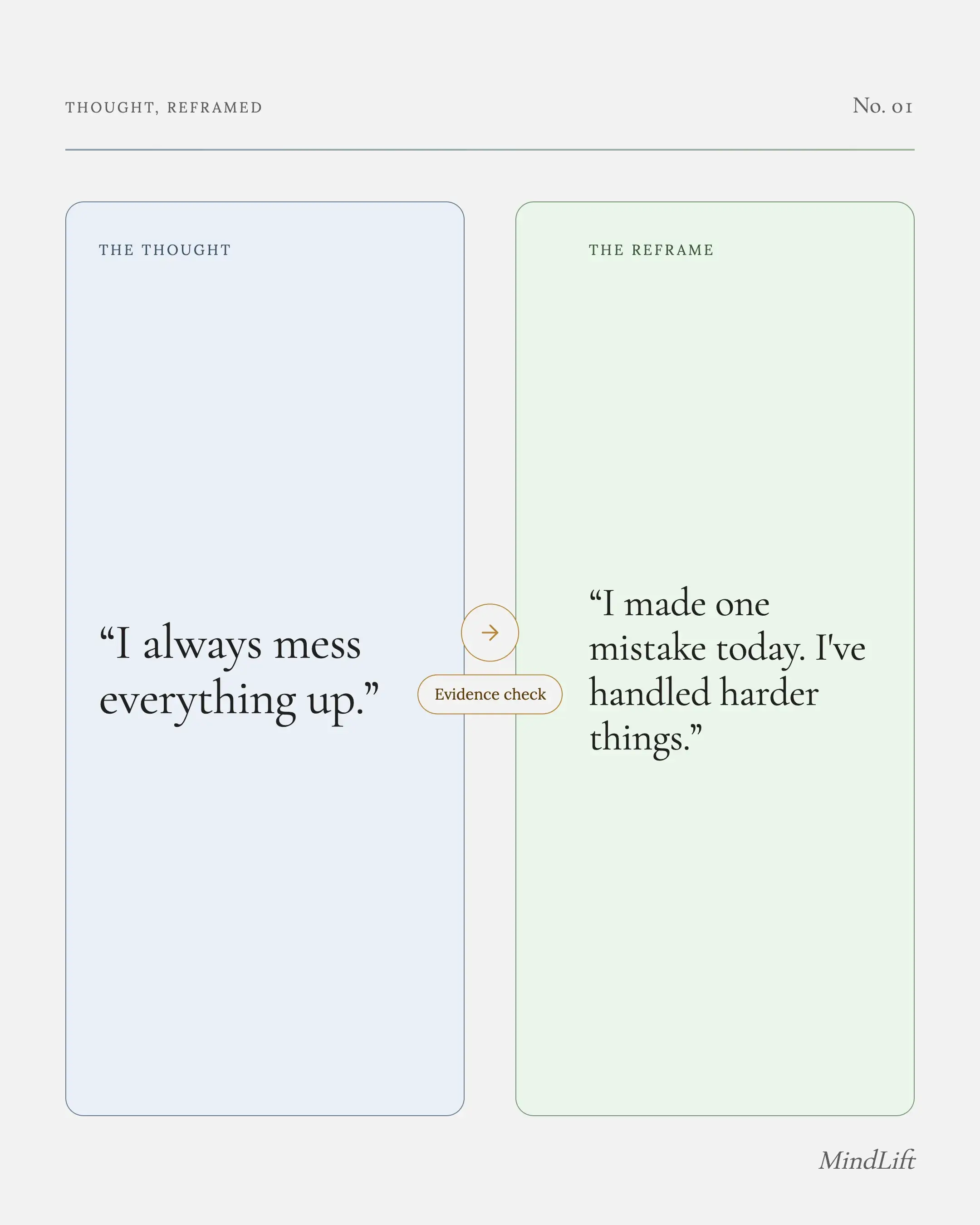
The goal isn't to feel better. It's to think more accurately. The emotional relief tends to follow naturally from that.
5. Schedule the worry
Research on worry postponement shows that designating a specific time window for anxious thoughts reduces their overall frequency and intensity throughout the day. Instead of trying to suppress the thoughts when they arrive, you redirect them: Not now — I'll think about this at 7pm for 20 minutes.
When 7pm arrives, sit with the worry deliberately. Often, you'll find it's less urgent than it felt at 11am. Sometimes you'll need the full 20 minutes. Either way, you've changed your relationship to the thoughts — from reactive to intentional.
6. Use your body to interrupt your brain
Cognitive tools are powerful, but sometimes the spiral is too activated for cognition to reach it. In those moments, physiological interruption is more effective than any reframe.
Slow, deliberate exhales activate the parasympathetic nervous system (the calm-down signal), reducing the physiological arousal that maintains anxious thought loops. A 4-7-8 breath (inhale 4 counts, hold 7, exhale 8) can shift your nervous system state in under two minutes. Physical movement — even a brief walk — changes the neurochemical environment your thoughts are running in.
7. Reduce the loop, not the feeling
One of the most important reframes in CBT: the goal of working with negative thoughts isn't to not feel bad. It's to not be stuck. There's a significant difference.
Feelings are appropriate responses to life — sadness when something sad happens, anxiety before something uncertain, anger when something feels unjust. The goal isn't emotional flatness. It's to stop the thought loop that keeps the feeling recirculating long past its usefulness.
8. Catch the early spiral, not the late one
Overthinking is easiest to interrupt in its first few minutes and extremely difficult to interrupt once it's been running for an hour. This sounds obvious but has a practical implication: the skill you're developing isn't crisis management. It's early detection.
What does the beginning of a spiral feel like in your body? Most people, once they pay attention, can identify a physical signature — a tightness, a specific quality of restlessness, a way the mind starts moving. That moment — before the loop has built momentum — is when your interventions will be most effective.
Why "Just Stay Positive" Is Making Things Worse
Toxic positivity — the cultural insistence that you should reframe everything as a good thing, find the lesson in every pain, and maintain an upbeat attitude regardless of circumstances — doesn't reduce negative thinking. It adds shame to it.
Now you're not just having negative thoughts. You're having negative thoughts about having negative thoughts. I shouldn't be feeling this way. Why can't I just be grateful? What's wrong with me?
The evidence-based alternative isn't positivity. It's psychological flexibility: the ability to hold difficult thoughts and feelings without being controlled by them, while continuing to move toward things you value.
You don't need to feel good. You need to not be derailed.
When Overthinking Is a Symptom, Not a Habit
Occasional overthinking is normal. Pervasive, relentless overthinking — especially when it's accompanied by physical symptoms like sleep disruption, tension, appetite changes, or a persistent sense of dread — may be a symptom of generalised anxiety disorder, OCD, depression, or another condition that responds well to professional treatment.
CBT techniques are highly effective for all of these conditions, but their application is different in a clinical context than in a self-help context. If the patterns described in this article feel entrenched rather than situational, a therapist trained in CBT or ACT is worth seeing. The tools work significantly better with guidance.
What Helps in the Immediate Moment
When the spiral is already running and you need something in the next few minutes:
Write the thought down exactly as it appears in your head. Not a summary — the actual words. Externalising it reduces its intensity and gives you something concrete to work with rather than a fog.
Then ask three questions:
- What is this thought actually claiming?
- What's the hidden assumption underneath it?
- What's the most accurate thing I can honestly say about this situation?
You're not looking for a positive spin. You're looking for precision. The spiral lives in vague, totalising language — everything, always, never, everyone, no one. Precision interrupts it.
The Long Game
The goal of working with overthinking and negative thoughts isn't to reach a state where you no longer have them. Negative thoughts are part of being a person with a functioning, threat-sensitive brain. The goal is to stop giving them so much real estate.
That shift — from fusion to observation, from reaction to choice, from spiral to pause — is something you build gradually, with practice, in the same way you build any other skill. It gets easier. The loops get shorter. The recovery gets faster. You stop being surprised by the thoughts, and you start being able to move through them.
There is evidence that reframing really does train like a skill. In a two-week study, people who practised reappraisal across five sessions reported less negative emotion in response to upsetting images as the sessions went on (Denny & Ochsner, 2014). The skill got easier with repetition.
That's what this work actually looks like. Not the absence of hard moments, but a different relationship to them.
Frequently asked questions
Why do negative thoughts feel more true than positive ones?
Because of negativity bias — the brain's evolved tendency to weight threats, losses, and failures more heavily than equivalent gains and successes. A negative thought isn't more credible because it feels more real; it feels more real because the brain gives it priority processing. Understanding this doesn't neutralise it, but it shifts the frame: the thought feels true because of how your brain is wired, not because it's accurate.
Does CBT actually work for overthinking?
Yes. CBT (Cognitive Behavioral Therapy) is among the most research-supported approaches for overthinking, rumination, and anxiety. It works by teaching you to identify the cognitive distortions maintaining the thought loop, examine the evidence for them, and generate more accurate alternatives. Unlike suppression (which increases thought frequency) or engagement (which strengthens the loop), CBT interrupts the cycle at the thought-appraisal stage.
What's the difference between overthinking and problem-solving?
Problem-solving moves forward — it generates new information, leads to decisions, and eventually resolves. Overthinking cycles in place: it revisits the same content from the same angles without producing new resolution. A rough test: after five minutes, do you feel clearer, or more anxious and stuck? Problem-solving produces clarity. Overthinking produces more thinking.
Is it possible to permanently stop overthinking?
The goal isn't to stop having negative thoughts — it's to stop being controlled by them. Overthinking-prone brains have a default mode network that tends toward self-referential, threat-focused content. That tendency doesn't disappear, but with practice the loops get shorter, recovery gets faster, and the thoughts stop derailing your day. It's a skill built gradually, not a state you reach once.
When should I see a professional about overthinking?
When the pattern feels entrenched rather than situational — particularly if it's accompanied by sleep disruption, physical symptoms of anxiety, persistent low mood, or significant impairment in work or relationships. CBT techniques are effective for generalised anxiety, OCD, and depression, but their application is different in a clinical context. A therapist trained in CBT or ACT can help you apply these tools in a way that's calibrated to your specific pattern.
Like what you're reading?
Stop the spiral in real time
MindLift gives you a gentle CBT-based reframe the moment your thoughts start looping.


Free to start · premium optional