
Turn this into a daily habit — free to start in the MindLift app:
Quick Answer
Why do my thoughts keep spiraling?
Spiraling happens when thoughts escalate — each one making the next worse. Your brain's threat-detection system interprets uncertainty as danger and generates worst-case scenarios. Unlike a thought loop (which repeats), a spiral climbs.
It starts with one thought.
Then that thought connects to another.
And suddenly you're catastrophizing about something that wasn't even the original problem.
That's a spiral. And the reason it's so hard to stop is that the usual advice — breathe, think positive, distract yourself — assumes you can access those tools from inside the loop. You can't.
Here's what actually works to stop spiraling thoughts before they take over.
Thoughts spiraling right now?
Let's interrupt it.
What's happening?
What Is a Thought Spiral, Actually?
Overthinking is replaying the same thought. A spiral is different: it escalates.
Example:
"I was quiet in that meeting"
↓ "They probably noticed"
↓ "They think I don't contribute"
↓ "Maybe they're going to cut my role"
↓ "I can't afford to lose this job right now"
You went from "quiet in a meeting" to "financial crisis" in about 90 seconds. Each thought didn't just repeat — it made the next one worse.
The spiral has momentum. That's what makes it different from regular overthinking loops — and why the same interruptions don't work for both.
How to Stop a Mental Spiral (3 Interruptions That Work)
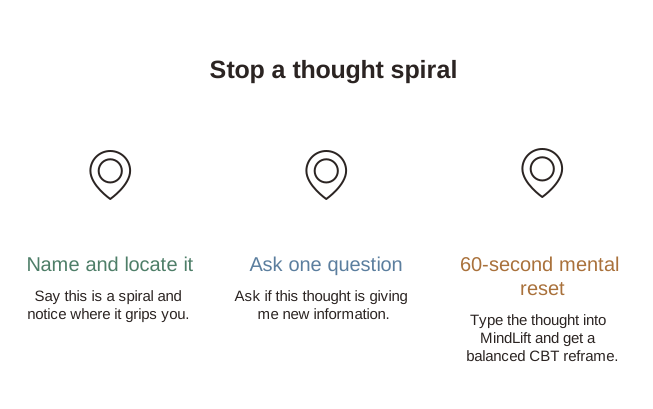
Interruption 1: Name it and locate it
The moment you notice escalation — thoughts getting worse instead of resolving — say (out loud or mentally):
"I'm spiraling about [X]."
Not: "I'm anxious." That's too vague — your brain can't do anything with it.
But: "I'm spiraling about whether that conversation went badly."
Naming it specifically activates your prefrontal cortex — the part that can actually reason — and reduces the amygdala's grip. It's a small shift, but it's the difference between being inside the spiral and observing it.
Interruption 2: Ask one question
After naming it, ask: "Is this problem actually solvable right now?"
If yes → do the one thing that would actually help and stop thinking about it.
If no → you're not problem-solving, you're ruminating. The spiral is giving you the feeling of doing something productive when you're not. This question exposes that.
Most spirals fail this test. The problem is either in the past (can't be solved) or in the future (can't be solved yet). Recognizing that isn't defeatist — it's the signal to stop. This connects to a broader truth: not every thought deserves a response.
Interruption 3: The 60-second mental reset
This is the fastest pattern-breaker. It doesn't require insight or emotional readiness — just 60 seconds and willingness to move.
Step 1 (10 seconds): Stand up and change rooms. Physical movement breaks the mental loop faster than willpower alone — your brain literally recalibrates to the new environment.
Step 2 (20 seconds): Write the spiral thought in one sentence. "I'm afraid that conversation went badly and they don't like me." Externalizing it stops the loop from running internally.
Step 3 (30 seconds): Write one honest counterweight. Not false reassurance — something realistic: "I can't know how it landed, and I'm probably evaluating it more harshly than they are."
That's it. You're not solving the problem. You're breaking the momentum. And momentum is everything in a spiral.


For a longer toolkit once the spiral has stopped, 10 ways to calm your mind from overthinking covers what to do in the quieter moments.
Why Doesn't Standard Advice Work When You're Already Spiraling?
"Breathe" — Useful for calm anxiety. Not useful mid-spiral when your thoughts are moving too fast.
"Think positive" — Your brain rejects the gap between where it is and where you want it to be.
"Distract yourself" — Works briefly, spiral returns when the distraction ends.
None of these address the escalation. They try to change the content of your thoughts without interrupting the momentum.
Does Spiraling Get Better With Practice?
The first few times you try these interruptions, the spiral will come back. That's fine.
You're not trying to eliminate spirals — you're shortening them. From 2 hours to 45 minutes. Then to 20. Then to 5.
Each interruption is practice. Each practice weakens the neural pathway that defaults to escalation.
Final Thought
You don't stop spiraling thoughts by thinking harder about them.
You stop them by interrupting before the next escalation.
Name it. Ask if it's solvable. Move. Write one honest counter.
That's the reset.
Frequently asked questions
How do I stop spiraling thoughts?
You stop spiraling thoughts by interrupting the escalation, not fighting the thoughts themselves. Name what you're spiraling about ('I'm catastrophizing about tomorrow's meeting'), ask if it's solvable right now, and if not — physically change your environment. Standing up and changing rooms interrupts the pattern more effectively than trying to think your way out.
What causes thought spirals?
Thought spirals are triggered by uncertainty combined with a brain that defaults to worst-case scenarios. Your amygdala detects an unresolved threat, your prefrontal cortex tries to solve it by imagining outcomes, but since the threat is hypothetical, there's no resolution — so it escalates. Tiredness and stress make spirals worse because they reduce your emotional regulation.
How do I stop a mental spiral at night?
At night, spirals are harder to stop because there are no distractions and your emotional regulation is weakened by tiredness. The most effective approach: write the spiral thought down exactly as it is, then write one believable counter ('this feels catastrophic right now but I probably can't see it clearly at 1am'). The act of externalizing the thought breaks its hold.
Is spiraling the same as overthinking?
Overthinking is dwelling on something repeatedly. Spiraling is when each thought makes the next one worse — it's escalating overthinking. You can overthink without spiraling ('I keep thinking about this'), but a spiral always involves escalation ('this is terrible → it's going to get worse → I can't handle it').
What is a quick mental reset?
A quick mental reset is any short action that interrupts a thought pattern before it escalates further. The most effective ones combine physical movement (changing environments, splashing cold water) with one cognitive shift (naming the spiral, asking one grounding question). It works in 60 seconds because you're interrupting momentum, not solving the underlying thought.
Like what you're reading?
Stop the spiral in real time
MindLift gives you a gentle CBT-based reframe the moment your thoughts start looping.
Free to start · no account required
CBT & Self-Talk Researchers
MindLift content is grounded in cognitive behavioral therapy principles and designed to help you shift harsh self-talk in real time. Our guides focus on practical, evidence-based techniques you can use in the moment.
Was this article helpful?