
Turn this into a daily habit — free to start in the MindLift app:
3:07am. Ceiling. The loop found you the second you surfaced — the conversation, the decision, the thing you should have handled differently — and it's running at a volume it never manages in daylight. You have to be up in four hours, which the loop also knows, and has added to the agenda. Here's what's actually happening, and the sequence that ends the session.
How do you stop ruminating at night?
Don't debate the loop's content — at 2am the brain's fact-checking systems are at their circadian low and will lose. Instead: name the loop ("I'm ruminating"), park the thought on paper in one sentence marked "decided at 9am," downshift the body (slow exhale-heavy breathing), and if you're still fully awake after ~20 minutes, leave the bed so it doesn't become a rumination cue. The lasting fix is daytime reframing practice, which shortens the night sessions.
Harvey (2002); standard CBT worry-postponement practice
Why the loop is louder at night
Nothing about your problems changes at sunset. What changes is the competition. Daytime is loud — tasks, conversations, notifications — and a rumination loop rarely gets ten uninterrupted seconds. At night the competition goes home, and the brain's default mode network — the system that generates self-referential chatter — becomes the only broadcaster still on air. The loop isn't stronger at 3am. It's unopposed. We've covered the full biology in why thoughts feel worse at night; the short version is that the systems supplying perspective are at their circadian low exactly when the loop takes the stage.
Night loops lie about urgency
Every night loop carries the same false claim: this must be resolved now. It's worth saying plainly — nothing on the loop's agenda gets decided tonight. Not the job situation, not the relationship, not the thing you said in 2019. You have the motivation to solve and none of the equipment. Adopting that as a formal rule (“no verdicts after midnight”) sounds trivial and isn't: it converts an open-ended session into something with a known ending.
The in-bed sequence
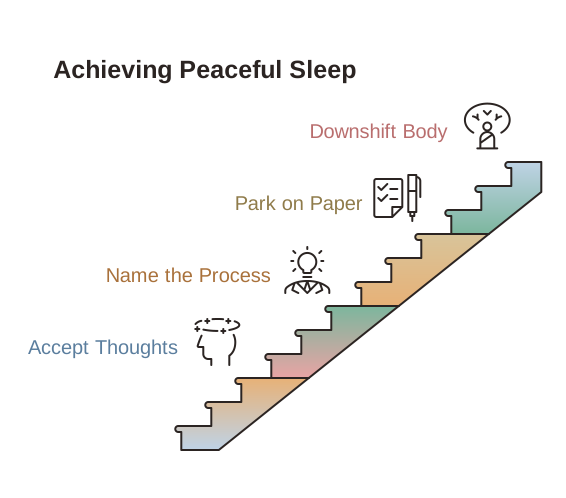
1. Don't argue with the content. Engaging the loop's claims point-by-point at 2am is a debate against a threat system running at full strength, refereed by nobody. You will lose, slowly, while getting more awake.
2. Name the process instead. “I'm ruminating. This is the night version. It always feels like this.” You're not dismissing the topic — you're correctly identifying the state you're hearing it in.
3. Park it on paper. Pen within reach, one sentence — the sentence, not the essay — and the words “decided at 9am.” This answers the loop's real demand, which was never “solve this now” but “don't lose this.” Filed is not lost. The processor can stand down.
4. Downshift the body. The loop keeps arousal high; return the favor in reverse. Slow breathing with a long exhale — four counts in, six-to-eight out, a few minutes — is the most portable way to tell the nervous system the threat review is over.
If you're fully awake anyway
Twenty minutes of genuine wakefulness is the commonly used line: past it, get out of bed. This comes straight from the cognitive model of insomnia — a brain that regularly ruminates in bed learns the bed as a cue to start ruminating, and then the pillow itself presses play. Low light, one dull activity, no screens making a case for your attention, back to bed at drowsy. You're not giving up on sleep; you're refusing to teach the bed the wrong lesson. More night-specific tactics are in how to stop overthinking at night.
Building a night that doesn't invite the loop
The real fix mostly happens in daylight. Loops feed on unfinished processing, so give them a daytime slot: a ten-minute scheduled worry window, on paper, ideally early evening — the full technique is in our six-step guide to stopping rumination. And practice reframing the loop's core sentence while your reasoning brain is online. A thought you've credibly reframed at 3pm has measurably less to say at 3am — the night session gets shorter because the case is already closed.
Night loops also have a personality — replaying, rehearsing, self-prosecuting, or endless fixing. Two minutes on the free What Kind of Ruminator Are You? quiz tells you which one owns your 3am, the rumination hub collects this whole series, and if it's specifically the waking-at-3am pattern, we built a page for exactly that hour.
Frequently asked questions
Why do I ruminate more at night than during the day?
Attention has nothing external to hold at night, so the brain's default mode network — the system behind self-referential thinking — becomes the loudest signal running. The thoughts aren't different from daytime; they're unopposed. Daytime protects you with constant interruption; night removes the competition and gives the loop the whole stage.
Should I get out of bed when I can't stop ruminating?
After roughly 20 minutes of full wakefulness, yes. Sleep researchers advise leaving the bed so the brain doesn't learn to pair "bed" with "loop" — that association is a core mechanism in the cognitive model of insomnia. Do one low-light, low-effort thing (a dull book, slow breathing in a chair) and return when drowsy, not when "finished thinking."
Do 3am thoughts mean anything?
They feel truer because they're unopposed, not because they're more accurate. At 3am, threat processing runs at full strength while the prefrontal systems that supply perspective sit at their circadian low. The same thought re-examined at 3pm usually shrinks to its actual size. The content is real; the 3am verdict on it is not reliable data.
Can writing thoughts down really stop night rumination?
Yes — parking the thought on paper works because it answers the loop's real demand, which is "don't lose this," without keeping the mental processor running. Keep pen and paper within reach, write the sentence (not the essay), add "decided at 9am," and give your brain explicit permission to stand down. Worry postponement is a standard CBT technique for exactly this window.
Like what you're reading?
Stop the spiral in real time
MindLift gives you a gentle CBT-based reframe the moment your thoughts start looping.


Free to start · no account required
- Harvey, A. G. (2002). A Cognitive Model of Insomnia. Behaviour Research and Therapy, 40(8), 869–893. — DOI (opens in a new tab)
Mental Wellness Writers
The MindLift Wellness Team writes evidence-based content on CBT, self-talk, and everyday mental health tools.
Was this article helpful?