
Turn this into a daily habit — free to start in the MindLift app:
You've told yourself to stop thinking about it. Several hundred times, at a rough count. And the loop is still here — same scene, same sentence, same sick pull back to the start. That's not a willpower failure. It's a strategy failure: rumination doesn't respond to force. It responds to a sequence. Here it is.
How do you stop ruminating?
Not by suppressing the thought — suppression reliably makes thoughts return more often. The sequence that works: name the loop ("I'm ruminating"), test whether it's producing anything new (it isn't), contain it with a scheduled 10-minute window, reframe the specific repeating sentence, and give the loop one concrete deliverable — a written next step. Loops end when they get an endpoint.
Wegner et al. (1987); Watkins & Roberts (2020)
Why “just stop thinking about it” fails
The most famous experiment in this territory asked people to do one simple thing: don't think about a white bear. They couldn't. Worse — when they were later allowed to think about it freely, they thought about it more than people who had never suppressed it at all. Daniel Wegner called this the paradoxical effect of thought suppression, and it's the reason every “stop dwelling on it” you've ever received has made things approximately zero percent better.
Suppression fails because your brain has to monitor for the thought in order to block it — which means some part of you is now employed full-time thinking about the thing you're not thinking about. So rule one: the goal is never to erase the thought. The goal is to end the loop — the repetition. That's a different job, and it's winnable.
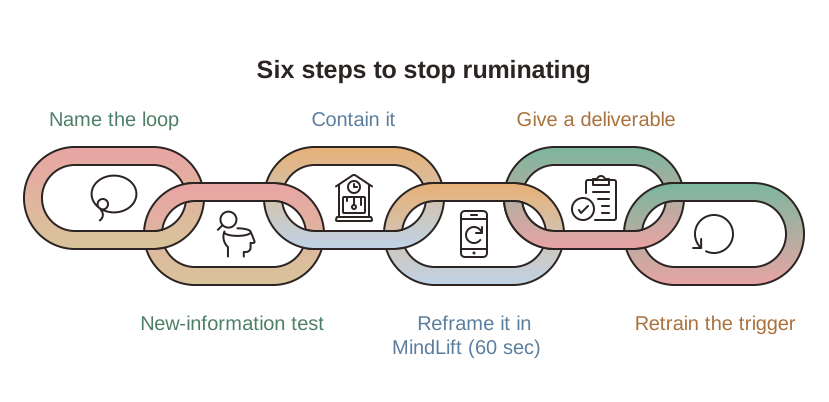
Step 1: Name the loop
The moment you notice the replay, say — out loud if you can — “I'm ruminating.” Not “I'm thinking this through,” not “I'm processing.” The accurate, slightly unflattering label.
This isn't a feel-good ritual. Labeling shifts you from being inside the thought to observing the thought — the distance psychologists call cognitive defusion. Rumination depends on you not having that distance. A loop you've named is a loop that has lost its disguise.
Step 2: Run the new-information test
One honest question: “Has the last repetition produced anything new?” A new fact, a new option, an actual decision?
Rumination researcher Edward Watkins draws the line exactly here: constructive processing moves — it converges on understanding or action. Rumination circles — it arrives, every time, back at the same emotional state with the same non-conclusions. If pass seventeen taught you nothing pass three hadn't, passes eighteen through four hundred won't either. The test takes five seconds, and it's the fairest trial the loop will ever get: you're not dismissing the thought, you're auditing its output.
Step 3: Contain it — the rumination window
Here's the counterintuitive one. Instead of forbidding the topic (see: white bear), schedule it. Ten minutes, deliberately, at a set time — “I will think about this at 6pm, fully.” When the loop shows up at 11am, 2pm, and 4:30, the answer isn't “no” — it's “you're on the calendar.”
Worry postponement is a standard CBT technique because it splits the difference the brain actually cares about: the topic isn't being lost (which is what the loop fears), it's being filed. Most people find that when 6pm arrives, the topic has shrunk to a fraction of its daytime size — and ten contained minutes beat eight leaking hours.
Step 4: Reframe the sentence, not the situation
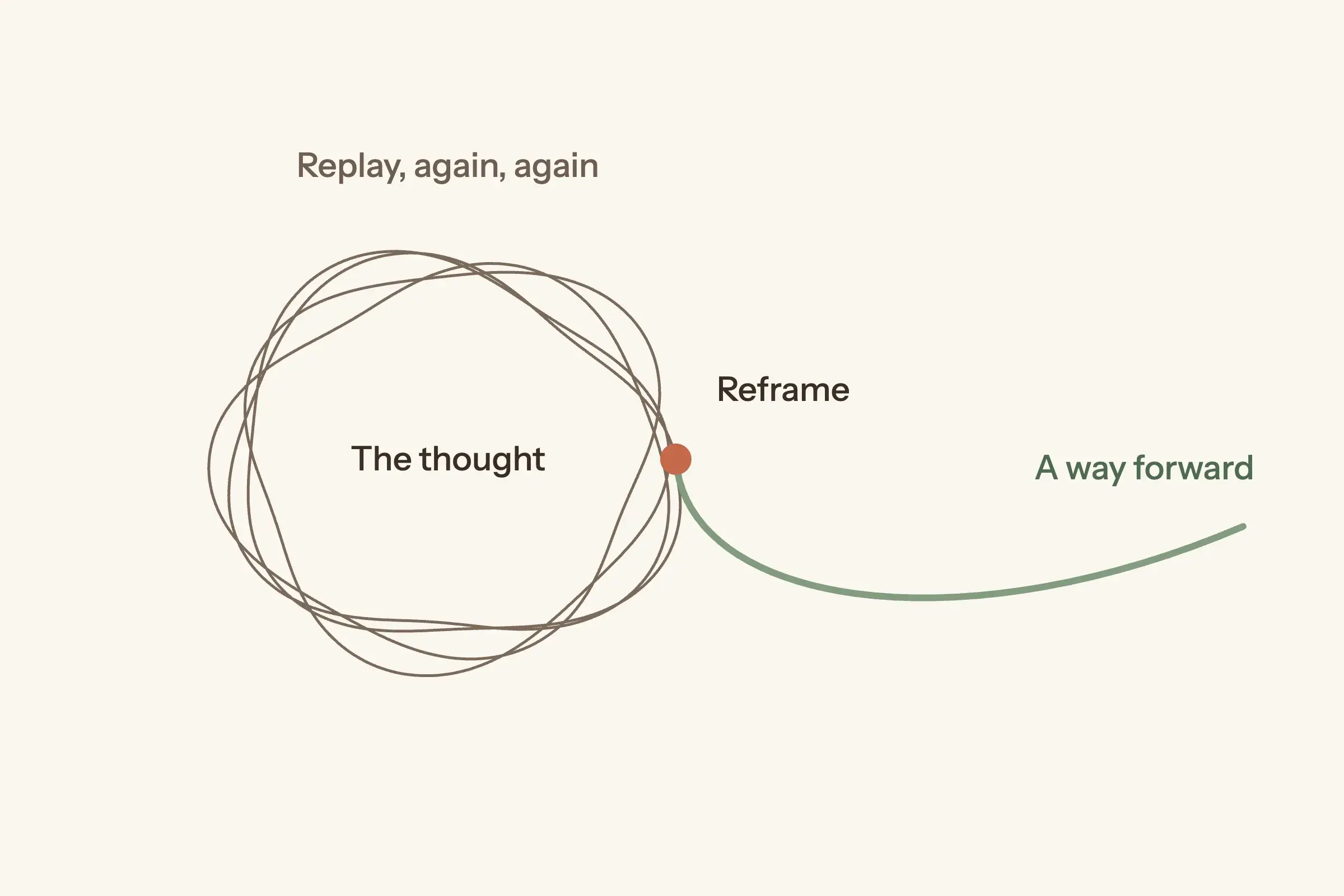
Every rumination loop has a core sentence. Not the whole saga — one line. “I embarrassed myself.” “I made the wrong call.” “They're upset with me.” The loop replays the footage, but the sentence is what's actually holding you.
So work on the sentence. Write it down, then build the most credible alternative you can — not the sunniest, the most defensible: “One awkward moment in a twenty-minute meeting isn't a verdict on me,” or “I made a reasonable call with the information I had.” A reframe only interrupts the loop if your own brain would sign off on it. This is the core mechanic of what happens in your brain when you reframe a thought — you're not deleting the memory, you're changing what it gets to mean.
Step 5: Give the loop a deliverable
Some loops persist because there is, buried in them, a real unresolved thing. The test from Step 2 has a constructive sequel: “Is there one action this actually needs?” An apology to send, a decision to make, a question to finally ask. If yes — write down the single next step and when you'll do it. The loop was a badly designed to-do item; give it a real one and it usually stands down.
If the loop refuses to produce a deliverable — if there is genuinely nothing to do — that's also an answer. Loops without deliverables aren't problem-solving. They're just weather. You don't negotiate with weather; you go inside.
Step 6: Retrain the trigger
Rumination is a habit, and habits live in triggers: the commute, the shower, the minute after you close the laptop, 2am. You probably already know yours. The long game is running steps 1–5 at the trigger point, repeatedly, for weeks. Each interrupted loop weakens the pathway slightly; each completed loop strengthens it. That's not a metaphor — it's how neuroplasticity works in both directions. You practiced your way into this pattern without meaning to. You can practice your way out on purpose.
When rumination needs more than self-help
Be honest about scale. If the loops are costing you sleep most nights, flattening your mood for weeks, or crowding out work and relationships, that's past the tips stage — rumination is a known engine of depression and anxiety, and rumination-focused CBT with a licensed therapist has solid evidence behind it. The steps here still help alongside therapy. They're just not a substitute for it at that level.
Know your loop
One more thing that makes all six steps land harder: knowing which loop you run. Replaying the past, rehearsing the future, prosecuting yourself, and endlessly re-solving problems are four different habits with four different best exits. Our free What Kind of Ruminator Are You? quiz pins yours down in two minutes — no email, instant result — and the rumination hub collects every guide in this series.
Frequently asked questions
How do I stop ruminating right now, in the moment?
Name the loop out loud ("I'm ruminating"), then run the new-information test: has the last repetition produced anything new? If not, redirect to one concrete physical action — stand up, write one sentence, change rooms. Naming creates distance; the action interrupts the default mode network that keeps the loop running.
Why can't I stop ruminating even when I know it's pointless?
Because knowing doesn't compete with the loop's promise. Rumination persists by impersonating something useful — review, preparation, honesty, or problem-solving. Your brain keeps running it because it believes the loop is working. The exit is showing the brain, each time, that the loop produced nothing new — not arguing with the content of the thought.
Does rumination go away on its own?
Occasional rumination fades when the triggering situation resolves. Habitual rumination usually doesn't — it's a reinforced thinking pattern, and each repetition strengthens the pathway. The good news from neuroplasticity research: patterns that are practiced can be un-practiced, and interrupting the loop consistently weakens it over weeks, not years.
When should I see a therapist about rumination?
If rumination regularly costs you sleep, focus, or relationships, or comes with persistent low mood, talk to a licensed therapist — rumination is a known mechanism in maintaining depression and anxiety, and it responds well to CBT and rumination-focused CBT specifically. Self-help tools work alongside therapy, not instead of it, at that level.
Like what you're reading?
Stop the spiral in real time
MindLift gives you a gentle CBT-based reframe the moment your thoughts start looping.


Free to start · no account required
- Wegner, D. M., Schneider, D. J., Carter, S. R., & White, T. L. (1987). Paradoxical Effects of Thought Suppression. Journal of Personality and Social Psychology, 53(1), 5–13. — DOI (opens in a new tab)
- Watkins, E. R., & Roberts, H. (2020). Reflecting on rumination: Consequences, causes, mechanisms and treatment of rumination. Behaviour Research and Therapy, 127, 103573. — DOI (opens in a new tab)
Mental Wellness Writers
The MindLift Wellness Team writes evidence-based content on CBT, self-talk, and everyday mental health tools.
Was this article helpful?