Rumination: The Loop That Feels Like Thinking
Why your brain replays, rehearses, and re-litigates — and the CBT exits that actually close the loop
11 articles in this topic
Rumination is repetitive thinking that never resolves — cycling through a painful thought, memory, or worry without moving toward an answer. It differs from overthinking in focus (rumination fixates on distress and its meaning) and from worry in direction (rumination chews on the past; worry pre-lives the future). It feels like problem-solving. It is, measurably, not.
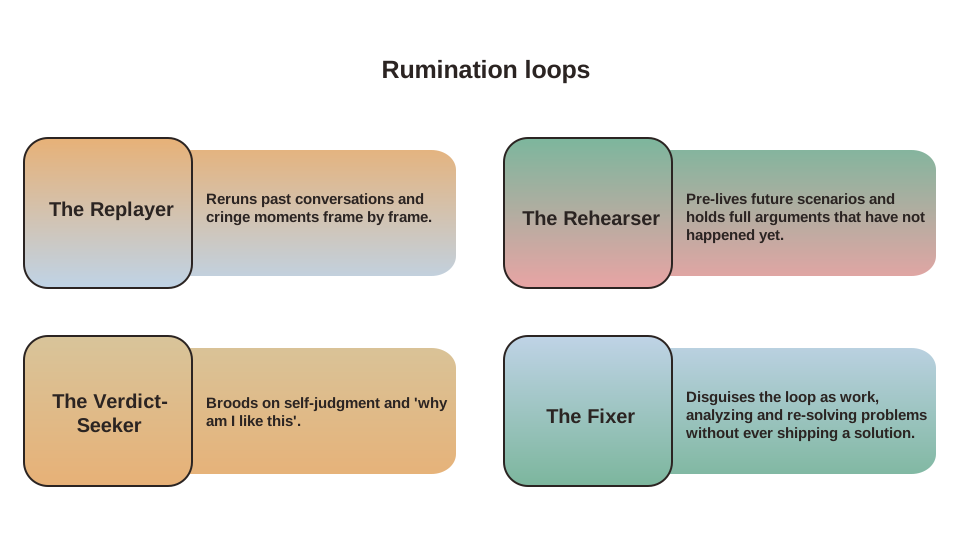
Rumination isn't one habit — it's four distinct loops, and they respond to different interruptions:
🔁The Replayer
Reruns past conversations, decisions, and cringe moments frame by frame.
🎬The Rehearser
Pre-lives future scenarios and holds full arguments that haven't happened.
⚖️The Verdict-Seeker
Turns every event into a trial about who you are ("why am I like this?").
🔧The Fixer
Disguises the loop as work — analyzing and re-solving without ever shipping a solution.
Two minutes on the free What Kind of Ruminator Are You? quiz — no email, instant result — identifies your loop and the CBT shift built for it. The guides below cover the rest: the science, the night version, and the step-by-step exits.
Interactive Quizzes
MindLift quizzes are short, science-based self-assessments that name the thinking pattern behind a problem, so the next step fits the way your mind actually gets stuck. Every quiz is free, needs no sign-up, and ends with a result you can act on.


Understanding Rumination
Rumination is the repetitive mental review of past events, mistakes and conversations that feels like thinking but never reaches a resolution. These articles explain what the loop is, what it does to you, and how to tell it from its lookalikes: worry, reflection and problem-solving.





Stopping the Loop
Closing a rumination loop takes a sequence, not a single trick: notice the replay, name the pattern it is running, and answer the exact sentence it keeps repeating. These guides give evidence-based sequences for doing that by day and at night.





MindLift For
MindLift condition pages are dedicated starting points for one specific challenge, such as anxiety, burnout or negative self-talk. Each page explains how CBT-based reframing applies to that challenge and what the app does in the exact moment the thought shows up.
Close the Loop in 60 Seconds
MindLift takes the exact sentence your loop keeps repeating and walks you to a reframe that actually holds. CBT-based, free to start, iOS and Android.
Try MindLift — free to start →Frequently asked questions
What are the types of rumination?
Rumination shows up in four recognisable loops: replaying past events (post-event processing), rehearsing future scenarios, brooding self-judgment ("what does this say about me?"), and pseudo-problem-solving that never reaches a solution. Research distinguishes brooding — the self-critical form — as the type most strongly linked to low mood; the loops respond to different interruptions, which is why identifying yours matters.
Is rumination the same as overthinking?
They overlap but aren't identical. Overthinking is the broad habit of excessive analysis — including decisions and hypotheticals — while rumination specifically fixates on distress and its meaning, cycling without resolution. All rumination is overthinking; not all overthinking is rumination.
How do I stop ruminating?
The evidence-based sequence: notice and name the loop, check whether the thinking is producing anything new (rumination never does), then reframe the specific repeating thought rather than suppressing it — suppression reliably backfires. Loop-specific tactics help too: a rumination window for replays, a written script line for rehearsals, and a concrete next action for fixing loops.
Why do I ruminate so much at night?
Rumination gets louder at night because external stimulation drops and the brain's default mode network — the system behind self-referential thinking — takes over. Without daytime distractions, the loop becomes the loudest signal available. It's not that 3am thoughts are truer; they're just unopposed.