
Turn this into a daily habit — free to start in the MindLift app:
2:14am. The thought arrives fully formed: you handled that all wrong, and now it's broken. By daylight standards it's a Tuesday-sized worry. Right now it has the weight of a verdict. You know, abstractly, that it will look smaller in the morning — it always does — and that knowledge helps not at all. Here's why the same thought weighs double at night, mechanically, and what to do inside the moment.
Why do thoughts feel worse at night?
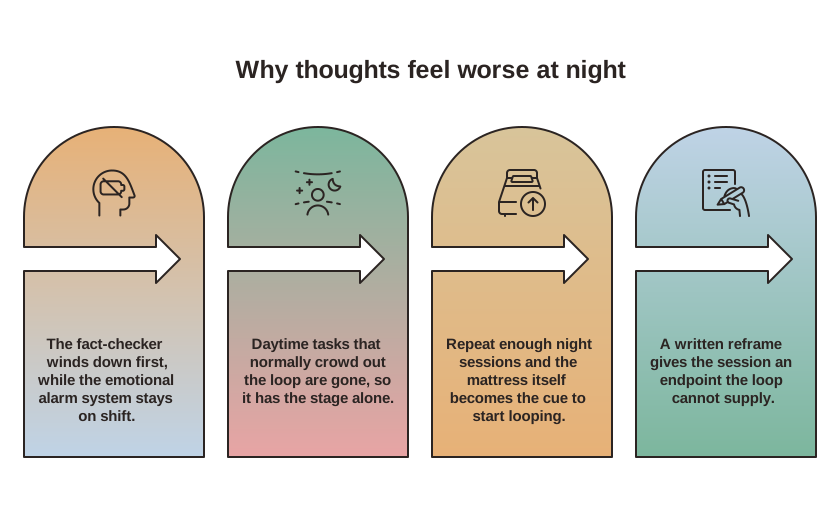
Because the equipment that supplies perspective is offline. Late night sits at the circadian low of prefrontal function — the reasoning, impulse-control, fact-checking systems — while emotional processing tilts negative; researchers call it the 'mind after midnight.' Add zero competing inputs and, if you often worry in bed, a trained association between the bed and worry. The thought is real; the 2am weighting of it is not reliable data.
Tubbs et al. (2022); Harvey (2002)
The night shift runs on half a brain
The "mind after midnight" hypothesis, laid out by Tubbs and colleagues in 2022, collects what's known about being awake when your circadian clock says you shouldn't be. The picture: in the small hours, the prefrontal systems responsible for reasoning, perspective and impulse control are at their circadian low point, while emotional processing shifts toward the negative. The researchers connect this window to elevated rates of impulsive and harmful behavior — but the everyday version is the one you know: a manageable worry arrives, and the department that would normally answer it with context is closed.
So the 3am math is: full-strength threat detection, skeleton-crew fact-checking. Of course the thought wins. It's the only lawyer in the room.
No competition for the stage
Daytime protects you in a way you don't notice: it's loud. Tasks, conversations, commutes — your attention is contested every waking minute, and a rumination loop rarely gets more than a few uninterrupted seconds. At night the competition goes home. Darkness, silence, a ceiling. For the first time all day the loop gets the whole stage, and what feels like the thought becoming more true is just the thought becoming unopposed.
The bed learns, too
If this happens often, a third mechanism joins. Allison Harvey's cognitive model of insomnia describes the loop: worry in bed produces arousal, arousal prevents sleep, monitoring for sleep produces more worry — and over repetitions, the bed itself becomes the cue that starts the sequence. If lying down reliably boots up your brain's open-cases file, that's not a character flaw. That's conditioning, and it responds to the standard countermeasures: keep worry out of the bed (leave it briefly if the spiral takes hold), and give the worry a scheduled daytime slot instead.
The reframe that ends the session
Notice what all three mechanisms have in common: none of them can be fixed at 2am, and none of them need to be. Which is why the reframe for night thoughts is different from daytime reframes — it doesn't argue the content at all. It challenges the jurisdiction:
The thought: "You handled that all wrong and now it's broken."
The reframe: "Maybe, maybe not — and nothing about this gets decided at 2am. The version of me that fixes things comes online at 9."
That's not avoidance; it's accurate. You genuinely are not equipped to evaluate the claim right now — the evaluating machinery is offline. Postponing the case to a competent court is the most honest thing you can tell yourself, which is exactly why it works when "everything is fine" doesn't.
Win the nights during the day
The lasting fix runs on daylight hours: every thought you catch and reframe while the reasoning brain is online strengthens the exact pathway you'll need at 3am — that's the reappraisal circuitry, and it trains like any skill. For the sleep-side tactics — wind-down routines, worry scheduling, what to do when you can't fall back asleep — see how to stop overthinking at night and why the brain won't shut off when you're exhausted.
And for the moment itself: MindLift's Mini-Reframe is built for exactly this window — type the 2am thought, get walked to the "decided at 9am" reframe in about a minute, put the phone down. Free to start, no account. The night session doesn't have to run its full three hours just because the fact-checkers went home.
50% off Premium · ends September 30
First month of MindLift Premium for $2.99 (then $5.99/mo) — code NOTOVERTHINKING50
On Android, enter the code in lowercase (notoverthinking50). The free tier stays free — the code unlocks the deeper library.
Get MindLiftFrequently asked questions
Why do my thoughts feel worse at night?
Three forces stack. Biologically, late night sits at the circadian low point of the systems that supply perspective and impulse control, while mood tilts negative — researchers call this the "mind after midnight" hypothesis. Situationally, night removes every competing input, so rumination gets the whole stage. And behaviorally, if you regularly worry in bed, the cognitive model of insomnia shows the bed itself becomes a cue to start worrying. The thought is real; its 2am verdict is not reliable.
Why does anxiety peak at 3am?
Waking at 3am drops you into the worst possible conditions for perspective: core body temperature and cortisol near their circadian turning points, prefrontal function at low ebb, total darkness and zero distraction. Any thought that surfaces gets amplified processing from the threat system and almost no counter-argument from the reasoning system. The same thought at 10am, with the full brain online, usually shrinks to its actual size.
Should I try to solve the problem my brain brings up at night?
No — and that is a rule worth adopting formally. At 2am you have the motivation to solve and none of the equipment. Problem-solving attempts become rumination within minutes. The evidence-based move is postponement: write the thought down or note it, tell yourself "this gets decided at 9am, not now," and give your brain permission to stand down. Worry postponement is a standard CBT technique precisely because it works with the circadian reality instead of against it.
How do I stop a 2am thought spiral in the moment?
Keep it small: catch the sentence your brain is repeating, name what it is doing (catastrophizing usually), and run one honest reframe — "nothing about this gets decided at 2am; the version of me that fixes things comes online at 9." Then move attention somewhere sensory and boring. If spirals at night are frequent, the daytime version of the skill matters more: reframing thoughts while the reasoning brain is online is what shortens the night sessions over time.
Like what you're reading?
Continue your wellness journey
Reframe negative thoughts in 60 seconds — free to start in the MindLift app.


Free to start · no account required
- Tubbs, A. S., Fernandez, F.-X., Grandner, M. A., Perlis, M. L., & Klerman, E. B. (2022). The Mind After Midnight: Nocturnal Wakefulness, Behavioral Dysregulation, and Psychopathology. Frontiers in Network Physiology, 1, 830338. — DOI (opens in a new tab)
- Harvey, A. G. (2002). A Cognitive Model of Insomnia. Behaviour Research and Therapy, 40(8), 869–893. — DOI (opens in a new tab)
Mental Wellness Researchers
Part of the MindLift team dedicated to translating psychological research into practical tools for everyday mental wellness.
Was this article helpful?