What Kind of Ruminator Are You?
Find the loop your brain keeps running
Rumination isn't one habit — it's four. Some brains replay the past, some pre-live the future, some put you on trial, and some disguise the loop as work.
This 2-minute quiz identifies which loop is yours — and the specific CBT shift that interrupts that loop, not a generic one.
What results can you get?
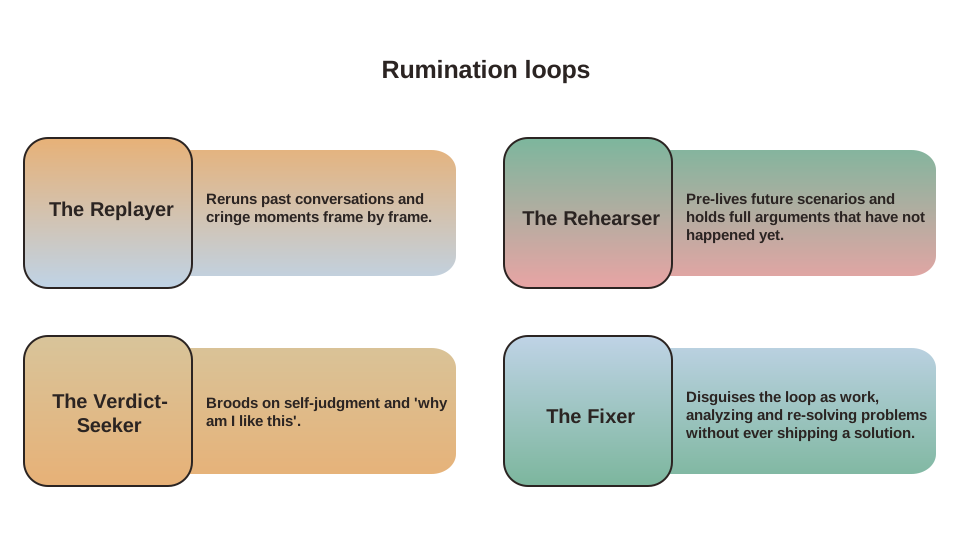
Your answers sort you into one of 4 results — The Replayer, The Rehearser, The Verdict-Seeker, The Fixer. Each result comes with a description of its thinking pattern and one growth move you can practise this week, plus the answer mix that produced it.
| Result | Who gets it | What it looks like |
|---|
| The Replayer | Mostly A answers | Post-event replay + social review + cringe archaeology |
| The Rehearser | Mostly B answers | Pre-living + imagined confrontations + anticipatory scripting |
| The Verdict-Seeker | Mostly C answers | Self-judgment + "why am I like this" + brooding |
| The Fixer | Mostly D answers | Solution loops + re-solving solved problems + mental project management |
The Replayer
Post-event replay + social review + cringe archaeology
Your loops point backward — conversations, decisions, moments you can't un-live.
Replaying feels like review — like you're extracting a lesson from what happened. But research on post-event processing shows the loop re-activates the original emotional charge without adding a single new piece of information.
Worse: each replay re-encodes the memory with today's anxiety attached. The moment doesn't get clearer with repetition. It gets heavier.
The event is fixed. Your interpretation of it isn't — and that's the only part the loop was never going to change on its own.
Name the loop out loud ("I'm replaying") and ask one question: "Is this rewatch producing any new information?" If no — the loop is done, even if the feeling isn't.
 Your loop, from trigger to exit — the rewatch never adds information, only charge.
The Rehearser
Pre-living + imagined confrontations + anticipatory scripting
Your loops point forward — rehearsing scenes that haven't happened.
Rehearsal feels like preparation. But your nervous system can't tell an imagined confrontation from a real one — it runs the stress response for both, at full price.
So you pay for the conversation twice: once in rehearsal, once (maybe) in reality. And the real version is almost always milder than the one you pre-lived.
Preparing has an endpoint — you know when you're ready. Rehearsing doesn't. That missing endpoint is how you know which one you're doing.
Write the one sentence you actually need to say, then close the tab. A script has a last line; a rehearsal loop doesn't.
 Your loop, from trigger to exit — a script has a last line; a rehearsal does not.
The Verdict-Seeker
Self-judgment + "why am I like this" + brooding
Your loops turn events into evidence in a trial about who you are.
This is what researchers call brooding — the most self-critical form of rumination, and the one most strongly linked to low mood. The loop takes something that happened and converts it into a question about your character.
But notice what the loop is actually doing: it isn't examining the event. It's prosecuting you with it. Every replay is another witness for the same verdict.
Here's the part brooding hides: a verdict about who you are was never the question the situation asked. The situation asked for a response, not a sentencing.
Swap "What does this say about me?" for "What did this situation need?" The first question has no answer; the second one usually does.
 Your loop at a glance — the trial never examines the event; it prosecutes you with it.
The Fixer
Solution loops + re-solving solved problems + mental project management
Your loops disguise themselves as work: analyzing, planning, re-deciding.
Fixing-mode rumination is the hardest type to spot, because it feels productive. You're not wallowing — you're working the problem. Again. From the same angle. Arriving at the same place.
The test is brutally simple: has the loop produced a next action you can take today? If not, it isn't problem-solving. It's rumination in work clothes.
Real problem-solving converges — each pass narrows the options. Rumination orbits — each pass returns you to the start with less energy than before.
Give every loop a deliverable and a deadline: "by 6pm I write down the next single step." If the loop refuses a deliverable, it never intended to solve anything.
 Your loop at a glance — real problem-solving converges; this orbit only ends when you give it a deliverable.
Frequently Asked Questions
What are the types of rumination?
Rumination shows up in four recognisable loops: replaying past events (post-event processing), rehearsing future scenarios, brooding self-judgment ("what does this say about me?"), and pseudo-problem-solving that never reaches a solution. Research distinguishes brooding — the self-critical form — as the type most strongly linked to low mood; the loops respond to different interruptions, which is why identifying yours matters.
Is this rumination quiz a diagnosis?
No. This is a self-reflection tool built on CBT concepts, not a clinical assessment. It identifies which thinking loop you most often run so you can apply the right interruption. If rumination is significantly affecting your daily life, a licensed therapist can provide a proper evaluation.
How do I stop ruminating?
The evidence-based sequence: notice and name the loop, check whether the thinking is producing anything new (rumination never does), then reframe the specific repeating thought rather than suppressing it — suppression reliably backfires. Loop-specific tactics help too: a rumination window for replays, a written script line for rehearsals, and a concrete next action for fixing loops.
Why do I ruminate so much at night?
Rumination gets louder at night because external stimulation drops and the brain's default mode network — the system behind self-referential thinking — takes over. Without daytime distractions, the loop becomes the loudest signal available. It's not that 3am thoughts are truer; they're just unopposed.
If you are in crisis or thinking about harming yourself, call or text 988 (US) or find a local line at findahelpline.com. MindLift is a self-help tool and not a replacement for professional care.