
Turn this into a daily habit — free to start in the MindLift app:
Your 1:1 got moved. Two of the execs have been in a room all afternoon. Someone said "restructure" on a call and moved on like it was nothing.
And now you're not working. You're reading. Everything is a signal — who's in which meeting, whose Slack status went quiet, why hiring paused. You've been doing this since Tuesday and you have learned exactly nothing, because there is nothing to learn. There is only more to read.
Is layoff anxiety irrational?
Usually not — and that's what makes it different from most work anxiety. Layoffs are real, and mostly outside your control, so the fear is often accurate risk detection rather than a thinking error. The distortion is generally elsewhere: in the certainty (“it's definitely happening”), the invented timeline (“by Friday”), and the catastrophic chain that runs past job loss into total ruin. Keep the signal. Drop the spiral.
Why this one is different
Most work anxiety runs on a thought that doesn't survive contact with evidence. Your manager's "ok." meant they were busy. The quick chat was about the Q3 timeline. Check the thought, and it dissolves.
Layoff anxiety doesn't dissolve, because it isn't wrong. Companies do cut roles. Good people do lose jobs for reasons that have nothing to do with their performance. If you're picking up on real signals in a real downturn, your threat-detection is working correctly, and any advice that starts with "you're catastrophizing" is asking you to be worse at reading your own situation.
So the usual move — check whether the thought is true — gives an uncomfortable answer here: it might be. Which means the work is different. You're not looking for a thought to disprove. You're looking for the part of the story that went past the evidence.
Where the distortion actually is
Three places, reliably — and none of them is the fear itself.
Certainty. "I might lose this job" is a reasonable read of ambiguous signals. "I'm getting laid off" is a forecast wearing a fact's clothing. The evidence supports a probability; your brain has issued a verdict.
Timeline. The spiral always seems to know when. By Friday. After the board meeting. Before the quarter closes. There is no version of the available evidence that contains a date, and yet the date is somehow in the thought.
The chain. This is the big one, and it's catastrophizing in its purest form: the thought never stops at job loss. It goes to no income, then to the flat, then to telling people, then to never working again, then to a version of your life that has genuinely ended — and it arrives there in about four seconds, presented as a single fact rather than as nine assumptions stacked end to end.
Notice what happened. "My role might be at risk" is survivable and probably true. "My life is over" is neither. The brain fused them, and now you're responding to the second one.
Reading tea leaves is not information-gathering
The scanning feels productive. It is the opposite: it's fortune-telling with unlimited raw material, which is why it never resolves.
A cancelled meeting is noise. A quiet exec is noise. A recruiter going silent is noise. Each one is genuinely uninformative, and each one gets filed as evidence — so the case against your job grows all day and never reaches a verdict, because noise cannot produce one. You're not investigating. You're generating.
The tell is the same as always: has the last hour produced anything I could write down? Not a feeling — an artefact. If not, that wasn't research.
Separate the possible from the catastrophic
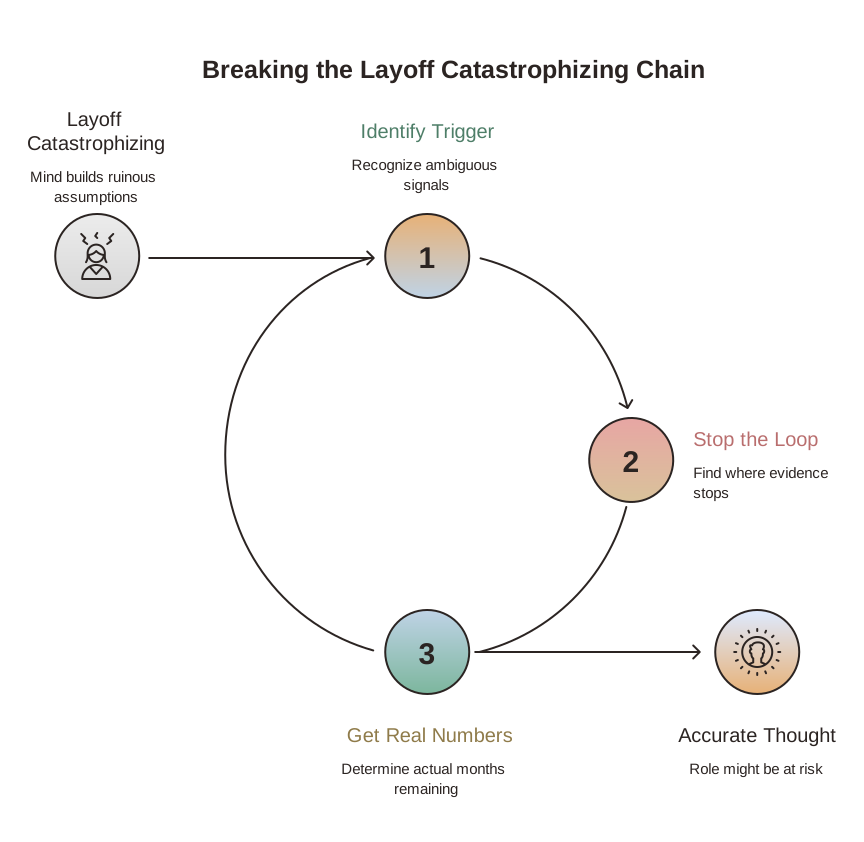
1. Write the chain out. All of it, in order, as far as it goes. It'll look something like: role at risk → laid off → no income → can't make rent → have to move → tell everyone → never recover. Seeing it as a numbered list rather than a feeling is most of the work, because a list can be examined and a dread cannot.
2. Find where the evidence stops. Usually at step one. You have signals about a role. You have no evidence whatsoever about step five. Everything after the break is invention — reasonable-sounding, internally consistent, and made up.
3. Get the real number. Not the feeling of the number — the number. Notice period. Redundancy terms. Savings, honestly. How many months do you actually have? People avoid this because it sounds terrifying, and it is almost always less terrifying than the unexamined version, because the unexamined version has no floor. A number has a floor.
4. Land on the accurate thought. Not "it'll be fine." You don't know that, and your brain will throw it straight out. The true one is: "my role might be at risk, I have roughly four months, and I don't know anything past that." That's not comforting. It's accurate — and it's the version you can act on, which the other one never was.
When the answer isn't calm — it's action
Here's the part most anxiety content won't say. Sometimes the correct response to this fear is not to feel better about it. It's to do something.
If the signals are real, the anxiety is trying to tell you something, and calming it down without acting would be the actual mistake. Update the CV. Message three people this week. Read what your contract says about redundancy. Find the number. These are finite tasks with endpoints, and they change your position — which is the one thing that scanning, no matter how many hours of it you do, will never do.
That's the honest line between rumination and preparation, and it's the same line as the pre-meeting version: preparation produces artefacts and stops. Rumination produces adrenaline and doesn't. Anxiety that ends with an updated CV did its job. Anxiety that ends with more scanning is just the tax.
One thing worth separating early
If it happens, it will be a business decision about a role — headcount, budget, a reorganisation drawn on a whiteboard by someone who has never met you.
Your brain will file it as a verdict on your worth. Those are different things, and the conflation is what does the lasting damage — far more than the money, usually. Worth deciding now, while it's still hypothetical and you can think clearly, that a spreadsheet cell does not get to grade you as a person.
The takeaway
You might lose the job. That's real, and no reframe should try to talk you out of a thing you're correctly reading.
But you are not currently losing the job — you're losing the afternoon, to a nine-step chain where the evidence ran out at step one. Keep the part that's paying attention. Drop the part that's already written the ending.
If the chain runs even when the signals are quiet, the layoff isn't really the subject — it's the hook the anxiety happened to find. The free work anxiety quiz names which of four patterns you run — Mind Reader, Fortune Teller, Catastrophizer or Overfunctioner. Two minutes, no email. The chain that runs past the evidence is the Catastrophizer's signature.
Frequently asked questions
How do I stop worrying about getting laid off?
You probably shouldn't stop entirely — some of that worry is accurate risk detection, and switching it off would be a bad trade. What's worth interrupting is the part that isn't doing anything: the all-day scanning, the certainty about timing you have no data on, and the leap from "I might lose this job" to "I lose the flat, and I never work again." Keep the signal, drop the spiral.
Is my layoff anxiety irrational?
Often not, and that's what makes it different from most work anxiety. Layoffs are real and mostly outside your control. The distortion typically isn't the fear — it's the certainty attached to it, the invented timeline, and the catastrophic chain that runs past job loss into total ruin. The fear can be reasonable while the story around it is not.
Why do I read into every small signal at work?
Because ambiguity plus stakes produces guessing, and under threat the guessing skews dark. A cancelled 1:1, a quiet exec, a meeting you weren't in — each is noise, and each gets filed as evidence. That's fortune-telling with an infinite supply of raw material, which is why it can run all day without ever reaching a conclusion.
What should I actually do if I think layoffs are coming?
Convert the anxiety into artefacts. Update the CV. Message three people. Know your notice period and what your contract says about redundancy. Build the number: how many months do you actually have? These are finite tasks with endpoints, and they do something scanning never does — they change your position. Anxiety that produces a CV is working. Anxiety that produces more scanning is not.
What if I do get laid off?
Then it's a real event with a real response, and you'll handle it with actual information instead of the imagined version. Worth saying plainly: being laid off is a business decision about a role, not a verdict on your worth — those get conflated constantly, and the conflation is the part that does the lasting damage.
Like what you're reading?
Continue your wellness journey
Reframe negative thoughts in 60 seconds — free to start in the MindLift app.


Free to start · no account required
CBT & Self-Talk Researchers
MindLift content is grounded in cognitive behavioral therapy principles and designed to help you shift harsh self-talk in real time. Our guides focus on practical, evidence-based techniques you can use in the moment.
Was this article helpful?