
Turn this into a daily habit — free to start in the MindLift app:
Your manager replies "ok."
Two characters and a full stop. And now you're reading it again. You're scrolling up to check what you said. You're comparing it to the message they sent on Tuesday, which had an exclamation mark. It's 9:40pm and you are conducting forensic analysis on the word "ok."
Why do short messages from your manager feel like bad news?
Text carries no tone, so your brain fills the gap — and under stakes it fills it with the worst plausible option rather than a neutral one. The thought “they're annoyed with me” feels like something you noticed, but it's something you generated. That's mind-reading: treating an interpretation of someone else's internal state as evidence. The accurate reframe isn't “they're happy with you” — it's “you don't have the data.”
The message isn't cold. It's empty.
Spoken, "ok" carries a dozen possible meanings and your ear picks the right one instantly — pitch, pace, the half-smile, whether they looked up. Written, all of that is deleted. What arrives is a container with the tone removed.
Your brain will not accept an empty container. It fills it. And the filling is not random: under any stakes at all, ambiguity resolves downward. A message from the person who controls your workload, your review and your Friday is maximally consequential and, at two characters, maximally ambiguous. That's the whole recipe.
Which means the spiral isn't evidence that you're oversensitive. It's evidence that you were handed an unanswerable question by someone who had eleven other messages to send.
The distortion has a name: mind-reading
In CBT terms this is mind-reading — concluding you know what someone thinks without them telling you, and then reacting to the conclusion as though it were reported speech.
The tell is that the thought doesn't arrive as a guess. It arrives as a perception. You don't think "one possible reading is that they're irritated" — you think "they're irritated with me", in the same voice you'd use for "it's raining." That's what makes it hard to catch: it doesn't feel like interpretation. It feels like noticing.
And there's a nasty second move. Once the verdict lands, your brain goes looking for support — and it finds some, because it's searching a database of every ambiguous thing that's happened this month. The Tuesday exclamation mark becomes evidence. The fact they replied to someone else first becomes evidence. You're no longer reading a message. You're building a case.
What's actually more likely
Here's the boring explanation you've already considered and dismissed: they were busy.
Brevity tracks calendar density, not regard. The people who send the shortest messages are the people with the most messages to send — that's not reassurance, it's just the more probable account, and probability is what you're supposed to be reasoning from. "Ok" is what "yes, fine, I have four minutes before my next call" looks like after compression.
Notice you almost certainly grant this to yourself. When you fire off a one-word reply, you know it means "received, I'm underwater." You don't imagine the recipient spending their night on it. The asymmetry is the point: you read your own brevity as context and theirs as content.
How to close the loop
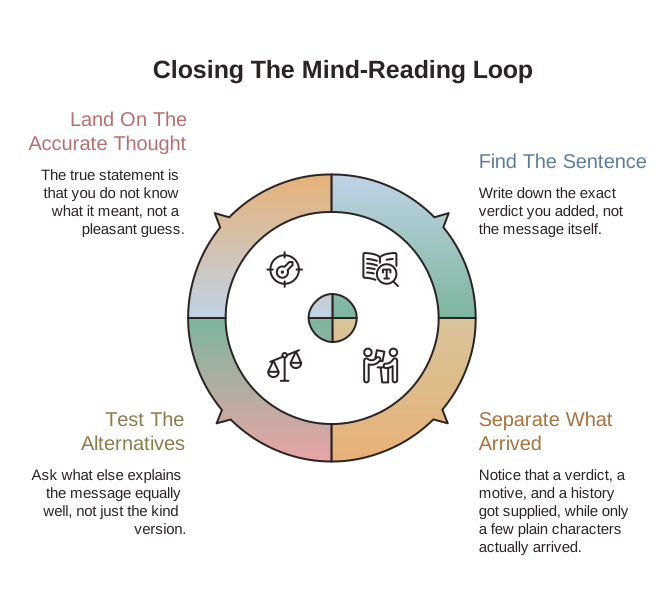
1. Find the sentence you added. Not the message — your line. "They're annoyed." "I've messed something up." "They've gone off me." Write it down exactly. You cannot examine a mood, but you can examine a sentence.
2. Separate what arrived from what you supplied. What arrived: two characters. What you supplied: a verdict, a motive, and a history. Seeing the ratio in writing does most of the work.
3. Ask what else explains it equally well. Not "what's the nice version?" — what's the equally likely version? Busy. On mobile. Between meetings. Answering while walking. If three explanations fit the same two characters, you don't have evidence. You have a preference for the worst one.
4. Land on the accurate thought, not the pleasant one. The reframe isn't "they think I'm great." It's "I don't know what that meant, and I'm treating a guess like a fact." That's not a consolation prize. It's the true statement — and it's the one that gives you your evening back, because you can't keep prosecuting a case you've admitted you have no evidence for.
If the loop tends to keep running after the moment has passed, that's the same machinery as replaying conversations — the brain filing an ordinary interaction as unresolved and reopening it on a schedule.
And if messages are only one of the places this happens, it's worth knowing which kind of work anxiety you actually run. The free work anxiety quiz sorts it into one of four — Mind Reader, Fortune Teller, Catastrophizer or Overfunctioner — in about two minutes, no email. Reading into your manager's tone is the Mind Reader almost by definition.
Sometimes the tone is real
This matters, so it's not a footnote.
Everything above assumes an ambiguous message from an ordinary manager having an ordinary week. That's most messages. It is not all of them. Some managers are genuinely dismissive, some are hostile, and some workplaces are actually unsafe — and a person in that situation reading "you're just mind-reading" is being handed a very sophisticated way to doubt themselves.
So be precise about what a reframe is for. It tests whether a thought is accurate — not whether it's comfortable. Sometimes you run the check and the thought survives: the pattern is real, it's repeated, other people have noticed it too. That's not a distortion. That's data, and the response to data is documentation, a conversation, HR, or an exit — not a better attitude.
The distinction is usually clear once you look. A distortion is a verdict built from two characters. A real problem is a pattern built from months. If it's the second one, the thinking isn't the thing that needs fixing.
The takeaway
A short message from your manager is an empty container, and your brain hates empty containers. It'll fill one in under a second, hand you the result as a fact, and then spend your evening defending it.
You don't need to decide they're pleased with you. You just need to notice that you made the tone up — and that the two characters on your screen never actually said anything. That's a smaller job than winning the argument, and unlike the argument, it ends.
Frequently asked questions
Why do I overthink messages from my manager?
Text has no tone. Your brain fills the missing information with a guess, and under any kind of stakes that guess skews negative — a phenomenon called negativity bias. A three-word reply from someone who controls your workload is maximally ambiguous and maximally consequential, which is exactly the combination that produces a spiral. It isn't oversensitivity; it's an ambiguity your brain refuses to leave open.
What does it mean when your boss sends a short message?
Almost always: they were busy. Brevity correlates with calendar pressure far more than with disapproval. The people who send the shortest messages are usually the ones with the most messages to send. That's not a comforting story invented to calm you down — it's the more probable explanation, and probability is what you should be reasoning from.
How do I stop reading into my boss's tone?
Catch the specific sentence you added — not the message, the verdict. "They're annoyed with me." Then ask what would have to be true for that to be the best explanation, and what else would explain it equally well. The goal is not to conclude they're happy with you. It's to notice you don't actually know, which is the accurate position and, oddly, the one that lets you go back to work.
Is overthinking work messages a sign of anxiety?
It's a common feature of anxiety at work, and it's also just common. It becomes worth addressing when the loop outlives the trigger: you've reread the message eleven times, you're drafting replies at 11pm, or a two-line Slack message has reorganised your evening. That's the pattern to interrupt, not the initial flinch.
What if my manager actually is being hostile?
Then the thought is accurate and the answer isn't a reframe — it's evidence, documentation, HR, or an exit. Reframing tests whether a thought is true; it does not require you to conclude that everything is fine. If a pattern of dismissiveness is real and repeated, the problem is the environment, and treating it as a thinking error would be the actual distortion.
Like what you're reading?
Continue your wellness journey
Reframe negative thoughts in 60 seconds — free to start in the MindLift app.


Free to start · no account required
CBT & Self-Talk Researchers
MindLift content is grounded in cognitive behavioral therapy principles and designed to help you shift harsh self-talk in real time. Our guides focus on practical, evidence-based techniques you can use in the moment.
Was this article helpful?