
Turn this into a daily habit — free to start in the MindLift app:
"Quick chat later?"
No agenda. No context. Four hours away. And your entire day just quietly ended — you're still at your desk, still typing, but nothing is going in. You're in the meeting already. You've been in it eleven times, and it's gone badly in nine of them.
Why does a meeting invite with no agenda cause so much anxiety?
Because it's an unanswerable question with real stakes. Your brain won't leave the gap empty, so it generates content — and under stakes, generated content skews bad. That's fortune-telling: predicting a specific outcome you have no data on, then feeling it as though it already happened. The dread isn't about the meeting. It's about the four hours before it, which is the only part imagination can reach.
The invite is a container, not a message
"Quick chat" tells you nothing. That's not a mistake by your manager — it's what a person types between two other meetings. But an empty invite with your job attached is exactly the shape your brain can't leave alone: consequential and unspecified.
So it specifies. It doesn't roll a fair die, either. It produces the version you most need to be ready for, on the reasonable-sounding logic that being ready for the worst is responsible. Which is how you end up rehearsing a firing for a conversation that turns out to be about the Q3 timeline.
The distortion has a name: fortune-telling
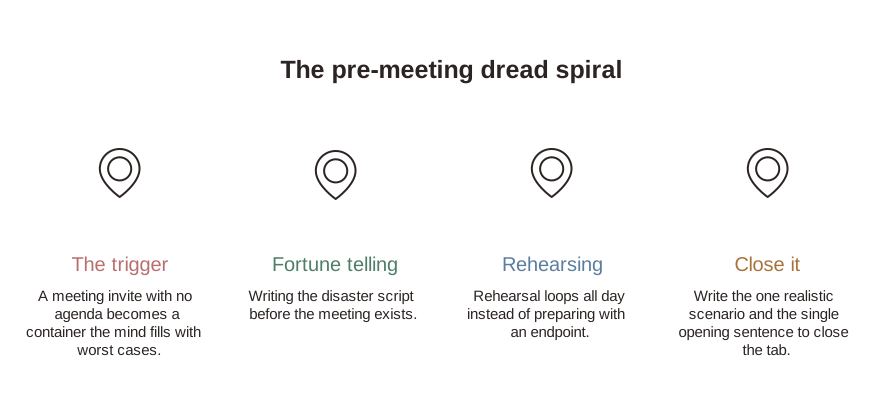
Fortune-telling is predicting the future and treating the prediction as information. The tell is the grammar. The thought doesn't arrive as "one possibility is…" — it arrives as "they're going to say my work isn't good enough." Flat. Declarative. Already true.
And your body doesn't distinguish. It runs the stress response for the imagined version at roughly the fidelity of the real one, which is why you arrive at a fifteen-minute meeting already exhausted. You've sat through it fifteen times. The version in the room is the sixteenth, and it's the only one that ever existed.
That's the cruel arithmetic of anticipatory anxiety: it charges you in full for events that mostly never happen, and it charges in advance.
Rehearsing is not preparing
This is the distinction that gets lost, because both feel like diligence.
Preparing produces something and stops. A number you might be asked for. Two bullet points. One question you actually want answered. It has an endpoint, and you can tell when you've reached it.
Rehearsing produces nothing and doesn't stop. You run the conversation, they say the bad thing, you draft a response, you improve the response, you run it again with a worse opening. There's no endpoint because it isn't seeking an answer — it's seeking certainty, and certainty about a conversation that hasn't happened isn't on offer at any price.
The honest test: has the last twenty minutes produced anything I could write down? If not, you're not preparing. You're paying for the meeting early.
How to close it before it eats the day
1. Say the prediction out loud, in full. Not "I'm anxious about the 1:1" — "they're going to tell me I'm underperforming and start a process." Vague dread is unarguable. A specific forecast can be checked.
2. Ask what the invite actually supports. Four words and a calendar slot. What percentage of quick chats in your working life have been bad news? Not how many felt like they might be — how many were. The honest number is usually small enough to be embarrassing.
3. Answer the question instead of arguing with it. The loop needs the question open. So close it: if it is the bad thing, what do I actually do? Once, concretely. Listen, ask for specifics, ask what good looks like, ask for it in writing. You'll notice you can answer that in about a minute — and that the loop had no interest in the answer, only in the asking.
4. Land on the accurate thought. Not "it'll be fine" — you don't know that either, and your brain will reject it on sight. The true one is smaller: "I don't know what this is, and I'm rehearsing a version I invented." That's the statement that holds up, which is why it's the one that works.
When the dread is information
One caveat, and it's not a small one.
If a 1:1 with a particular manager reliably is bad news — if the pattern is real, repeated, and other people have noticed — then the dread isn't a distortion. It's an accurate forecast from good data, and reframing it would just be talking yourself out of something you correctly detected.
A reframe checks whether a thought is accurate. Sometimes it is. The difference is usually visible: fortune-telling is a verdict built from four words on a calendar; a real read is a pattern built from months of consistent evidence. If it's the second, the thing to change isn't your thinking.
The takeaway
The meeting will take fifteen minutes. The version in your head has already taken four hours and it hasn't happened once.
If meetings are your specific trigger — rather than emails, or deadlines, or being perceived at all — that's worth knowing precisely. The free work anxiety quiz names the pattern driving it — Mind Reader, Fortune Teller, Catastrophizer or Overfunctioner — in about two minutes, no email. Rehearsing a meeting that hasn't happened is the Fortune Teller's whole move.
You're not being careful. You're being charged in advance for an event that mostly doesn't arrive — and the only thing rehearsal reliably changes is how tired you are when you walk in. If this dread shows up on Sundays rather than before meetings, it's the same machinery on a longer timer: the Sunday version runs on exactly the same fuel.
Frequently asked questions
Why do I get anxious before a 1:1 with my manager?
Because a calendar invite with no agenda is an unanswerable question with real stakes attached. Your brain treats the ambiguity as a problem to solve, and since it has no information, it generates some — usually the worst plausible version. The anxiety isn't about the meeting. It's about the gap between now and the meeting, which is the only part you can fill with imagination.
What does it mean when your boss schedules a "quick chat" with no agenda?
Statistically: almost nothing. Managers schedule quick chats to ask about timelines, hand you work, share context, or because they saw a free slot. Bad news is a small fraction of the total, and it usually arrives with more warning, not less. The invite feels ominous because it's empty — and you're the one filling it.
How do I stop spiraling before a meeting?
Catch the specific prediction — "they're going to tell me my work isn't good enough" — and notice it's a forecast, not a fact. Then ask what you would actually do if it happened, once, concretely. Fortune-telling loses its grip when you answer it rather than argue with it, because the loop runs on the question staying open.
Is rehearsing a meeting in my head helpful?
Preparing is; rehearsing isn't. The difference is output. Preparing produces something — notes, a number, one question you want answered — and then it stops. Rehearsing produces nothing and doesn't stop, because it isn't trying to reach an answer. It's trying to reach certainty, which isn't available, so it just runs.
What if the meeting actually is bad news?
Then you'll handle it in the room, with the actual information, which is a completely different task from handling fifteen imagined versions in advance. And if 1:1s with a particular manager reliably are bad news, that's not anxiety — that's a pattern telling you something real about the job.
Like what you're reading?
Continue your wellness journey
Reframe negative thoughts in 60 seconds — free to start in the MindLift app.


Free to start · premium optional