Turn this into a daily habit — free to start in the MindLift app:
Twelve male archetypes, what each one actually sounds like from the inside, and a free quiz that names yours in about five minutes. No email, no signup, result on the page.
What are the 12 male archetypes?
King, Warrior, Protector, Sage, Magician, Creator, Lover, Caregiver, Jester, Rebel, Explorer, and Hero. They group into four families — King (organises and defends), Sage (understands and builds), Lover (connects and attunes), and Rebel (breaks out and proves). Each is a default way of reading pressure, not a personality type. The free quiz finds your family first, then names one of the twelve.
What the 12 male archetypes actually are
Not personality types. Not a diagnosis. An archetype is the default interpretation your brain reaches for when something goes wrong — the thing it decides the situation means, before you've consciously decided anything.
That distinction matters, because it's what separates this from the version of archetype content that tells you to find your type and then become it harder. A default can be examined. An identity just gets defended.
Group 1 — King energy: King, Warrior, Protector
The family that organises and defends. These men move toward responsibility rather than away from it, and they're usually the reason a thing holds together.
The King — order, responsibility, stewardship. Builds structure and absorbs the pressure so the people inside it get to feel safe. Inner voice: "It's on me." His shadow is control that hardens into distance: a kingdom nobody can enter.
The Warrior — discipline, drive, advancing through resistance. Treats obstacles as information about effort. Inner voice: "Push through." His shadow turns the engine on himself, and it has no idle setting.
The Protector — vigilance, loyalty, holding the line. Sees the threat before anyone else does. Inner voice: "Not on my watch." His shadow never files an all-clear, because a mind scanning for danger always finds some.
Group 2 — Sage energy: Sage, Magician, Creator
The family that understands and builds. These men need to know how the thing works before they trust it — and often before they'll touch it.
The Sage — wisdom, depth, seeing beneath the surface. Inner voice: "Think it through." His shadow is understanding as a substitute for acting: the most insightful man in his own waiting room.
The Magician — transformation, mastery, making the impossible practical. Inner voice: "There's a way." His shadow can't accept that some things don't move, so acceptance starts to feel like failure.
The Creator — craft, vision, building what he imagines. Inner voice: "Build it better." His shadow is the gap between what he made and what he pictured — always open, which is why finishing never lands.
Group 3 — Lover energy: Lover, Caregiver, Jester
The family that connects and attunes. These men read rooms, and the reading is usually accurate — right up until it becomes certainty.
The Lover — depth, devotion, feeling life at full volume. Inner voice: "Stay close." His shadow builds a verdict out of a half-second: the flicker he caught means what he fears it means.
The Caregiver — steadiness, generosity, showing up every time. Inner voice: "They need me." His shadow keeps a ledger nobody else knows exists, and being needed becomes the safest way to be close without being known.
The Jester — levity, timing, lightness in heavy rooms. Inner voice: "Keep it light." His shadow gets the joke out half a second before the feeling arrives, every time, so nothing ever gets bad enough to mention.
Group 4 — Rebel energy: Rebel, Explorer, Hero
The family that breaks out and proves. These men need the exit to exist, even when they don't take it.
The Rebel — autonomy, edge, answering to himself. Inner voice: "Says who?" His shadow has two settings, because accepting help reads as being controlled.
The Explorer — momentum, curiosity, the edge of the map. Inner voice: "What's next?" His shadow is certain the next thing will feel different, which is how momentum becomes motion.
The Hero — courage, proof, rising to the moment. Inner voice: "Prove it." His shadow quietly concluded that rising is the only reason he counts, so the scoreboard resets every morning.
Where King, Warrior, Magician and Lover fit
If you've met archetypes before, you've met four of these. King, Warrior, Magician and Lover come from the Moore–Gillette model of the mature masculine, and they're the reason most men have heard of the idea at all.
All four are here. The twelve don't replace that model — they give it resolution. Four categories put very different men in the same box: the Warrior and the Protector are both "King energy" and they are not the same man, and neither is the Creator and the Sage. The families preserve the original logic; the twelve let you find yourself inside it.
How the free quiz works
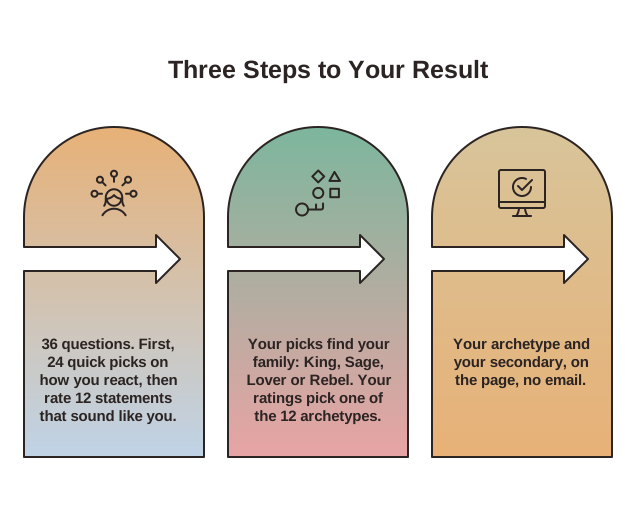
Thirty-six questions in two stages, about how you actually respond when something goes wrong — not how you'd like to respond, and not which archetype sounds best. That distinction is the entire point, because men reliably pick the archetype they admire over the one they run. Reading a list and choosing tells you about your aspirations. The quiz asks about your defaults.
The first 24 questions find your family — King, Sage, Lover or Rebel. The last 12 are statements you rate, and the highest-rated one inside your family is your archetype, one of the twelve. Separating King from Warrior from Protector takes that second stage, which is why the quiz takes about five minutes rather than two. The guides show you what each of the twelve looks like from the inside.
Take the free male archetypes quiz → No email. No signup. Result on the page.
What to do with your result
A type is a nice thing to know and a useless thing to own. Here's the part that does something.
Find your default distortion. Each archetype leans on a specific thinking error under stress — the King on personalization, the Warrior on should statements, the Protector on catastrophizing, the Hero on labeling. All 12 inner-voice patterns maps each one, and that mapping is the useful output: it tells you what to check first when your head gets loud.
Meet the version of you that shows up when threatened. The shadow side of your archetype covers what each one becomes under pressure — the King becomes the Fortress, the Jester becomes the Deflector — and the single sentence holding each in place.
Then work the sentence, not the identity. This is where MindLift comes in: you type the actual line your archetype runs — "it's on me", "I should be handling this better" — and get three structured reframes in about 60 seconds, each tagged with the distortion underneath it. Free to start.
Is this real psychology?
Half of it. The archetype framework is Jungian in origin: descriptive, useful, and not a clinical instrument. Nobody should tell you your archetype is a test result, because it isn't one.
What is evidence-based is the second half — the cognitive distortions each archetype defaults to, and the cognitive restructuring used to work on them. That has decades of controlled trials behind it. So take the archetype as a map of your own self-talk, and take the reframing seriously. In that order.
Explore the rest
The free quiz names your family. The male archetypes hub has all twelve in depth. The inner-voice guide maps each to its distortion, and the shadow guide covers what each becomes when it's threatened.
You are not your archetype. You're the one who noticed it — and that's the whole opening.
Frequently asked questions
Is the male archetypes quiz really free?
Yes. No email, no signup, no paywall, no results held back. You answer the questions and get your result immediately on the page. MindLift is free to start, with a premium tier — but nothing about this quiz is gated.
What are the 12 male archetypes?
King, Warrior, Protector, Sage, Magician, Creator, Lover, Caregiver, Jester, and Rebel, Explorer, Hero. Each describes a recurring pattern of motivation and self-talk — a default way of reading pressure — rather than a personality type or a fixed identity.
Does the quiz give one of 12 results or just 4?
One of twelve. The quiz has 36 questions in two stages: the first 24 find your family — King, Sage, Lover or Rebel — and the last 12 are statements you rate, which pick your archetype from the three inside that family. The King family covers King, Warrior and Protector, so the second stage is what tells those three apart.
How is this different from King, Warrior, Magician, Lover?
It extends it. All four Moore–Gillette archetypes are here, and the four families keep their logic — but four categories put very different men in one box. The King family covers King, Warrior and Protector; Sage covers Sage, Magician and Creator; Lover covers Lover, Caregiver and Jester; Rebel covers Rebel, Explorer and Hero.
Can your male archetype change over time?
The default tends to be stable; what it does isn't. An archetype isn't a cage — it's the interpretation your brain reaches for first under pressure. What changes with practice is the distortion riding on it: the Warrior keeps the drive and drops the should, the Hero keeps the courage and stops grading his worth on it.
Is this based on real psychology?
The archetype framework is Jungian in origin — descriptive rather than diagnostic, and not a clinical instrument. What's evidence-based is the second half: the cognitive distortions each archetype defaults to, and the cognitive restructuring used to work on them. Treat the archetype as a useful map of your self-talk, not a test result.
Like what you're reading?
Accelerate your growth journey
Reframe the patterns that hold you back — and watch your Top Pattern change over time.


Free to start · no account required
- Jung CG (1959). The Archetypes and the Collective Unconscious (Collected Works, Vol. 9, Part 1). Princeton University Press (Bollingen Series XX).
- Moore R, Gillette D (1990). King, Warrior, Magician, Lover: Rediscovering the Archetypes of the Mature Masculine. HarperSanFrancisco.
- Beck AT (1963). Thinking and Depression. Archives of General Psychiatry. — DOI (opens in a new tab)
- Hofmann SG et al. (2012). The Efficacy of Cognitive Behavioral Therapy: A Review of Meta-analyses. Cognitive Therapy and Research. — DOI (opens in a new tab)
Mental Wellness Writers
The MindLift Wellness Team writes evidence-based content on CBT, self-talk, and everyday mental health tools.
Was this article helpful?