Turn this into a daily habit — free to start in the MindLift app:
You know what you're good at. The thing people rely on you for — the steadiness, the drive, the read on the room, the ability to make something out of nothing.
Do you know what that becomes when you're threatened?
Most writing about the masculine shadow describes a monster: some suppressed brute to confront in a dark corner of yourself. That framing is useless, and it's wrong in a specific way that matters.
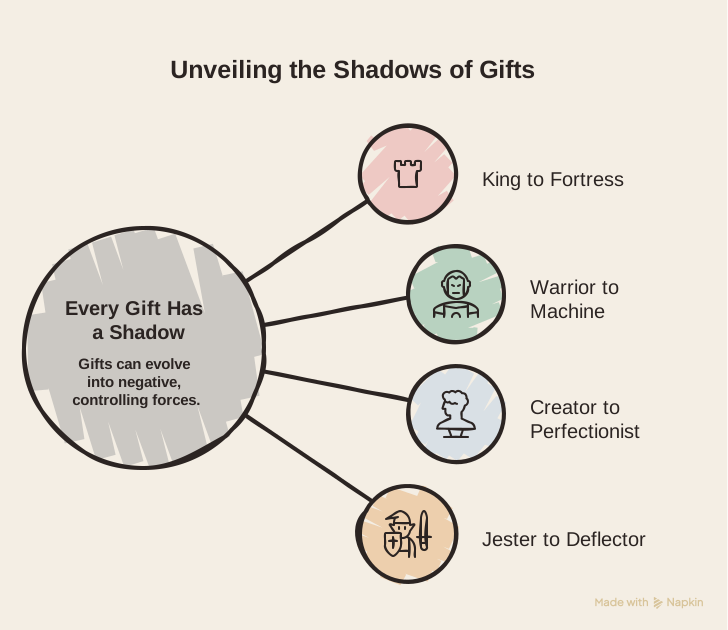
Your shadow isn't a separate half of you. It's your best quality with the volume stuck on. The Protector who spots the threat early is running the same machinery as catastrophizing. The Creator who sees the gap between the work and the vision is running the machinery of never being able to finish. Nothing foreign got in. The thing that makes you good at this simply stopped having a limit.
Which explains why it's so hard to see from the inside. The shadow doesn't announce itself as a problem — it feels like your integrity. Questioning it feels like being asked to be worse at the one thing you're reliably good at, so you don't question it. You defend it.
How to read this
Each of the twelve below has the same structure: what he looks like at his best, what the shadow does, the single sentence holding it in place, what sets it off, and the way back.
Pay attention to the sentence. That's not decoration — it's the whole mechanism. Shadows don't run on vague feelings; they run on specific, repeated, unexamined lines, which is exactly what makes them catchable. If you don't know your archetype yet, the free male archetypes quiz is about five minutes and no email, or read all 12 inner-voice patterns first.
The King
The King carries authority that other people organise themselves around, and his shadow is the Fortress — the version of him convinced that it is all on him, and that letting go of any of it means the whole thing drops.
At his best: Steady authority. The one people look to when things need to hold.
His Shadow: The Fortress
The King's shadow doesn't get loud. It gets cold. Under pressure he becomes more decisive, more capable, more thoroughly in control — and completely unreachable. He hasn't stopped providing. He's stopped being a person anyone can get to.
In his shadow he:
- Absorbs every problem rather than distributing any of it
- Reads rest as negligence and asking for help as abdication
- Answers "how are you" with a status update on other people
- Gets colder as the stakes rise, and calls it composure
The thought underneath:
“It's on me. If I let go of any of it, it drops.”
What sets it off: Anything that suggests the structure might not hold without him — a missed deadline, a mistake he didn't catch, someone else being trusted with something.
The way back: Hand someone a real piece of the weight, not the scraps, and let it be done differently than you'd do it. Then ask the question the fortress can't: "is this mine to carry, or is being needed just safer than being known?"
The Warrior
The Warrior is built to push straight through resistance, and his shadow is the Machine — the version of him that turns that engine inward, insisting he should be handling this better and should have been further along by now.
At his best: Drive that moves through resistance instead of around it.
His Shadow: The Machine
The Warrior's shadow treats every signal from his own body and mind as an obstacle to override. Tiredness is weakness. Doubt is weakness. The engine that got him through hard things starts running on him instead of for him, and it does not have an idle setting.
In his shadow he:
- Reads every limit as a personal failure of will
- Speaks to himself in a register he'd never use on anyone else
- Confuses being exhausted with being committed
- Cannot rest without a justification for the rest
The thought underneath:
“I should be handling this better. I should be further along by now.”
What sets it off: Falling short of a standard nobody set but him — a slower week, a bad session, being outperformed by someone he respects.
The way back: Catch the word should. It isn't a plan; it's a way of hitting yourself with a standard you never agreed to. Swap it for "what does this actually need?" Drive aimed at a real target compounds. Drive aimed at yourself just erodes.
The Protector
The Protector spots danger before anyone else does and puts himself in its path, and his shadow is the Sentry — the version of him that never files an all-clear, certain that the moment he stops watching is exactly when it happens.
At his best: Sees the threat early and stands in front of it.
His Shadow: The Sentry
The Protector's shadow never files an all-clear. His value is spotting danger before it arrives, so his brain is rewarded for running worst-case scenarios — and a mind scanning for danger always finds some. He isn't paranoid. He's on a watch that never ends because he never scheduled the end.
In his shadow he:
- Runs disaster scenarios and mistakes them for planning
- Reads ordinary ambiguity — a short reply, a quiet room — as a warning sign
- Can't enjoy a good stretch because he's scanning it for the catch
- Protects people from information they could handle
The thought underneath:
“If I stop watching, that's exactly when it happens.”
What sets it off: Calm. Genuinely — the shadow gets loudest when nothing is wrong, because unexplained quiet reads as the setup rather than the reprieve.
The way back: Move from "what if it all goes wrong" to "what's actually likely, and what would I do?" Answer it once, concretely. Vigilance with an off-switch is protection. Without one it's just fear doing overtime in a uniform.
The Sage
The Sage reads what sits under the surface of a situation and names it plainly, and his shadow is the Observer — the version of him who understands everything and does nothing, always needing to think about it a little longer before he acts.
At his best: Sees beneath the surface and says the true thing.
His Shadow: The Observer
The Sage's shadow understands everything and does nothing. Thinking feels like progress because it's effortful, so he keeps going — but past a point, more analysis stops producing new information and just produces more analysis. He has become the most insightful person in his own waiting room.
In his shadow he:
- Researches instead of deciding, and calls it diligence
- Understands the problem far better than anyone acting on it
- Watches his own life from a slight distance, with commentary
- Uses complexity as a reason not to move yet
The thought underneath:
“I need to think about this more before I act.”
What sets it off: A decision with genuine stakes and no clean answer — exactly the conditions where thinking feels safest and helps least.
The way back: Ask: "what would I do if I already understood it?" Then do that. Depth is a tool. It was never meant to be a waiting room.
The Magician
The Magician's gift is finding the angle everyone else missed, and his shadow is the Operator — the version of him who cannot stop working the problem, holding on to the belief that there is a way and he simply has not found it yet.
At his best: Finds the lever nobody else spotted.
His Shadow: The Operator
The Magician's shadow can't accept that some things don't move. He's solved enough impossible problems to believe every problem has an angle — so when something won't budge, the conclusion is never "this is outside my control," it's "I haven't found it yet." Which means he can spend years working a lever that isn't attached to anything.
In his shadow he:
- Treats acceptance as a failure of imagination
- Optimises situations that needed leaving, not fixing
- Manages people's reactions instead of telling them things
- Exhausts himself on outcomes that were never his to determine
The thought underneath:
“There's a way. I just haven't found it yet.”
What sets it off: Anything genuinely outside his control — someone else's choice, an illness, a market, a person who doesn't want to change.
The way back: Ask "is this mine to move?" before asking how to move it. Mastery includes knowing what doesn't respond to mastery — and that isn't giving up, it's aiming.
The Creator
The Creator makes real what he pictured and holds it to a standard nobody else required, and his shadow is the Perfectionist — the version of him for whom the work is never good enough yet, because anything less than right reflects back on him.
At his best: Builds the thing he pictured, to a standard nobody asked for.
His Shadow: The Perfectionist
The Creator's shadow can't finish, because he can always see the gap between what he made and what he pictured. That gap is the engine of his craft — and it's also why nothing he ships ever lands. The work goes out, people respond, and he's already looking at the flaw only he can see.
In his shadow he:
- Reworks past the point of improvement, into avoidance
- Hears praise as evidence they haven't looked closely
- Won't show anything until it can't be criticised
- Feels nothing on delivery except relief that it's over
The thought underneath:
“It's not good enough yet. If it isn't right, it reflects on me.”
What sets it off: Being seen — a launch, a review, a deadline that forces the work out before he's finished hiding its seams.
The way back: Both things are true: it could be better, and it's good. Only one of them ever gets said out loud. Say the other one, out loud, once, and notice nothing bad happens.
The Lover
The Lover takes in the full weight of a relationship and does not leave, and his shadow is the Reader — the version of him who scans every pause and short reply for evidence that something has changed and someone has gone quiet on him.
At his best: Feels it all and stays anyway.
His Shadow: The Reader
The Lover's shadow builds whole verdicts out of half-seconds. He reads a room faster than anyone in it — tone, pause, the beat before a reply — and that sensitivity is real. It's also why a short text can reorganise his evening. He isn't imagining the flicker. He's certain about what it meant.
In his shadow he:
- Interprets tone and treats the interpretation as reported speech
- Replays conversations looking for the moment it turned
- Adjusts himself constantly to manage how he's landing
- Asks for reassurance in ways that don't look like asking
The thought underneath:
“Something's changed. They've gone quiet on me.”
What sets it off: Ambiguity from someone who matters — a delayed reply, a flatter tone, a plan that moved.
The way back: Move from "they've gone quiet on me" to "I noticed something and I don't know what it means yet." Attunement is a gift. Certainty about other people's heads is a guess wearing the gift's clothes.
The Caregiver
The Caregiver is reliably there before anyone thinks to ask, and his shadow is the Ledger — the version of him who keeps a running account of everything he gives, and feels the debt of it whenever the giving is not returned.
At his best: Shows up every time, without being asked.
His Shadow: The Ledger
The Caregiver's shadow keeps an account nobody else knows exists. He gives, genuinely — and quietly logs it. When it doesn't come back the hurt has nowhere to go, because naming it would expose a deal he never told anyone he'd made. Being needed also turns out to be the safest way to be close without being known.
In his shadow he:
- Says yes when the honest answer was no, then resents the yes
- Feels owed, and can't say so without it sounding petty
- Makes himself indispensable rather than close
- Has no idea what he wants, having never had to know
The thought underneath:
“After everything I do for them.”
What sets it off: Giving without acknowledgement — or worse, someone giving to him, which the ledger has no column for.
The way back: Swap the ledger for a sentence: "I want this, and I can ask." Generosity you can't say no to isn't generosity. It's an invoice with better manners.
The Jester
The Jester can lift a hard room without shrinking what is happening in it, and his shadow is the Deflector — the version of him who keeps everything light on principle, because he has decided nobody actually wants the real version of him.
At his best: Makes a heavy room lighter without making it smaller.
His Shadow: The Deflector
The Jester's shadow gets the joke out half a second before the feeling arrives. Every time. The timing is genuine skill and it's also a door closing — nothing ever gets bad enough to mention, because the bit lands first and everyone moves on. Including him. Especially him.
In his shadow he:
- Makes the joke precisely where the honest answer went
- Is everyone's good time and nobody's close friend
- Says "it's not a big deal" reflexively, before checking
- Is the last person anyone would think to ask if he's okay
The thought underneath:
“Keep it light. Nobody wants the real version.”
What sets it off: Sincerity aimed at him — a direct question, a silence that wants filling with something true.
The way back: Try: "it's not a big deal, and it's bothering me." Both clauses. The room does not need saving from you being serious for one minute.
The Rebel
The Rebel keeps his own counsel and says the thing everyone else is avoiding, and his shadow is the Contrarian — the version of him who pushes back on reflex rather than on judgement, because nobody gets to tell him what to do.
At his best: Answers to himself and tells the truth nobody wanted said.
His Shadow: The Contrarian
The Rebel's shadow has only two settings. If accepting help means being controlled, then every offer is a threat and there's no middle — so autonomy stops being something he has and becomes something he defends, full-time, against people who weren't attacking it.
In his shadow he:
- Refuses good advice because of who it came from
- Reads structure as a cage and support as a leash
- Fights battles nobody scheduled with him
- Confuses being unreachable with being free
The thought underneath:
“Says who? Nobody tells me what to do.”
What sets it off: Being told — instruction, expectation, or anyone assuming a claim on how he does things.
The way back: Move from "nobody tells me" to "whose call is this, actually?" Sometimes it's theirs and that's fine. Autonomy you have to defend constantly isn't autonomy — it's a fight you scheduled with yourself.
The Explorer
The Explorer heads for unfamiliar ground and comes back with what he found, and his shadow is the Departer — the version of him already asking what is next, convinced that whatever he is standing in right now is not it.
At his best: Goes to the edge of the map and reports back.
His Shadow: The Departer
The Explorer's shadow is certain the next one will feel different — the next city, role, relationship, version of his life. And it does, for a while. He reads his own restlessness as curiosity, which is flattering and mostly wrong: he isn't moving toward the edge so much as away from the room.
In his shadow he:
- Leaves at the exact moment things get real rather than exciting
- Has a rich history of beginnings
- Treats staying as a failure of nerve
- Never finds out what was on the other side of the boring part
The thought underneath:
“What's next? This isn't it.”
What sets it off: The plateau — the ordinary, unglamorous middle where the novelty has gone and only the thing itself is left.
The way back: Ask "what's here that I haven't looked at?" before asking what's next. Some things only open up on the other side of not leaving.
The Hero
The Hero shows up at the moments that matter, and they come around often, and his shadow is the Scoreboard — the version of him who reads a single failure as a verdict on the man, and then has to prove it wrong all over again.
At his best: Rises when it counts, and it counts often.
His Shadow: The Scoreboard
The Hero's shadow has quietly concluded that rising when it counts is the only reason he counts. So there's no floor. A bad quarter isn't a bad quarter, it's a verdict — and the scoreboard resets every morning, which means yesterday's proof buys him nothing today.
In his shadow he:
- Collapses a performance into an identity, every time
- Cannot accept help, because help means the win wasn't his
- Needs a crisis to feel legitimate, and finds one
- Is nobody without the result, and knows it
The thought underneath:
“I failed, so I'm a failure. Prove it again.”
What sets it off: Falling short in public — or a stretch of ordinary time where there's nothing to rise to and therefore nothing holding him up.
The way back: Separate the two sentences: "that went badly" and "I am the same person." One is a result. The other is a verdict, and you handed it down yourself, without a hearing.
What to actually do with your shadow
Working with your shadow is four ordinary steps, none of them dramatic — notice that the sentence arrives as a fact rather than an opinion, name the distortion instead of the man, keep the strength while dropping the verdict attached to it, and expect repetition rather than insight to shift the default.
Not confront it. Not integrate it in some ceremonial sense. Catch the sentence.
1. Notice it arrives as a fact. "It's on me." "I should be further along." "Prove it again." None of these show up as opinions — they arrive in the same voice you'd use for the weather. That flat, declarative delivery is the tell. Real observations can be checked; these can't, because they were never claims about the world.
2. Name the distortion, not the character. "It's on me" is personalization. "I should be further along" is a should statement. "They've gone quiet on me" is mind-reading. Naming it does something oddly reliable: it converts the thought from something you're inside into something you're looking at. The names aren't new, either — Aaron Beck catalogued these distortions in 1963[1], and the list has held up for six decades.
3. Keep the strength. This is where most advice loses men, and deservedly. Telling the Warrior to stop pushing is telling him to be less himself, so he ignores it — correctly. The move was never to lose the drive. It's to aim it at something real instead of at yourself. The King keeps the responsibility and drops the fortress. The Creator keeps the standard and drops the verdict.
4. Expect it to take repetition, not insight. You will not read this and be finished. The sentence has been running unchallenged for years; catching it once changes nothing, and catching it a hundred times changes the default. That's not a motivational point — it's just how thought habits work, and anyone selling you a breakthrough is selling you something. The slow version is the evidenced one: a review of 269 meta-analyses found the strongest support for CBT — which is this exact catch-name-reframe loop — in anxiety, anger, and general stress problems[2].
The part worth keeping
Your shadow is not evidence that something is wrong with you. It's evidence that something is right with you, running without a governor.
The Fortress is a King who took the responsibility seriously. The Machine is a Warrior who never learned that the engine has an idle setting. The Deflector is a Jester who is very good at making rooms bearable and has never once let anyone make his bearable. Every one of them is a strength that stopped asking whether this was the moment for it.
You don't need to become someone else. You need to catch one sentence, tonight, and notice you made it up. That's a much smaller job than becoming a different man — and unlike that one, it's actually available.
Frequently asked questions
What is the shadow side of a male archetype?
It isn't a hidden dark half or a separate personality. The shadow is the same strength running without a limit: the Protector's early threat-detection becomes catastrophizing, the Creator's standards become an inability to register that anything is finished, the King's responsibility becomes carrying what was never his. That's why it's hard to see from inside — it doesn't feel like a flaw, it feels like the thing you're best at.
What triggers a male archetype shadow?
Threat, specifically the kind aimed at what the archetype is built to provide. The King's shadow activates when the structure looks like it might not hold. The Hero's activates when there's nothing to rise to. The Explorer's activates at the plateau. That's the cruel timing: the shadow shows up exactly when you have least capacity to notice it.
Is shadow work the same as Jungian shadow work?
It shares the vocabulary. The difference here is the method: rather than excavating the unconscious, this treats each shadow as a specific, catchable thought — "it's on me", "I should be further along", "prove it again" — and applies cognitive restructuring to it. Same map, different tool: a sentence you can examine tonight rather than material you dig for over years.
Can you get rid of your shadow?
No, and you wouldn't want to — you'd be removing the strength it's made of. The Warrior without drive isn't integrated, he's flattened. What changes is the distortion riding on the strength: the Warrior keeps the drive and drops the should. That's integration, and it's ordinary, repetitive work rather than a breakthrough.
How do I find out which male archetype I am?
Reading the twelve and picking the one you like is the wrong method — men reliably choose the archetype they admire over the one they run. The free male archetypes quiz asks how you actually respond when something goes wrong, takes a few minutes, and needs no email.
Like what you're reading?
Accelerate your growth journey
Reframe the patterns that hold you back — and watch your Top Pattern change over time.


Free to start · no account required
- Beck, A. T. (1963). Thinking and depression: I. Idiosyncratic content and cognitive distortions. Archives of General Psychiatry, 9(4), 324–333. — DOI (opens in a new tab)
- Hofmann, S. G., Asnaani, A., Vonk, I. J. J., Sawyer, A. T., & Fang, A. (2012). The efficacy of cognitive behavioral therapy: A review of meta-analyses. Cognitive Therapy and Research, 36(5), 427–440. — DOI (opens in a new tab)
CBT & Self-Talk Researchers
MindLift content is grounded in cognitive behavioral therapy principles and designed to help you shift harsh self-talk in real time. Our guides focus on practical, evidence-based techniques you can use in the moment.
Was this article helpful?