
Turn this into a daily habit — free to start in the MindLift app:
You took an archetype quiz. It said King, or Warrior, or — if the quiz was feeling generous — Magician. And the next thought arrived on schedule: okay, but how many other guys got that?
Fair question. Here is the honest answer most archetype sites will not give you, followed by the useful one they cannot.
First, the honest part: the percentages are fiction
If you have seen a chart claiming “only 3% of men are the Magician” or “12% of men are Kings,” you have seen a number someone typed because it looked good. No archetype quiz operates at anything close to census scale. None publish audited distributions. The decimal points are set dressing.
We are in a position to say this bluntly because we know exactly what our own 12 male archetypes quiz can and cannot tell us. Your answers never leave your device; the quiz logs only an anonymous count of which result was shown, with no name, email, or cookie attached. That count comes only from people who chose to take our quiz, a self-selected sample, so it cannot tell you how rare any archetype is in the population. We could dress those counts up as a rarity table. Everyone else simply invented one. We would rather show you how to reason about rarity honestly, because the reasoning turns out to be more interesting than the fake numbers.
What actually makes an archetype rare
An archetype is a default pattern — the version of you that runs first under pressure. And defaults are trained. From roughly age five, male socialization rewards some patterns relentlessly (push through, stand guard, provide) and quietly starves others (make strange things, refuse the script, sit still long enough to see clearly).
So rarity has a logic to it: the more a pattern must override its training to exist, the rarer it is as a genuine default. That gives you a defensible ladder — tiers, not percentages. Here is the whole map before we walk it:
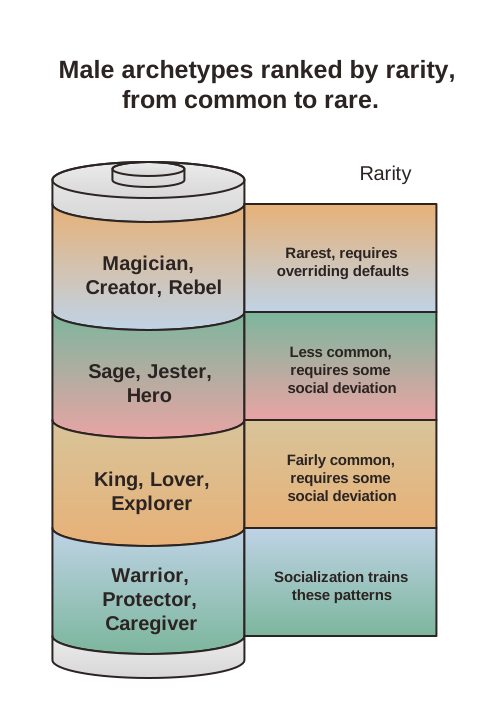
Tier 1 — Most common
The patterns modern life trains into most men
The Warrior, the Protector, and the Caregiver are common for a structural reason: they are the versions of masculinity that get rewarded earliest and most often. Boys are praised for pushing through, for standing guard, for holding it together while someone else falls apart. Run that reinforcement for thirty years and it becomes a default.
The Warrior
Drive and discipline are the most consistently rewarded male traits from the first report card onward. Most men have a Warrior circuit whether they chose it or not — the question is only whether it has an off switch.
The Protector
Vigilance on behalf of other people is the masculine role script in its purest form. It shows up everywhere because it is what most men were explicitly told they were for.
The Caregiver
Quieter than the Protector but nearly as common — the man who shows love through maintenance: fixing, driving, providing, remembering. Undercounted in every archetype conversation because it rarely announces itself.
Tier 2 — Fairly common
Defaults with a higher entry cost
The King, the Lover, and the Explorer are widespread but not universal, because each one requires something the culture distributes unevenly: authority that others actually grant, emotional access, or the freedom to keep moving.
The King
Plenty of men carry responsibility; fewer carry it as identity. The King pattern needs a domain — a family, a team, a company — and not every life hands one over.
The Lover
Depth and devotion as a primary pattern is more common than the stereotype suggests, but it competes with a lifetime of training to route feeling into doing.
The Explorer
The pull toward the next horizon is common in younger men and gets quietly traded away with each obligation. Its rarity rises with age — which tells you it is trainable in both directions.
Tier 3 — Less common
Patterns that need protected ground
The Sage, the Jester, and the Hero survive only where a man has carved out room for them — perspective takes distance, levity takes safety, proof-seeking takes a stage. Most environments quietly starve all three.
The Sage
Seeing the pattern under the noise requires stepping out of the noise, and most male lives are structured to prevent exactly that. The Sage as a genuine primary — not a persona — is uncommon.
The Jester
Reading a room and lifting it is a high-skill pattern hiding behind a low-status reputation. Fewer men lead with it than borrow it, because staying the funny one costs credibility they were told to protect.
The Hero
Doing the hard thing while others discuss it is celebrated everywhere and practiced rarely — because it requires volunteering for risk with no guarantee anyone records it.
Tier 4 — Rarest
Patterns that override the social defaults
The rarest archetypes are rare because each one, in a different way, requires disobedience: making something that did not exist, transforming instead of maintaining, or refusing the script outright. Nothing in the standard male curriculum teaches these. They persist despite it.
The Magician
Mastery deep enough to transform a situation — not manage it, transform it — takes years of unrewarded practice first. Most men are pulled off that path long before it pays.
The Creator
Craft and vision as a primary identity means tolerating a long stretch where the work is real and the validation is not. That filter removes most candidates.
The Rebel
Genuine pattern-breaking — not contrarianism, but paying the actual price of refusing the script — is the rarest position because it costs belonging, and belonging is the oldest currency there is.
Now the part that matters more than rarity
Notice what your brain did while reading that ladder. If your archetype landed in Tier 1, some part of you deflated — common, great, I'm a default setting. If it landed in Tier 4, something puffed up. Same information, and the feeling came entirely from the ranking instinct, not the content.
That instinct has a name. It is the comparison trap — the cognitive habit of converting every fact about yourself into a position on a leaderboard. It is the same circuit that turns a salary into a verdict and a group photo into an audit. Rarity-hunting is just the comparison trap wearing a Jung costume.
The truth the ladder actually contains: common patterns are common because they work. The Protector is everywhere because people need protecting. And rare patterns are rare because they are expensive, not because they are elite — the Rebel pays in belonging, the Creator pays in years of unvalidated work. Every tier has a bill.
The thought worth catching:
“My archetype is common, so there's nothing special about me.”
The reframe:
Common means load-bearing. The patterns most men share are the ones holding the most weight — the real question is what mine costs me when it runs unexamined.
The better question than “how rare am I?”
Every archetype — common or rare — has a shadow: the same strength running without a limit. The Warrior becomes the Machine. The King becomes the Fortress. The rarity tier changes nothing about that mechanism; a Tier 4 Creator burns out on the same schedule as a Tier 1 Warrior, just with better aesthetics.
So the sequence that actually pays off: find your default with the free quiz (36 questions, no email, and your answers never leave your device — the quiz only counts, anonymously, which result was shown). Then read what your archetype's shadow looks like and the exact sentence it repeats in your head. That sentence is the practical part — it is the thing you can catch and reframe while the rarity chart is still congratulating or insulting you.
And if you are curious how the ladder looks across the aisle: the female archetype rarity ladder runs on the same logic with a nearly inverted result — the patterns rare in men are not the ones rare in women, which is itself the strongest evidence that archetypes are trained, not issued.
The full framework, all twelve archetypes with gifts, shadows, and inner voices, lives on the male archetypes hub.
Frequently asked questions
What is the rarest male archetype?
Reasoning from how strongly each pattern is trained or suppressed by male socialization, the rarest male archetypes are the Magician, the Creator, and the Rebel — each requires overriding social defaults rather than following them. No quiz can honestly give you a percentage, because no archetype test publishes verifiable distribution data.
What is the most common male archetype?
No census of archetypes exists, so nobody can name the most common male archetype from data — including us. Reasoning from socialization instead, the strongest candidates are the Warrior, the Protector, and the Caregiver, because they are the patterns modern male socialization rewards earliest and most consistently: pushing through, standing guard, and showing love through providing. Treat that as an argument about training, not a measured frequency.
Are the rarity percentages I see on other sites real?
No. Claims like "only 3% of men are the Magician" have no published data behind them — no archetype quiz operates at census scale, and none publish audited distributions. MindLift's quiz never sends your answers anywhere; it logs only an anonymous count of which result was shown. That count covers only people who chose to take our quiz, so it cannot measure how common an archetype is in the population, and we will not invent those numbers. Rarity can be reasoned about; it cannot honestly be measured to a decimal.
Is a rare archetype better than a common one?
No — rarity is not rank. A common archetype like the Protector is common because it works and is needed. Wanting a rarer result is itself a recognizable thinking pattern (the comparison trap), and it says more about how you measure your worth than about your archetype.
Can my archetype change over time?
Yes. An archetype is a default pattern, not a fixed identity — the Explorer commonly fades as obligations accumulate, and deliberately practiced patterns (like the Sage's perspective-taking) can strengthen at any age. The tiers describe where the current pulls, not where you must stay.
Like what you're reading?
Accelerate your growth journey
Reframe the patterns that hold you back — and watch your Top Pattern change over time.


Free to start · no account required
CBT & Self-Talk Researchers
MindLift content is grounded in cognitive behavioral therapy principles and designed to help you shift harsh self-talk in real time. Our guides focus on practical, evidence-based techniques you can use in the moment.
Was this article helpful?