
Turn this into a daily habit — free to start in the MindLift app:
What are MindLift's three reframe cards?
MindLift gives you three CBT-based reframes for every thought: Realist (corrects cognitive distortions to make the thought more accurate), Growth (finds the smallest next step forward via behavioral activation), and Compassionate (validates the feeling underneath without judgment). You choose whichever fits what you actually need in that moment.
Most apps give you one solution and hope it fits.
MindLift gives you three — because the same thought can need a completely different kind of help depending on the day, the hour, and where you are in your head.
Here's what actually happens after you type a thought into Mini-Reframe.
The Thought You Type
Let's say it's Sunday evening and you're lying in bed with this one on repeat:
"I'll never reach my goals."
You've thought it before. You'll probably think it again. But right now it feels completely, undeniably true.
You open MindLift. You type it exactly as it sounds in your head. You hit submit.
And instead of one reframe — you get three.
Each one is a different lens on the same thought. Each one is built from your words. And each one is designed for a different version of what you might need right now.
The Realist Card — When Your Thought Feels Like Truth
"Never is fear talking, not fact."
The Realist card doesn't try to make you feel better. It makes your thought more accurate.
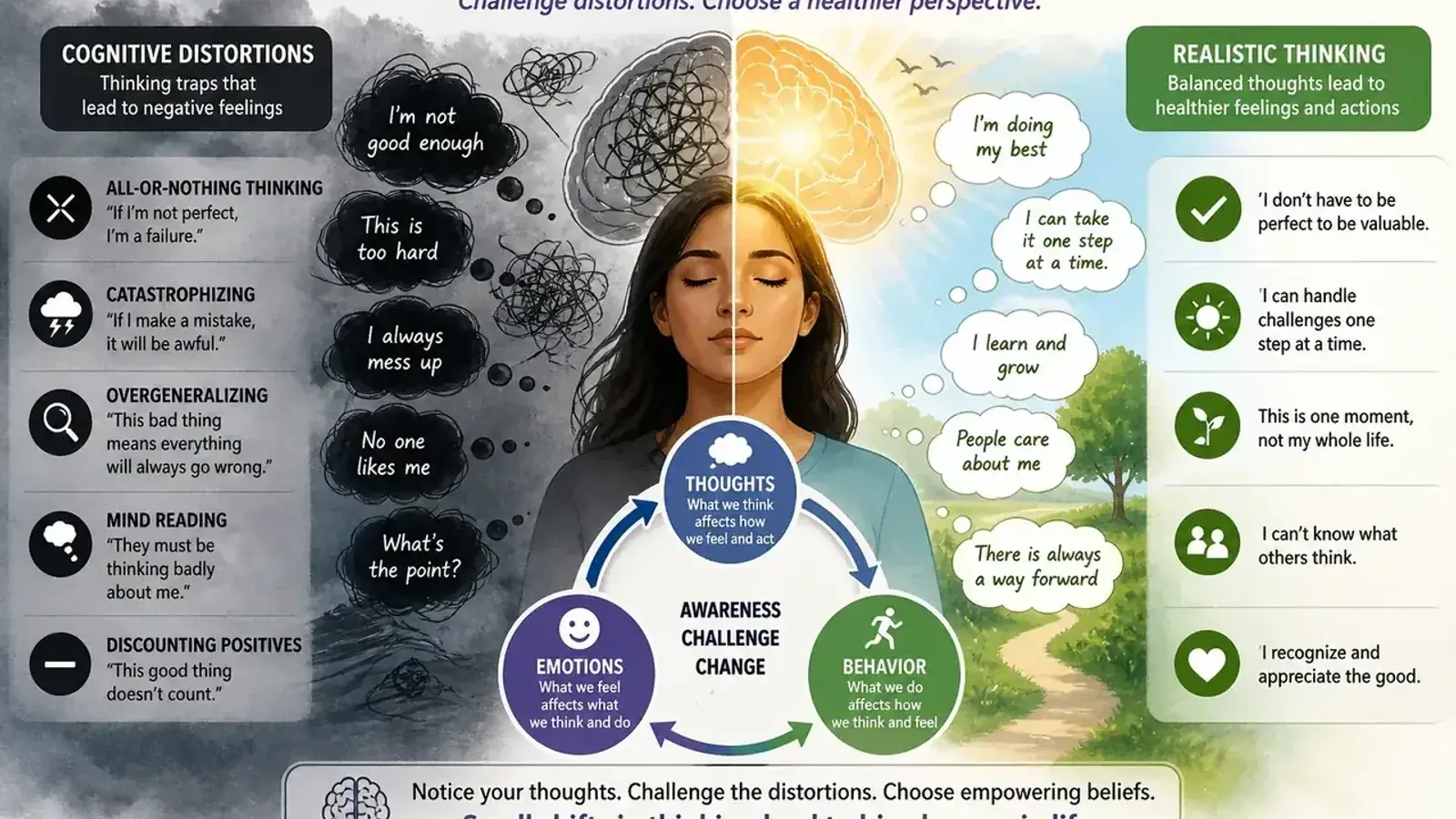
This is pure CBT in action. When your brain says "I'll never reach my goals," it's using what therapists call absolute thinking — a cognitive distortion that turns a bad moment into a permanent verdict. Words like never, always, everyone, no one are almost always signals that your brain has slipped into pattern mode, not truth mode.
The Realist reframe catches that. It doesn't tell you your goals are close or that everything will work out. It just quietly removes the word that was doing the most damage — never — and hands the thought back to you as something examinable instead of something final.
Use this one when: the thought feels like a fact, but part of you knows it might just be a pattern. When you need your brain to slow down before it reaches a verdict.
The Growth Card — When You're Stuck and Need a Next Step
The Growth card stays inside your words — but instead of closing a door, it opens one.
Where the Realist corrects the thought, the Growth card moves you forward. It finds the one small thing that's still possible. Not a big pivot. Not a motivational speech. Just a crack of light in the wall your brain just built.
"I'll never reach my goals" becomes an invitation to ask: what's one thing I could do today — even a tiny thing — that would count as movement?
This card is grounded in a CBT concept called behavioral activation: the idea that action, even small action, breaks the cycle of stuck thinking. You don't think your way out of a spiral. You do your way out of it. One small thing. Then another.
Use this one when: you're not just spiraling — you're paralyzed. When you've lost trust in yourself and need to rebuild it one micro-step at a time.
The Compassionate Card — When You Just Need to Feel Less Alone in It
The Compassionate card doesn't challenge the thought. It validates the feeling underneath it.
Because sometimes the problem isn't that your thought is wrong. It's that you're treating the pain of having it as proof that something is wrong with you.
"I'll never reach my goals" doesn't come from nowhere. It comes from caring about something. From trying. From the gap between where you are and where you want to be — which only hurts because it matters to you.
The Compassionate reframe says: the fact that you're struggling doesn't mean you're failing. It means you care. And caring is not a character flaw — it's the thing that got you here in the first place.
This card is rooted in self-compassion research, which consistently shows that people who treat themselves with kindness during setbacks are more likely to recover, try again, and succeed — not less. Harsh self-criticism doesn't motivate. It paralyzes.
Use this one when: you don't need to be fixed or pushed. You need to feel like a human being who's allowed to be having a hard time.
Why Three?
Because the same thought on a Monday morning hits differently than on a Sunday night.
Because sometimes you need clarity. Sometimes you need momentum. Sometimes you just need to breathe.
CBT has always recognized that different cognitive distortions call for different interventions. What MindLift's three-card system does is give you all three at once — and let you choose what you actually need in that moment, rather than making that decision for you.
There's no right card. The one that resonates is the right one.
What This Looks Like in Practice
You type: "I completely embarrassed myself in that meeting."
- Realist reminds you that one moment in a meeting is not a summary of your competence — and that completely is doing a lot of work in that sentence.
- Growth asks: is there one thing you could do before the next meeting that would help you feel more prepared? One email you could send, one thing you could clarify?
- Compassionate says: the fact that you care this much about how you showed up? That's not weakness. That's someone who takes their work seriously and wants to do it well.
Three lenses. One thought. Sixty seconds.
The Bigger Idea
Most of the time, negative thoughts don't need to be eliminated. They need to be examined.
The three cards give you three different ways to examine the same thought — from the angle of accuracy, the angle of action, and the angle of self-kindness. Together, they cover almost every version of stuck that a difficult thought can produce.
And because every reframe is built from your own words, none of it sounds like someone else's advice. It sounds like the part of you that already knows — the part that just needed a little help getting loud enough to hear.
free to start · subscription available
Open MindLift. Type the thought that's been sitting heaviest lately.
See which card you reach for first. That's usually the one your brain needed most.
New to Mini-Reframe? Read how the 60-second reset works →
Frequently asked questions
What are the three reframe cards in MindLift?
MindLift gives you three different CBT-based reframes for every thought you type: the Realist card (makes your thought more accurate by challenging cognitive distortions), the Growth card (finds the smallest possible next step forward), and the Compassionate card (validates the feeling underneath the thought without criticism). You choose whichever one fits what you actually need in that moment.
What is the Realist reframe card?
The Realist card applies pure CBT cognitive restructuring — it identifies the distortion in your thought (words like "never," "always," "everyone") and strips it back to what's actually examinable. It doesn't try to make you feel better. It makes your thought more accurate. Use it when the thought feels like a fact but part of you suspects it's a pattern.
What is the Growth reframe card?
The Growth card is based on behavioral activation — the CBT principle that action, even tiny action, breaks the cycle of stuck thinking. Instead of correcting the thought, it finds one small crack of possibility inside it. Use it when you're paralyzed and need to rebuild trust in yourself one micro-step at a time.
What is the Compassionate reframe card?
The Compassionate card is rooted in self-compassion research. Instead of challenging the thought, it validates the feeling underneath it. It reminds you that struggling doesn't mean failing — it means you care. Research consistently shows that self-kindness during setbacks improves recovery and long-term motivation more than harsh self-criticism.
Like what you're reading?
Continue your wellness journey
Reframe negative thoughts in 60 seconds — free to start in the MindLift app.


Free to start · premium optional