
Turn this into a daily habit — free to start in the MindLift app:
It’s 11:40pm. Tomorrow you’re presenting to the whole team, and your brain has already run the full film: you freeze on slide three, someone asks a question you can’t answer, your manager does that small, polite nod that means we’ll talk later.
Your heart is going faster than it should for someone lying in bed. And the voice in your head is not helping. Why do I always do this? I’m going to mess it up. I’m not ready.
Here’s what’s actually happening: nothing about tomorrow has changed in the last hour. What changed is the story you’re telling yourself about it.
That’s the good news, because stories can be retold. That’s what reframing is.
What is reframing, really?
Reframing (or cognitive reframing) means changing how you interpret a stressful situation, or your own reaction to it, so it stops feeding the spiral.
The situation stays the same. The presentation is still tomorrow. What changes is the frame around it: the meaning your mind attaches to the facts.
Psychologist Ethan Kross, who directs the Emotion & Self-Control Lab at the University of Michigan, calls the negative loop in your head “chatter”: the repetitive, looping self-talk that turns a single worry into a full-night event. In his book Chatter, reframing comes up again and again as one of the tools for quieting it[1].
It also sits at the heart of cognitive behavioral therapy (CBT), where it’s often called cognitive restructuring. The idea is simple: it isn’t events alone that shape how we feel, but how we interpret them. Change the interpretation, and the feeling has room to shift.
What reframing is not
Let’s clear this up early, because it’s where most advice goes wrong.
- It’s not positive thinking. Telling yourself “everything will be perfect!” when your brain doesn’t believe it tends to bounce right off. Reframing looks for an interpretation that is more accurate and more useful, not just more cheerful.
- It’s not denial. You’re allowed to find the situation hard. A good reframe doesn’t say “this doesn’t matter.” It says “this matters, and I can deal with it.”
- It’s not lying to yourself. If a reframe feels fake, it’s the wrong reframe. Look for one you can actually believe.
A good reframe doesn’t make the problem smaller. It makes you feel bigger next to it.
Why your mind spirals: threat vs. challenge
So why does the same presentation feel exciting to one person and terrifying to another?
According to research on what psychologists call challenge and threat states, much of it comes down to a quick, mostly automatic calculation your brain makes: do I have what it takes to handle this?[2]
- If your answer is no, you’re in a threat state. The demand looks bigger than your resources. Chatter rushes in to fill the gap: worst-case scenarios, harsh self-criticism, replaying old mistakes.
- If your answer is yes, probably, you’re in a challenge state. The demand is real, but so are your resources. You still feel pressure, but it feels more like energy than dread.
Notice that this calculation is about perception, not reality. You can have exactly the same skills on both nights and still land in a threat state, simply because you’re tired, or alone with your thoughts, or zoomed in too tightly on the problem.
That’s where reframing comes in. Reframing is how you move yourself from threat to challenge. You’re not inventing resources you don’t have. You’re reminding your brain about the ones it forgot to count.
Threat frame
- “I’m going to freeze and everyone will see I don’t know what I’m doing.”
Challenge frame
- “This is hard and I’m nervous. I’ve prepared, I know this material, and I’ve done tough presentations before.”
Same facts. Different frame. Very different night.
Your body isn’t betraying you: reframing stress signals
There’s a second layer to chatter that most people don’t talk about: your body.
Pounding heart. Fast, shallow breathing. Sweaty palms. When these show up before something important, they often trigger a fresh wave of chatter: See? I’m already panicking. I’m definitely going to blow this.
The body sensation becomes evidence for the threat story. And the threat story makes the body sensations worse. Round and round.
Kross highlights research by psychologist Jeremy Jamieson and colleagues that tested a different approach. Instead of trying to calm people down, researchers asked them to think of their stress response as functional and adaptive: the body’s way of preparing to perform[3]. A faster heartbeat helps deliver more oxygen-rich blood to your brain and muscles. It’s an old, adaptive system built to help you meet a demand, not a sign that you’re failing.
People who were asked to read their arousal this way showed a more adaptive cardiovascular response during a stressful task than people in the comparison groups: their hearts pumped more efficiently and their blood vessels showed less resistance, a pattern researchers link to a challenge response rather than threat. They were also less pulled toward negative information. Their bodies were still activated. They just weren’t fighting themselves anymore.
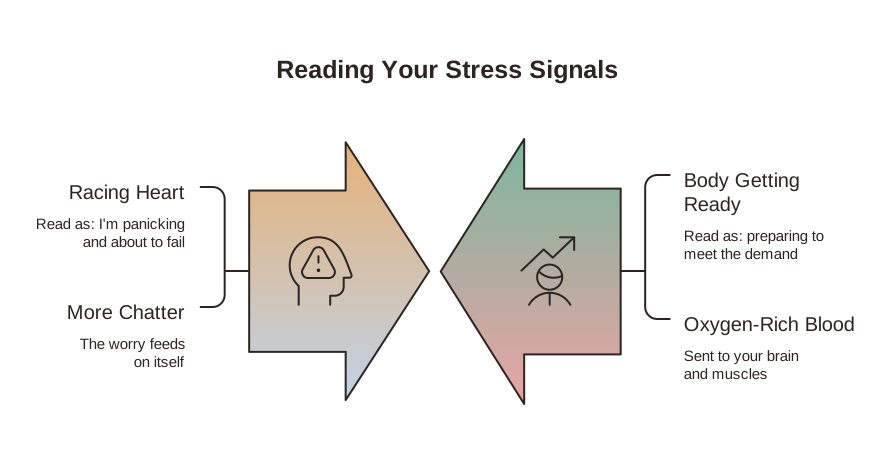
Try this next time your heart races:
“My heart is pumping harder because my body is getting ready. This is fuel, not a warning sign.”
You’re not trying to make the feeling go away. You’re changing what it means. For more ways to work with the body side of stress, see how to reduce stress naturally.
5 ways to reframe (that actually work)
In Kross’s framework, reframing isn’t a standalone trick. It works best combined with self-distancing: tools that help you step back from the problem so you can see it from a wider angle.
Here’s why that matters. When chatter starts, your attention narrows to a tiny, tight point: the problem, the feeling, the worst case. From that close up, everything looks enormous. Distance gives you room to reframe.
Here are five ways to combine the two.
1. Talk to yourself like a friend (distanced self-talk)
How it works: Instead of thinking in “I” (“Why am I so overwhelmed?”), talk to yourself using your own name or “you” (“Sasha, why are you so overwhelmed?”).
Why it helps: In studies by Kross and his colleagues, this small language shift helped people feel less distressed during stressful tasks like giving a speech, and independent raters judged their performance as better[4]. In the same set of studies, people who used non-first-person language appraised upcoming stressors in more challenging and less threatening terms. Switching away from “I” creates instant psychological distance. Suddenly you’re in the role of coach instead of the person drowning in the problem.
Try it: “You’ve handled tough presentations before. You prepared for this one. You can do this too.”
2. Become a fly on the wall
How it works: When you replay a painful moment, like an argument or an awkward meeting, don’t watch it through your own eyes. Picture the scene from above, as if you were a neutral observer watching it happen.
Why it helps: In experiments by Kross, Ozlem Ayduk and Walter Mischel, people replayed an anger-provoking memory either through their own eyes or from a distanced, observer’s view while asking why they felt as they did. The distanced group could think the experience through without stirring up as much negative emotion as the group that relived it[5]. Distance shifts you from reliving to understanding, and understanding is what makes a constructive reframe possible.
Try it: Replay the moment from the corner of the ceiling. What would an outsider notice that you missed?
3. Travel forward in time
How it works: Ask yourself: How will I feel about this in a week? A year? Ten years?
Why it helps: This is called temporal distancing. In a series of studies by Emma Bruehlman-Senecal and Ozlem Ayduk, taking a distant-future perspective on a recent stressor reduced distress about it, largely because it drew people’s attention to how temporary the situation is[6]. It’s not that the problem doesn’t matter. It’s that you realize the feeling won’t last forever.
Try it: “A year from now, will I even remember slide three?”
4. Use the universal “you”
How it works: When you’re processing something painful, phrase the lesson in the general “you”, the way you’d say “you win some, you lose some.”
Why it helps: Research by Ariana Orvell, Ethan Kross and Susan Gelman found that using this generic “you” when reflecting on negative experiences helps people normalize them, by extending the experience beyond the self[7]. It turns something isolating (“I failed, I’m the problem”) into something shared (“when you try new things, sometimes you fall short”). That move from “this proves something is wrong with me” to “this is part of being human” is a reframe in itself.
Try it: “When you care about your work, you’re going to feel nervous before it’s judged.”
5. Reframe your body’s signals
How it works: We covered this above, but it belongs in the toolkit. When a racing heart or shaky hands show up, label them as preparation, not panic.
Why it helps: It interrupts the loop where body sensations “prove” the threat story, and it helps your body move toward a challenge response.
Try it: “This is my body getting ready, not falling apart.”
How to reframe a thought in 3 minutes
Ready to try it? Here’s a simple routine you can use on paper or in your notes app the next time chatter starts.
Step 1: Catch the thought (30 seconds). Write down the exact sentence in your head. Not a summary. The real words. “I’m going to embarrass myself.”
Step 2: Name the frame (30 seconds). Ask: is this a threat frame or a challenge frame? Am I telling myself I can’t handle this? If yes, you’ve found what to work on. It may also match a familiar thinking trap, like catastrophizing or all-or-nothing thinking.
Step 3: Step back (1 minute). Pick one distancing tool. Talk to yourself by name. Picture yourself from the outside. Or jump a year ahead.
Step 4: Write the new frame (1 minute). Find an interpretation that is true and more helpful. A quick test: would you say it to a friend in the same situation? If yes, you can say it to yourself.
Old frame: “I’m going to embarrass myself.”
New frame: “You’re nervous because this matters to you. You know this material. Even if one part goes wrong, you’ll recover. You always have.”
That’s it. No affirmation you don’t believe. No pretending you’re not scared. Just a more honest, more useful story. For more worked examples, see how to reframe a negative thought and these 8 cognitive reframing techniques.
When reframing feels impossible
Let’s be honest: some nights, reframing won’t land. You’ll write the new frame and your brain will roll its eyes.
That’s normal, and there are good reasons why reframing doesn’t always work. A few things that help:
- Lower the bar. You don’t need a great reframe, just a slightly better one. “This might be okay” counts.
- Go for distance first. If you can’t reframe from inside the spiral, just step back. Say your name. Picture the room from above. The reframe often shows up once you have space.
- Repeat it. Reframing is a skill. The first few times feel clunky. With practice, your brain starts reaching for the challenge frame on its own.
- Get support. If the spiral is constant, heavy, or getting in the way of your life, talk to someone you trust or a mental health professional. Reframing is a powerful everyday tool, not a replacement for real support when you need it.
The story isn’t finished yet
Chatter is convincing because it sounds like you. It uses your voice, your memories, your worst-case imagination. But it’s telling one version of the story, usually the scariest one.
Reframing is how you write a second draft. Not a fairy tale. A truer, kinder version that leaves room for you to cope.
You don’t need to get it perfect. You just need to start noticing the frame, and practice choosing a better one.
MindLift helps you practice exactly that. Write down the thought that’s looping, exactly as it sounds in your head. MindLift names the thinking pattern behind it and gives you a more accurate way to see it, in about 60 seconds. Reframes come in three tones (Realist, Growth and Compassionate), so you can keep the one you actually believe, and save the ones that land to your Favorites. Your “This week’s reframes” card shows how often you’ve reframed and which pattern shows up most.
Try your first reframe in MindLift. Free to start, on iOS 15+, Android 8+ and the web.
Download MindLift for iOS and Android
The research above tested the techniques, not the app. MindLift is a self-help tool and not a substitute for professional care. If negative thoughts are constant or affecting your daily life, consider talking to a licensed mental health professional.
Frequently asked questions
What is reframing in simple terms?
Reframing means changing how you interpret a situation or feeling so it becomes less overwhelming and more manageable. The facts stay the same; the meaning you give them changes.
Is reframing the same as positive thinking?
No. Positive thinking tries to make things sound good. Reframing looks for an interpretation that is more accurate and more useful. A good reframe can admit something is hard while reminding you that you can handle it.
What is cognitive reframing in CBT?
In cognitive behavioral therapy, reframing (often called cognitive restructuring) means noticing unhelpful thought patterns, such as catastrophizing or all-or-nothing thinking, questioning them, and replacing them with more balanced interpretations.
What does Ethan Kross say about reframing?
In Chatter, Kross describes reframing as one way to quiet negative self-talk, including seeing a stressful situation as a challenge rather than a threat and reinterpreting physical stress signals as your body preparing to perform. He pairs it with self-distancing tools like talking to yourself by name.
Why does talking to myself in the third person help?
Using your name or "you" instead of "I" creates psychological distance. It puts you in the role of advisor rather than the person caught in the problem, which makes it easier to see things clearly and reframe them.
How long does it take for reframing to work?
A single reframe can take the edge off in minutes. Making it a habit, so your mind reframes more automatically, takes regular practice over weeks.
Like what you're reading?
Continue your wellness journey
Reframe negative thoughts in 60 seconds — free to start in the MindLift app.


Free to start · premium optional