
Turn this into a daily habit — free to start in the MindLift app:
Screenshots of mental health apps all look the same: soft gradients, a breathing circle, a streak counter. None of them answer the only question that matters — what happens in the thirty seconds after I open it with a thought stuck in my head? So here is exactly that, start to finish, with a real thought.
What happens when you open MindLift?
You type the thought that's looping — verbatim, as harsh as it sounds inside. MindLift identifies the thinking pattern distorting it (catastrophizing, mind-reading, all-or-nothing), walks you through what the evidence actually supports, and lands on a reframe written in your own vocabulary — believable, not sunny. First open to saved reframe takes about 60 seconds. Free to start, no account required.
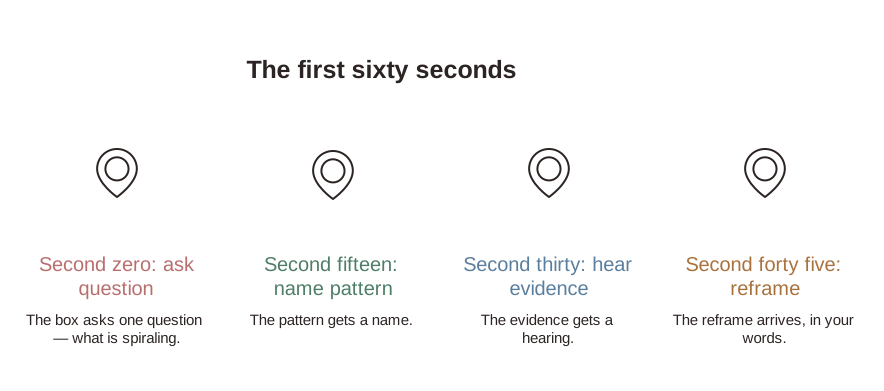
Second 0: the box asks one question
No onboarding carousel standing between you and the tool. The home screen leads with the Mini-Reframe: a text box that asks what's looping. You type it the way it actually sounds — not the polite version:
"I'm too much for people."
That verbatim capture matters more than it looks. A thought you've summarized ("I felt insecure today") is already at arm's length. The sentence your brain actually uses is the one doing the damage — and the one worth auditing.
Second 15: the pattern gets a name
MindLift's first move is the one that does the most work per second: it names what the thought is doing. "I'm too much for people" is labeling (a verdict on your whole self from a few data points) built on mind-reading (reporting other people's tolerance levels without asking them). The moment a thought has a pattern-name, something shifts — it stops being a fact about you and becomes a thing your brain does. Psychologists have a phrase for why this helps: naming is taming.
Second 30: the evidence gets a hearing
Next comes the question the spiral never asks on its own: what actually supports this? Who, specifically, said you were too much? The friend who texted you first yesterday? The people who keep inviting you? The claim starts to wobble the moment it's asked to produce witnesses — which is the whole CBT bet, and the neuroscience behind why it works is well mapped.
Second 45: the reframe — in your words
Then the rewrite appears, built from your phrasing and your active goal, not from a quote library:
"The people who matter keep choosing me. 'Too much' is one old voice's review — not the room's."
Notice what it isn't: it isn't "you're perfect and everyone loves you." A reframe you can't believe is worse than none — your brain files it under lies and doubles down (we've written about why forced positivity backfires). The target is a sentence you'd accept from a good friend. You save it, it joins your history, and you can replay it as audio later — including offline, because 2am wifi is not a given.
That's it. That's the app.
Two more passes through the same flow, so you can see the range:
Typed: "I'm going to bomb this interview." → Named: fortune telling. → Reframed: "I can't control their decision. I can control how prepared I walk in — and that part is done."
Typed: "You handled that all wrong and now it's broken." (2:14am edition) → Named: catastrophizing, with the fact-checkers offline. → Reframed: "Nothing about this gets decided at 2am. The version of me that fixes things comes online at 9."
Around that core there's a mood check-in, reframe history, curated categories, and one active goal that tunes your daily reframes. What there isn't: a chatbot persona, a social feed, a meditation timer, or anything else standing between the thought and the rewrite.
The honest scope
MindLift drills one skill — the reframe rep. It is not therapy and doesn't pretend to be (if cost is what's keeping you from the real thing, we wrote honestly about that too). It's free to start — Mini-Reframe, quizzes, and daily reframes, no account, no ads — with premium unlocking the deeper library. Sixty seconds after you open it, you have a kinder sentence you actually believe, and the phone is back in your pocket. That's the whole pitch, because that's the whole product.
Frequently asked questions
What does MindLift actually do?
One thing, quickly: you type a negative thought exactly as it sounds in your head, and MindLift walks you through the core CBT loop — naming the thinking pattern distorting it, checking it against evidence, and rewriting it into a response you would actually believe. A full pass takes about 60 seconds. Around that core sit mood tracking, reframe history, audio playback, and daily reframes tuned to your active goal.
Is MindLift free?
Free to start — the core Mini-Reframe, the quizzes, and daily reframes need no account, no card, and show no ads. A premium subscription unlocks the deeper content library and additional features. The honest framing: the part of the app described in this article is the free part.
Is MindLift a chatbot or AI therapist?
Neither. There is no character to talk to and no conversation to maintain. MindLift is a structured tool: thought in, guided reframe out. And it is not therapy — it drills one skill from CBT (cognitive reframing), the same exercise therapists assign as homework. For severe or crisis situations, a professional or a crisis line is the right door, not an app.
Does MindLift work offline and on what devices?
MindLift runs on iOS 15.0+ and Android 8.0+, and core features work offline — the 2am use case does not depend on your connection. It is software-only: no wearables, sensors, or hardware of any kind.
Like what you're reading?
Continue your wellness journey
Reframe negative thoughts in 60 seconds — free to start in the MindLift app.


Free to start · no account required
Mental Health App Reviewers
Making mental health practical and accessible — one grounded tool at a time.
Was this article helpful?