
Turn this into a daily habit — free to start in the MindLift app:
You've been over this thought before. Maybe an hour ago. Maybe at 2am. You turn it over, examine it from a new angle, feel like you're getting somewhere — and then you're back at the start, holding the same worry, just more tired.
That's the part nobody tells you about overthinking: it feels productive. It has all the texture of problem-solving — effort, focus, urgency — without any of the output. You're not stuck because you haven't thought hard enough. You're stuck because thinking harder was never going to be the thing that worked.
You can't think your way out of overthinking because overthinking isn't thinking — it's rumination, a loop that rehearses distress rather than resolving it. Reflection moves: you consider a problem and land somewhere. Rumination repeats the same thought unchanged, and the repetition itself is what keeps the feeling alive. What interrupts it isn't less thinking or more willpower, but a different angle on the same thought — a reframe that names the distortion inside it.
Overthinking isn't thinking. It's rumination.
There's a real distinction in psychology between reflection and rumination, and it matters more than it sounds like it should.
Reflection moves. You consider a problem, you learn something, you land somewhere — even if that somewhere is just "I need more information" or "I'll revisit this tomorrow." Rumination doesn't move. It loops. Researchers who study this pattern — often under the term "response styles theory" — have found that people who default to dwelling on a distressing thought, rather than acting on it or distracting from it, tend to stay distressed longer and recover more slowly. The loop itself is what keeps the feeling alive, not the original problem.
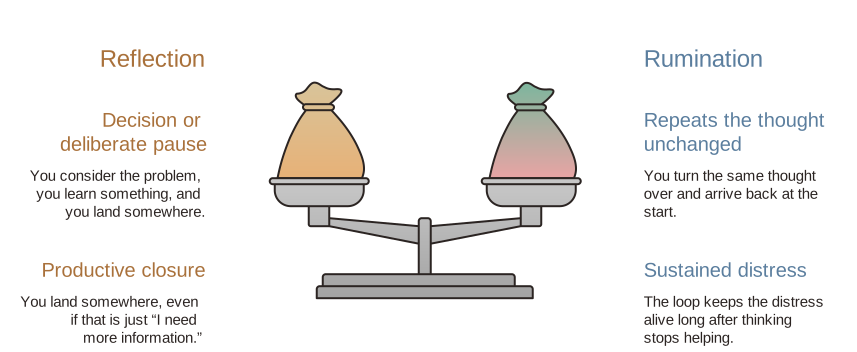
This is the part that's hard to believe when you're in it: the thinking isn't solving anything. It's rehearsing the distress.
The thoughts that sound rational but aren't
Overthinking usually doesn't feel irrational in the moment. It feels careful. That's what makes it so sticky — it's dressed up as diligence. A few patterns show up constantly in the thoughts that keep people up at night:
Catastrophizing — "If I get this wrong, everything falls apart." The thought jumps straight to worst-case and treats it as the likely case.
Mind reading — "They think I'm incompetent." Certainty about what someone else is thinking, with no actual evidence for it.
Fortune telling — "This is going to go badly." A prediction stated as fact, before anything has happened.
Should statements — "I should have handled that better." A rule applied retroactively, as if you had information then that you only have now.
None of these are stupid thoughts. They're the kind of thoughts a careful, self-aware person has — which is exactly why they're so hard to catch from the inside. You don't feel like you're distorting reality. You feel like you're finally being honest about it.
Why "just stop thinking about it" doesn't work
If overthinking were a willpower problem, willpower would have fixed it by now. It isn't. Trying to suppress a looping thought tends to make it louder — you end up thinking about the thought as much as the thing that triggered it.
What actually interrupts the loop isn't less thinking. It's a different angle on the same thought — one you can't generate yourself, because you're standing too close to it. This is the core idea behind cognitive behavioral therapy: the goal was never to stop having the thought. It's to notice the distortion inside it and hold up a version that's still honest, just not warped by catastrophizing or mind reading.
That reframe is hard to do alone, in the moment, at 11pm, mid-spiral. Not because you're bad at it — because nobody can edit their own handwriting while they're still holding the pen.
This is the exact gap MindLift was built for. You type the thought — the real one, in your own words, not a cleaned-up version of it — and it comes back reframed three ways: one that challenges the hidden assumption directly, one that reframes it as a skill you're building, and one that's honest about what you're carrying without minimizing it. No affirmations standing in for your actual words. No 10-minute meditation before you're allowed to feel better. Just the thought, looked at from outside itself, in under a minute.
What changes when the loop breaks
The goal was never to think less. It's to stop mistaking the loop for progress. Once a thought has been reframed — really looked at, not just repeated back softer — it tends to lose its grip a lot faster than it does when you keep rehearsing it unchanged.
Frequently asked questions
Is overthinking the same as anxiety?
They overlap but are not identical. Anxiety is the felt sense of threat or worry; overthinking is a behavior pattern — the repetitive dwelling — that often accompanies it and tends to prolong it.
How do I know if I'm reflecting or ruminating?
Reflection ends somewhere — a decision, a next step, or a conscious "I'll come back to this." Rumination just repeats. If you've had the same thought, unchanged, more than twice today, that's a signal.
Can journaling help with overthinking?
Sometimes — but writing the same thought down does not automatically reframe it. Journaling without a structured lens can end up rehearsing the loop on paper instead of interrupting it.
Do I need therapy for this, or can an app actually help?
They're not competing. Therapy is depth work, usually an hour a week. MindLift is built for the other 167 hours — the specific 11pm thought that's looping right now and can't wait until your next session.
Like what you're reading?
Stop the spiral in real time
MindLift gives you a gentle CBT-based reframe the moment your thoughts start looping.


Free to start · premium optional