
Turn this into a daily habit — free to start in the MindLift app:
You know that person who can see 17 angles to every problem, debate both sides brilliantly, and explain exactly why each option is simultaneously the best and worst choice?
Yeah. They're still stuck on what to order for lunch.
Intelligence doesn't cause overthinking.
But it definitely gives you better tools to torture yourself with.
Here's why smart people get stuck — and how to use that big brain to actually decide things.
Understanding Intelligence and Decision Making
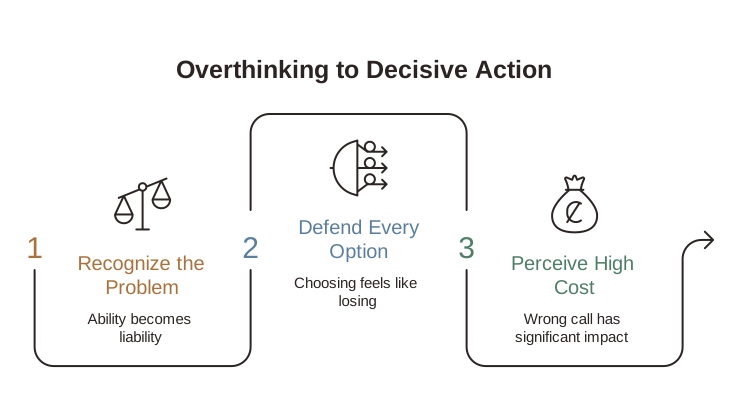
1. Intelligence Doesn't Create Overthinking — It Amplifies It
Let's be clear: being smart doesn't make you an overthinker.
But if you already have anxiety or perfectionist tendencies, intelligence makes them worse.
Why?
🧠 You see more possibilities — Your brain generates more "what ifs" than others.
🧠 You're better at justifying your fears — You can argue why every option is risky.
🧠 You have higher standards — "Good enough" feels like failure.
🧠 You overthink your overthinking — Meta-analysis is your specialty.
So while someone else might think, "Eh, I'll just pick this one," you're building a mental decision tree with 47 branches.
2. Knowing More Can Make Simple Decisions Complicated
Here's the trap:
The more you know about something, the harder it becomes to decide.
Examples:
🎯 You know too much about nutrition, so choosing what to eat becomes an ethical/health/environmental calculus.
🎯 You understand career risks too well, so every job change feels like a potential disaster.
🎯 You've read about relationship psychology, so every date becomes an analysis of attachment styles.
The more information you have, the more variables you can feel you need to account for.
And the result? Paralysis.
3. Smart People Confuse "Thinking" with "Solving"
Here's the uncomfortable truth:
Most smart people are terrible at distinguishing between productive thinking and mental spinning.
You think you're "working through it."
But really, you're just rehearsing the same thoughts on repeat.
Quick test:
✔ If your thinking is leading to new insights or action → productive
❌ If you're rehashing the same points in different ways → spinning
Most smart people are stuck in the second category but convinced they're doing the first.
4. High Achievers Are Trained to Avoid "Wrong" Answers
If you did well in school, you learned: there's a right answer, and getting it wrong is bad.
But real life doesn't work that way.
Most decisions don't have a "correct" option — they have trade-offs.
And smart people hate that.
So instead of choosing and dealing with the trade-offs, you stay in research mode indefinitely.
Because if you're still deciding, you haven't failed yet.
Practical Solutions for High Achievers
5. How Smart People Can Stop Overthinking (Counterintuitive Strategies)
Okay, so how do you use your intelligence to decide faster instead of slower?
✨ 1. Set "good enough" criteria upfront
Before you start analyzing, define what "good enough" looks like.
Then stop when you hit it.
Example: "A good-enough job is one that pays X, aligns with my values, and doesn't make me miserable."
If it checks those boxes, stop researching.
✨ 2. Limit your information intake
More information ≠ better decisions.
Past a certain point, you're just overloading yourself.
Try: "I'll read 3 reviews, not 30."
✨ 3. Use "satisficing" instead of optimizing
Satisficing = choosing the first option that meets your criteria.
Optimizing = endlessly searching for the perfect option.
Smart people default to optimizing. It's exhausting.
Try satisficing for low-stakes decisions and see what happens.
✨ 4. Externalize the pros and cons, then close the doc
Write it out once. Review it once. Decide.
Then close the document and don't reopen it.
If you find yourself editing the list 10 times, you're stalling.
✨ 5. Practice making "bad" decisions on purpose
This one's wild but effective:
Deliberately choose the "wrong" option in low-stakes situations.
Order something random. Take the less optimal route. Break your usual system.
You'll learn that most "wrong" choices don't actually matter.
✨ 6. Accept that regret is inevitable
No matter what you choose, part of you will wonder "what if."
That's not a sign you chose wrong — it's just how brains work.
The goal isn't to avoid regret. It's to tolerate it.
6. The Secret Smart People Need to Hear
Here's what nobody tells high achievers:
Your intelligence is a tool, not a requirement.
You don't have to use all of it, all the time.
Sometimes the smartest thing you can do is stop thinking and just choose.
Final Thought
Intelligence doesn't trap you in overthinking.
Perfectionism does.
And the only way out is to lower the bar on what counts as a "good enough" decision —
and then actually make one.
Your brain will protest.
Choose anyway.
Frequently asked questions
Why do smart people overthink?
Intelligence amplifies overthinking but doesn't cause it. Smart people see more possibilities, are better at justifying fears, have higher standards where 'good enough' feels like failure, and overthink their overthinking through meta-analysis. If you already have anxiety or perfectionist tendencies, intelligence makes them worse.
Is overthinking linked to intelligence?
Intelligence and overthinking are correlated but not causally linked. Anxiety and perfectionism are the true drivers — intelligence just gives you better tools to build elaborate worry structures. Many intelligent people don't overthink at all, and many overthinkers aren't particularly analytical.
How do high achievers make decisions?
The most effective high achievers use satisficing: defining 'good enough' criteria upfront, then choosing the first option that meets them. They limit information intake, externalize pros and cons (then close the document), and accept that some regret is inevitable regardless of the choice.
Why can't I stop analyzing everything?
Perfectionism trained you to find the 'right answer' — a skill that's useful in academic settings but counterproductive in real life where most decisions have trade-offs, not correct solutions. Staying in research mode feels safe because you haven't 'failed' yet. The fix is lowering your bar for what counts as a 'good enough' decision.
Like what you're reading?
Accelerate your growth journey
Reframe the patterns that hold you back — and watch your Top Pattern change over time.


Free to start · premium optional