Turn this into a daily habit — free to start in the MindLift app:
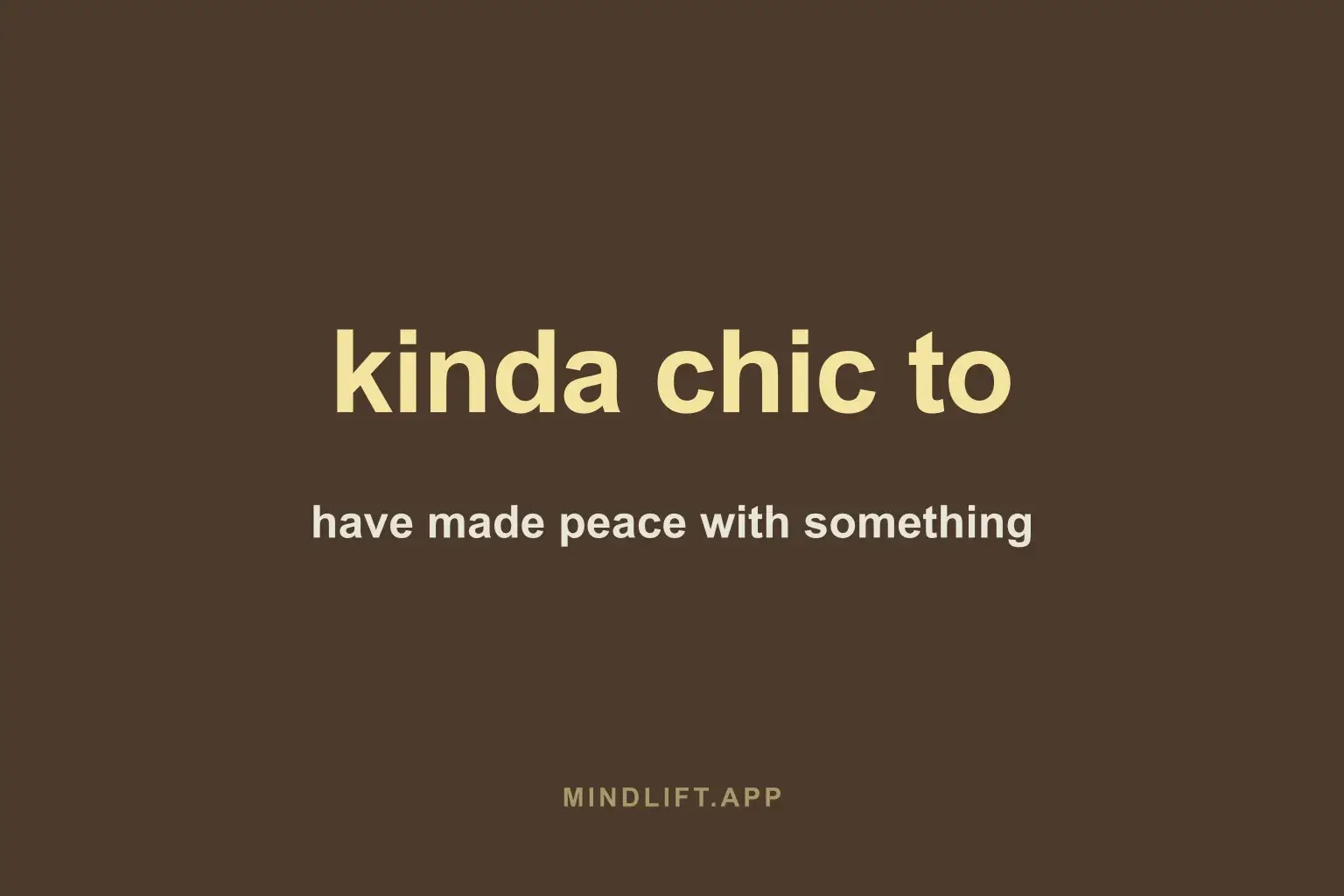
You've seen the pale yellow text by now. Kinda chic to repeat outfits. Kinda chic to be in your fifties. Kinda chic to leave the party early. Kinda chic to have a physical media collection.
Maybe you made your own. Most people who make one describe the same small, surprising thing: it felt good. Not in a fake way. Writing down "kinda chic to be underestimated" and putting it out where people could see it actually shifted something for a minute.
And then, for a lot of people, the feeling ran out somewhere around 11pm, and the thought they hadn't posted came back. The one that doesn't fit the format. The one that isn't kinda chic and isn't going to become kinda chic by being typed in yellow.
The "kinda chic to" trend works because it's cognitive reappraisal — the same move CBT calls a reframe — done in public. It reaches the thoughts you've already made peace with by relabelling them. It doesn't reach the ones still running at 3am, because those need more than a new label: an accurate reading, the actual next step, or a kinder-but-true version, checked side by side.
What the "kinda chic" trend actually is
The format is almost too simple to explain. You post a photo, a carousel, or a short video, and overlay a line that starts with "kinda chic to…" and ends with a habit, a trait, a choice, or something you'd previously filed under flaw.
It surfaced earlier in 2026 as a plain-text prompt from body-positive creators and hardened into a recognizable template over the following months — pale yellow lettering laid over ordinary photos. Searches for the phrase were widely reported to have spiked, and the hashtag climbed into the tens of thousands of posts on Instagram. Reese Witherspoon posted a list in early August that included being underestimated and calling your mom; Drew Barrymore and Ashley Graham followed.
The interesting part isn't the celebrity adoption. It's what the word is being asked to do. "Chic" used to be a gatekept word — reserved for a specific kind of expensive restraint. The trend takes it and points it at secondhand furniture, quiche, being overdressed, aging, and cheering for other women. Curious what your own answer would look like? Your style, decoded takes about two minutes and skips the judgment part entirely.
That's not a fashion trend. That's a very large number of people performing the same cognitive operation in public at the same time.
The trend has a clinical name, and it's a good one
What "kinda chic to…" does is called cognitive reappraisal. It's one of the most studied emotion-regulation strategies there is, and it's the engine underneath cognitive behavioural therapy.
The mechanism: an event or trait doesn't produce a feeling directly. Your interpretation of it does. Change the interpretation and the feeling moves — not because you lied to yourself, but because the first interpretation was one of several available and you'd stopped noticing you'd chosen it.
"I repeat outfits because I'm not put-together enough to have a real wardrobe" and "kinda chic to repeat outfits" describe the same jeans. One of them costs you something. The other doesn't. Neither is a fact.
The trend works because it makes this operation social. Reappraisal is hard to do alone from a standing start. It's much easier when you've just watched forty other people do it and one of them named the exact thing you were quiet about. The plus-size creator credited with the earliest version of the format used it to talk about continuing to post herself online despite the comments — which is reappraisal doing real work, not decoration.
So the format is sound. The problem is the entry requirement.
The thoughts that never make the list
Here's the pattern if you scroll long enough: almost every "kinda chic" line is about something the person has already made peace with.
Kinda chic to be single. Kinda chic to go to bed at nine. Kinda chic to be the loud one. These are declarations, and a declaration is what you post after the fight is over. The format is a victory lap. It's genuinely nice. It is not the fight.
Nobody posts:
- Kinda chic to be the friend who always texts first.
- Kinda chic to check if he's online four times before you fall asleep.
- Kinda chic to have replayed that meeting eleven times since Tuesday.
- Kinda chic to be the reason it ended.
Not because those people don't exist. Because the format can't hold them. "Kinda chic" is a label you apply from the outside, once you're safe. The thoughts that need the most work are the ones you're still inside of, and you can't laminate your way out of the inside.
We use a rough test for this: would this still feel true at 3am? Not at 2pm with good lighting and a caption you're pleased with. At 3am, alone, with nothing to perform against. Most reframes fail that test instantly, and the ones that fail loudest are the ones that sound the most like a slogan.
"Kinda chic to be underestimated" passes the 3am test for someone who has genuinely stopped minding. For someone who is currently, painfully underestimated at a job they need, it doesn't pass. It just adds a second problem: now you can't even do the trend right. If you're not sure which pattern your own inner voice runs on, what your self-talk pattern actually is is worth a two-minute look before you try to argue with it.
What actually moves the ones that don't fit
The thoughts that don't make the list need something the format can't provide: more than one alternative, and the freedom for those alternatives to be unflattering.
A reframe that holds usually does one of three things, and it's worth knowing which one you're reaching for.
It gets more accurate. Not more positive — more accurate. "Everyone in that meeting thinks I'm incompetent" is a prediction about eleven people's private mental states, made by someone who couldn't see any of their faces. The honest version is smaller and duller and much easier to carry: one person disagreed with me, and I don't know what the rest thought. Duller is the point. This is the distortion CBT calls mind reading, and accuracy is the entire treatment.
It finds the actual next move. Some thoughts aren't distorted at all. Sometimes you did handle it badly. The reframe isn't "kinda chic to mess up" — it's separating the event from the verdict. That went badly, and the specific thing I'd do differently is send the follow-up I've been avoiding. One is a sentence about your character. The other is a sentence about Tuesday.
It gets kinder without getting false. The hardest one. The version of you talking at 3am would be fired from any job requiring it to speak to another human that way. Naming that — not arguing with the content, just noticing the tone — is often enough to loosen it. You don't have to agree that you're doing great. You have to notice you're being cross-examined by someone with no interest in the truth.
None of these are affirmations, and none of them are chic. They're not designed to be posted. That's what makes them work on the thoughts the trend skips.
The private version of the trend
If the kinda chic format did something for you, the useful next step isn't a longer list. It's the same operation aimed one notch lower — at a thought you'd never caption.
Try it in the plainest possible way. Write the sentence exactly as it arrives in your head, ugly phrasing included. Don't clean it up. Then write three responses: the accurate one, the next-move one, and the kind one. Then read all three and notice which one you flinched at, because that's usually the one doing something.
It takes about four minutes and it is significantly less fun than making a yellow list. It also works at 3am, which the list doesn't.
MindLift exists for that second version. You type the thought as it actually sounds. You get three reframes back — one realistic, one focused on what's next, one that's simply kinder — each labelled with the thinking pattern it's answering, in about a minute. It reframes your words, not someone else's. It isn't an affirmation feed and it isn't a companion to talk to at night. It's a tool for the specific job of getting a sentence out of your head and looking at it from three angles.
Kinda chic to have made peace with something. Also fine to not have, yet — MindLift is free to start.
If you're in acute distress or thinking about harming yourself, please reach out to a local crisis line or emergency services. MindLift is a self-help tool for everyday negative thinking and isn't a substitute for professional care.
Frequently asked questions
What does "kinda chic" mean?
It's a social media format where people post a photo or video with a line beginning "kinda chic to…" followed by a habit, trait, or choice that isn't conventionally glamorous. It reclaims the word "chic" from luxury and applies it to ordinary or previously self-critical things — repeating outfits, aging, going home early.
When did the kinda chic trend start?
It surfaced earlier in 2026 as a plain-text prompt from body-positive creators and hardened into a recognizable template — pale yellow text over photos — over the following months. Searches for the phrase were widely reported to have spiked, and the hashtag climbed into the tens of thousands of posts on Instagram.
Is the kinda chic trend just toxic positivity?
Not inherently. It's cognitive reappraisal, which is a legitimate emotion-regulation strategy. It becomes hollow when the reframe is applied to something the person hasn't actually resolved — a public label doesn't change a private belief. The line is whether the statement would still feel true when nobody's watching.
Why do reframes stop working after a few hours?
Usually because the reframe was aimed at the feeling instead of the thought underneath it. A reframe that only says "this is fine" gets overwritten the next time evidence shows up. A reframe that identifies the specific distortion — a prediction, a mind-read, an all-or-nothing verdict — gives you something to check against reality later, which is why it lasts longer.
How do I reframe a negative thought properly?
Write it exactly as it occurs, without editing. Identify what kind of claim it's making — a prediction, an assumption about someone else's mind, a global judgement about yourself. Then produce more than one alternative reading, including an unflattering-but-accurate one. Single reframes tend to feel like arguments you lose. Three give you somewhere to land.
Like what you're reading?
Continue your wellness journey
Reframe negative thoughts in 60 seconds — free to start in the MindLift app.


Free to start · no account required
CBT & Self-Talk Researchers
MindLift content is grounded in cognitive behavioral therapy principles and designed to help you shift harsh self-talk in real time. Our guides focus on practical, evidence-based techniques you can use in the moment.
Was this article helpful?