
Turn this into a daily habit — free to start in the MindLift app:
You took an archetype quiz. It said Queen, or Healer, or — if the algorithm was in a good mood — Mystic. And the next thought arrived right on time: okay, but how many other women got that?
Fair question. Here is the honest answer most archetype sites won't give you, and then the useful one they can't.
First, the honest part: the percentages are fiction
Archetype rarity percentages are fiction. If you've seen a chart claiming “only 4% of women are the Mystic” or “the Queen is the rarest feminine archetype,” you've seen a number someone typed because it looked authoritative. No archetype quiz operates at census scale. None publish audited distributions. The decimal points are costume jewelry.
We can say this bluntly because we know exactly what our own 12 female archetypes quiz can and cannot tell us. Your answers never leave your device; the quiz logs only an anonymous count of which result was shown, with no name, email, or cookie attached. That count comes only from people who chose to take our quiz, a self-selected sample, so it cannot tell you how rare any archetype is in the population. We could dress those counts up as a rarity table. Everyone else simply invented one. We'd rather show you how to reason about rarity honestly, because the reasoning says more about you than the fake numbers ever could.
What actually makes an archetype rare
An archetype is rare because training suppressed it, not because nature rationed it. Your archetype is a default pattern — the version of you that runs first under pressure — and defaults are trained: female socialization rewards some patterns constantly and taxes others.
From early on, the rewarded set is specific: notice what people need, hold everyone together, push through quietly. So is the taxed set: trust your own signal, refuse the script, spend unvalidated time making things.
So rarity has a logic: the more a pattern must override its training to exist, the rarer it is as a genuine default. That produces a defensible ladder — tiers, not percentages. The whole map, before we walk it:
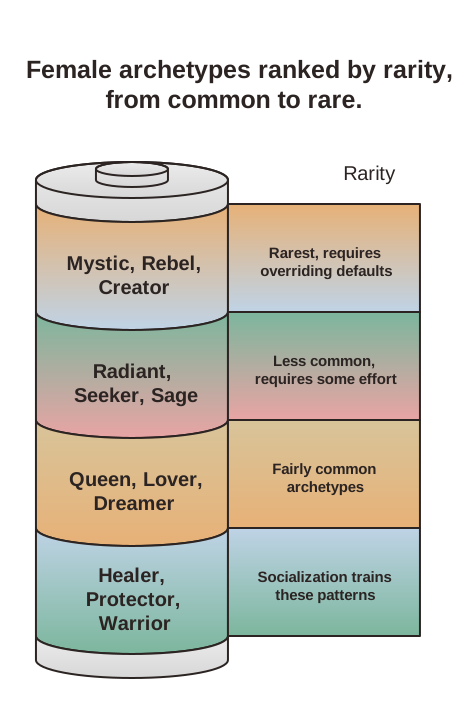
Tier 1 — Most common
The patterns socialization trains into most women
The Healer, the Protector, and the Warrior are common for a structural reason: they are the versions of femininity that get rewarded earliest and most reliably. Girls are praised for noticing what others need, for holding people together, for pushing through without making it anyone’s problem. Decades of that reinforcement build a default.
The Healer
Tending to other people’s pain is the female role script in its purest form — noticed, praised, and expected from childhood on. The Healer is everywhere because most women were explicitly trained to be her.
The Protector
Standing between the people you love and whatever threatens them is the second-oldest assignment. It runs so quietly in so many women that it rarely even registers as a pattern — it just feels like Tuesday.
The Warrior
Courage and drive were once the rare pattern; modern life trains them into most women now, usually on top of the other two. The triple shift — achieve, protect, tend — is why the Warrior is common and exhausted.
Tier 2 — Fairly common
Defaults with a higher entry cost
The Queen, the Lover, and the Dreamer are widespread but not universal, because each needs something distributed unevenly: authority that others actually accept, safety enough to feel deeply, or room to imagine past the current week.
The Queen
Plenty of women run things; fewer are allowed to run them without apology. The Queen as a genuine default needs a domain where her authority is not renegotiated daily — and not every life provides one.
The Lover
Passion and connection as a primary pattern is common wherever it is safe to be — which is the catch. The Lover thrives or hides depending on how her openness was received the first few times.
The Dreamer
Imagining how much better things could be is common in girls and quietly taxed out of women — each obligation converts a little vision into logistics. Fairly common, and usually running below the surface.
Tier 3 — Less common
Patterns that need protected ground
The Radiant, the Seeker, and the Sage survive only where a woman has defended space for them — light needs somewhere it will not be dimmed, movement needs permission she usually has to write herself, and wisdom needs distance from the noise.
The Radiant
Genuine warmth and lightness as a leading pattern is rarer than it looks — most rooms tax brightness with suspicion or demand it on schedule. Staying radiant without performing radiance is the uncommon part.
The Seeker
Growth and reinvention as a default requires repeatedly choosing the unknown over the approved next step. Most women get that choice priced out of them early; the ones who keep it are noticeably fewer.
The Sage
Understanding deeply before acting requires unclaimed time — the single resource female socialization allocates last. The Sage as a true primary, not an aspiration, is uncommon for exactly that reason.
Tier 4 — Rarest
Patterns that override the social defaults
The Mystic, the Rebel, and the Creator are the rarest because each demands a form of disobedience: trusting an inner signal over consensus, refusing the script outright, or making strange new things while the to-do list burns. Nothing in the standard curriculum teaches these. They persist despite it.
The Mystic
Trusting what hasn’t been said out loud — and acting on it — runs against a lifetime of being told to doubt exactly that signal. The Mystic is rare because intuition is trained out before it can become a default.
The Rebel
Questioning the rules instead of obeying them costs women more than it costs men, and the bill is belonging. Genuine pattern-breaking as a primary — not an aesthetic — is the rarest position on the board.
The Creator
Turning what you feel into something you can make requires a long stretch of unvalidated work — time the Healer default keeps donating to everyone else. The Creator is rare because she has to out-negotiate her own training first.
Now the part that matters more than rarity
What matters more than rarity is your reaction to the ladder. Notice what happened: if your archetype sat in Tier 1, something deflated — common, wonderful, I'm factory settings. If it sat in Tier 4, something straightened up. Same information; the feeling came entirely from the ranking instinct, not from anything the tiers actually say.
That instinct has a name: the comparison trap — the habit of converting every fact about yourself into a leaderboard position. It's the same circuit that turns another woman's kitchen into a verdict on yours. Rarity-hunting is the comparison trap in a Jungian dress.
What the ladder actually says: common patterns are common because the world runs on them. The Healer is everywhere because everywhere needs her. And rare patterns are rare because they are expensive, not because they are elite — the Rebel pays in belonging, the Creator pays in years of work nobody claps for. Every tier has a bill.
The thought worth catching:
“My archetype is common, so I'm nothing special.”
The reframe:
Common means load-bearing. The patterns most women share are the ones holding the most weight — the real question is what mine costs me when it runs unexamined.
The better question than “how rare am I?”
The better question is what your archetype costs you: every archetype, common or rare, has a shadow — the same strength running without a limit. The Healer becomes self-erasure. The Queen's leadership becomes control. Rarity changes nothing about that mechanism; a Tier 4 Mystic spirals on the same schedule as a Tier 1 Warrior, just with better lighting.
The sequence that pays off: find your default with the free 12 female archetypes quiz (46 questions, no email, and your answers never leave your device — the quiz only counts, anonymously, which result was shown). Then read your archetype's shadow side and the sentence it repeats at 2am. That sentence is the practical part — the thing you can catch and reframe while the rarity chart is still deciding whether to flatter you.
Curious how the ladder looks across the aisle? The male archetype rarity ladder runs on the same logic with a nearly inverted result — the patterns common in women are rare in men and vice versa, which is the strongest evidence there is that archetypes are trained, not issued.
The full framework — all twelve archetypes with gifts, shadows, and inner voices — lives on the female archetypes hub.
Frequently asked questions
What is the rarest female archetype?
Reasoning from how strongly each pattern is trained or suppressed by female socialization, the rarest female archetypes are the Mystic, the Rebel, and the Creator — each requires overriding social defaults rather than following them. No quiz can honestly attach a percentage, because no archetype test publishes verifiable distribution data.
What is the most common female archetype?
No census of archetypes exists, so nobody can name the most common female archetype from data — including us. Reasoning from socialization instead, the strongest candidates are the Healer, the Protector, and the Warrior, because they are the patterns female socialization rewards earliest and most consistently: tending to others, standing guard over loved ones, and pushing through without complaint. Treat that as an argument about training, not a measured frequency.
Are the archetype rarity percentages I see online real?
No. Figures like "only 4% of women are the Mystic" have no published data behind them — no archetype quiz operates at census scale, and none publish audited distributions. MindLift’s quiz never sends your answers anywhere; it logs only an anonymous count of which result was shown. That count covers only people who chose to take our quiz, so it cannot measure how common an archetype is in the population, and we will not invent those numbers. Rarity can be reasoned about; it cannot honestly be measured to a decimal.
Is a rare archetype better than a common one?
No — rarity is not rank. The Healer is common because the world runs on her. Wanting a rarer result is itself a recognizable thinking pattern (the comparison trap), and it measures how you score your worth, not what your archetype is.
Why is the female rarity ladder different from the male one?
Because the training differs. Patterns rare in men (like the Caregiver’s cousin, the Healer) are the most common in women, and vice versa. If archetypes were issued at birth, the ladders would match. They don’t — which is the clearest evidence that your archetype is a trained default you can work with, not a fixed identity.
Like what you're reading?
Accelerate your growth journey
Reframe the patterns that hold you back — and watch your Top Pattern change over time.


Free to start · no account required
- Jung CG (1959). The Archetypes and the Collective Unconscious (Collected Works, Vol. 9, Part 1). Princeton University Press (Bollingen Series XX).
- Roesler C (2012). Are archetypes transmitted more by culture than biology? Questions arising from conceptualizations of the archetype. Journal of Analytical Psychology, 57(2), 223–246. — DOI (opens in a new tab)
- Eagly AH, Wood W (1999). The origins of sex differences in human behavior: Evolved dispositions versus social roles. American Psychologist, 54(6), 408–423. — DOI (opens in a new tab)
- Festinger L (1954). A Theory of Social Comparison Processes. Human Relations, 7(2), 117–140. — DOI (opens in a new tab)
CBT & Self-Talk Researchers
MindLift content is grounded in cognitive behavioral therapy principles and designed to help you shift harsh self-talk in real time. Our guides focus on practical, evidence-based techniques you can use in the moment.
Was this article helpful?