
Turn this into a daily habit — free to start in the MindLift app:
You've probably heard that happiness is a choice. And you've probably wanted to throw something at whoever said it. Because it doesn't feel like a choice. It feels like something that happens to other people — people who don't lie awake replaying conversations, who don't spiral over a two-word reply, who don't spend Sunday evenings dreading Monday for no specific reason.
Here's what's actually true: happiness isn't a choice you make once. It's a skill your brain either practices or doesn't. And most of us have spent years accidentally practicing the opposite.
The good news? Your brain is more changeable than you think. It doesn't take an hour of meditation, a gratitude journal, or a weekly therapist to start shifting it. It takes about five minutes. And it starts with an audit. (Not sure where your starting point is? The happiness baseline quiz shows your negativity-bias level in two minutes.)
Why Your Brain Is Biased Against You
Your brain didn't evolve to make you happy. It evolved to keep you alive — which means it's wired to scan for threats, replay mistakes, and catastrophize outcomes. This is called negativity bias, and it's not a personal flaw. It's a feature that helped your ancestors survive.
The problem is you're not being chased by predators. You're being chased by emails, comparison spirals, and the feeling that you said the wrong thing at dinner three years ago.
Negativity bias means your brain:
- Registers negative experiences more strongly than positive ones
- Replays threats and failures more vividly than wins
- Defaults to worst-case interpretations when information is ambiguous
A vague message from your manager? Threat. A quiet response from a friend? Threat. A compliment you can't quite believe? Probably a trick. This isn't pessimism — it's neurological default. And you can interrupt it, deliberately and repeatedly, until your brain builds new defaults. That's what neuroscientists call neuroplasticity: your brain's ability to rewire itself based on what you practice thinking.
What a Happiness Audit Actually Is
A happiness audit isn't a list of things you're grateful for. Gratitude lists work for some people, but for overthinkers they often just trigger a second layer of guilt: I know I should feel grateful. Why don't I feel grateful?
A happiness audit is a quick, honest scan of what's actually running in the background of your mind — and a deliberate reset of the thoughts that aren't serving you. Think of it like clearing your mental cache. You're not forcing positivity. You're removing friction.
The 5-Minute Happiness Audit
Set a timer. Five minutes. You can do this in the morning, midday, or whenever you notice you've gone quiet and tense without knowing why.
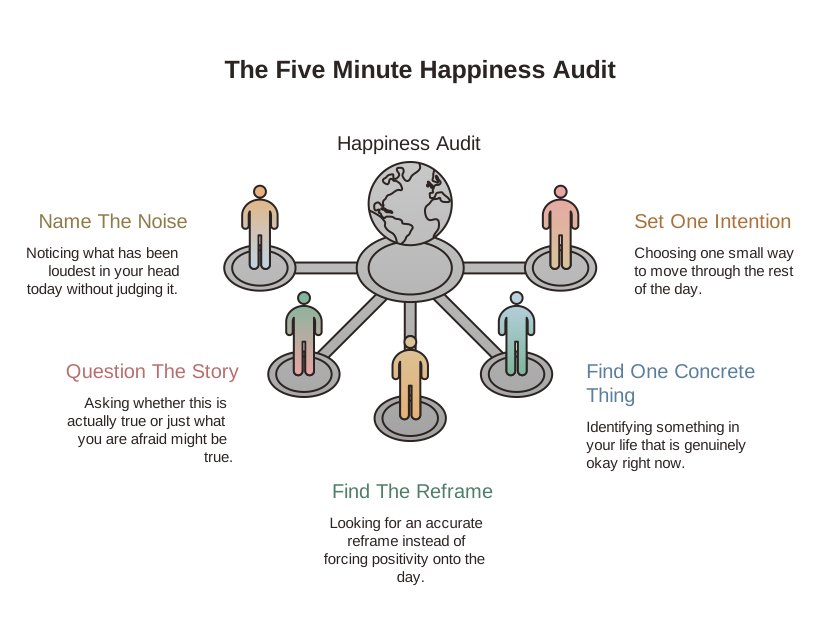
Minute 1: Name the noise
Without judging it, note what's been loudest in your head today. Not a to-do list — the emotional undercurrent. Anxious about something you can't control? Ruminating on a conversation? Dreading something vague and nameless? Name it: I'm worried I came across as too much in that meeting. I'm comparing myself to someone online and feeling behind.
Naming a thought reduces its intensity. This is well-documented — labeling emotions activates the prefrontal cortex and dials down the amygdala's alarm response. You're not solving anything yet. You're taking the thought out of the fog and putting it somewhere you can see it.
Minute 2: Question the story
Your brain told you a story about that thought. Ask: Is this actually true, or is this what I'm afraid might be true? Most anxious thoughts aren't lies — they're extrapolations. You take one ambiguous data point and your brain writes a whole narrative around it, usually the darkest plausible version.
CBT calls these cognitive distortions. Common ones:
- Mind reading — assuming you know what someone thinks about you
- Fortune telling — treating a feared outcome as already decided
- Catastrophizing — amplifying the worst case until it feels inevitable
- Personalization — taking responsibility for things outside your control
You don't need to diagnose yourself. Just ask: Am I responding to what happened, or to what I've added to what happened?
Minute 3: Find the reframe
A reframe isn't spin. It's not "everything happens for a reason." A real reframe takes your exact thought and finds the truer, more complete version.
If you're thinking "I haven't heard back. They probably hated it," a reframe isn't"I'm sure they loved it!" — it's "I haven't heard back. That's all I actually know right now." If you're thinking "I always mess things up," a reframe isn't "I never mess things up!" — it's "I made a mistake. That's different from being someone who always fails."
The goal isn't to feel better by lying to yourself. It's to stop feeling worse by telling yourself a story that isn't the whole truth. This is where a tool like MindLift helps: instead of trying to reframe your own thoughts — which is hard when you're inside them — you put the thought in, in your own words, and get back distinct reframes (a realist view, a growth-oriented one, and a compassionate one). The 60-second interruption breaks the loop before it goes another twenty minutes. If you want the full method, the cognitive restructuring worksheet walks through it step by step.
Minute 4: Identify one true thing
Not a gratitude list. One specific, concrete thing that is genuinely okay right now. Not "my life is good" — something smaller: I had a coffee I actually enjoyed. I sent that message I'd been putting off. I'm sitting somewhere quiet.
Specificity matters. Vague positivity slides off an anxious brain; concrete detail lands. You're giving your brain something real to hold onto — and practicing the act of noticing what's okay, a skill that atrophies when you only look for what's wrong.
Minute 5: Set one intention
Not a to-do. An intention about how you want to move through the next part of your day: I'm going to stop checking my phone for an hour. I'm going to let that conversation be done instead of replaying it. I'm going to be a little more patient with myself today. One intention — specific, achievable, genuinely yours.
Why Repetition Is the Whole Point
One audit won't rewire your brain — but that's not what one audit is for. Every time you catch a spiral and interrupt it, you weaken that neural pathway slightly. Every time you redirect toward a more accurate thought, you strengthen a different one. Over weeks, not years, your brain starts to catch itself. The spirals get shorter. The gap between noticing and redirecting gets smaller.
This is the neuroplasticity principle applied to mood. You're not changing your personality — you're changing your brain's default route. Research consistently shows that brief, repeated cognitive interventions — even two to three minutes a day — measurably shift emotional baselines over time. You don't have to feel it working for it to work. You just have to keep doing it.
The Gap Most People Don't Talk About
There's a problem with relying on therapy alone for this kind of work — and therapists are often the first to acknowledge it. You see your therapist for an hour, once a week. That leaves 167 hours in between where your brain is on its own.
Those 167 hours are where most of the actual thinking happens — the 2am spirals, the pre-meeting anxiety, the replaying of a text you sent four days ago. Your therapist gives you the tools, but you have to use them in real time, when the loop is actually running. That's the gap MindLift was built for — not to replace therapy, just to be there in the 167 hours: a 60-second CBT-based interruption you can use the moment a thought starts pulling you under. Free to start, no ads.
Your Brain Isn't Broken — It's Undertrained for Happiness
The audit is training. So is every reframe, every interrupted spiral, every moment you choose the more accurate thought over the catastrophic one. Five minutes. Start today.
Frequently asked questions
How do you train your brain to be happier?
You train your brain to be happier the same way you build any skill: short, repeated practice. The most effective approach interrupts negativity bias deliberately — noticing an anxious or self-critical thought, questioning whether it's actually true, and redirecting toward a more accurate (not just positive) thought. Done consistently, even a few minutes a day, this weakens the neural pathways behind spirals and strengthens healthier defaults. This is neuroplasticity applied to mood: you're changing your brain's default route, not your personality.
What is a happiness audit?
A happiness audit is a quick, honest 5-minute scan of what's actually running in the background of your mind, followed by a deliberate reset of the thoughts that aren't serving you. Unlike a gratitude list (which can backfire for overthinkers by adding guilt), the audit names the emotional noise, questions the story behind it, finds an accurate reframe, identifies one concrete thing that's genuinely okay, and sets one intention. Think of it as clearing your mental cache — you're not forcing positivity, you're removing friction.
Why is my brain biased toward negativity?
Your brain didn't evolve to make you happy — it evolved to keep you alive, which means it's wired to scan for threats, replay mistakes, and catastrophize. This negativity bias caused your ancestors to register danger quickly and survive. The problem is that the same system now fires at emails, comparison spirals, and ambiguous messages. A vague note from your manager reads as a threat; a quiet reply from a friend reads as a threat. It's a neurological default, not pessimism — and you can interrupt it deliberately until your brain builds new defaults.
Can you rewire your brain to be happier?
Yes, within limits. Neuroplasticity is your brain's ability to rewire itself based on what you repeatedly practice thinking. You can't choose to feel happy on command, but you can change which thoughts your brain reaches for by default. Each time you catch a spiral and redirect toward a more accurate thought, you weaken one pathway and strengthen another. Over weeks — not years — the spirals get shorter and the gap between noticing and redirecting shrinks. You don't have to feel it working for it to work; you just have to keep doing it.
Like what you're reading?
Continue your wellness journey
Reframe negative thoughts in 60 seconds — free to start in the MindLift app.


Free to start · no account required
CBT & Self-Talk Researchers
MindLift content is grounded in cognitive behavioral therapy principles and designed to help you shift harsh self-talk in real time. Our guides focus on practical, evidence-based techniques you can use in the moment.
Was this article helpful?