
Turn this into a daily habit — free to start in the MindLift app:
Quick Answer
Can you actually change the way you think?
Yes — and the evidence is well-established. Neuroplasticity means the brain rewires based on repeated experience. CBT (cognitive behavioral therapy) is one of the most researched methods for changing automatic thought patterns, with decades of clinical trials supporting its effectiveness.
Your mind produces thousands of thoughts every day.
Most of them appear automatically.
Some are helpful. Others quietly pull your mood downward.
You may recognize thoughts like:
"I'm going to mess this up."
"They probably think I'm awkward."
"Everyone else is doing better than me."
"Something bad is going to happen."
When these thoughts repeat often enough, they shape how you feel about yourself and the world.
Modern psychology is clear: learning to work with these thoughts is one of the best ways to improve how you feel day to day.
This idea forms the foundation of Cognitive Behavioral Therapy (CBT) and decades of research on self-talk and emotional regulation.
Why Your Thoughts Matter More Than You Think
A key insight from cognitive psychology is simple:
Your brain reacts to your interpretation of events, not just the events themselves.
Psychologists describe this through the cognitive model, which shows how thoughts drive feelings and actions.
Thoughts → Emotions → Behavior
For example:
| Step | Scenario A | Scenario B |
|---|---|---|
| Event | Your colleague sends a short message | |
| Thought | "They must be annoyed with me." | "They're probably just busy." |
| Emotion | Anxiety | Neutral |
| Behavior | Overthinking the conversation | You move on with your day |
The situation didn't change. Only the interpretation did.
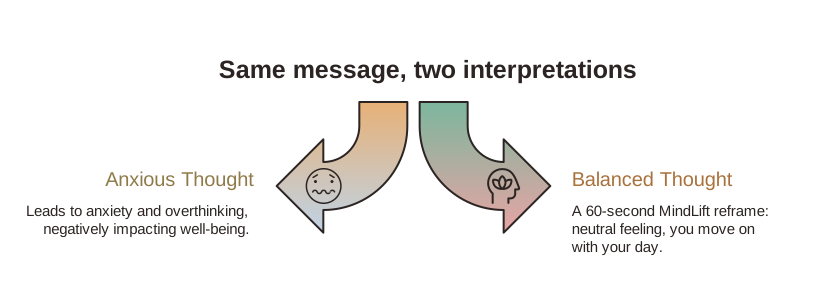
Research shows that our thoughts strongly influence how we feel and how we act.
Why Does Overthinking Feel So Hard to Stop?
Overthinking happens when the mind chews on a situation again and again without reaching an answer.
This mental loop often forms around predictable thinking patterns known as cognitive distortions.
Cognitive distortions are built-in thinking errors. They make situations look worse or more threatening than they really are.
Common distortions include:
- Catastrophizing — Expecting the worst possible outcome.
- Mind reading — Assuming you know what others think about you.
- All-or-nothing thinking — Viewing situations as total success or total failure.
- Emotional reasoning — Believing something is true because it feels true.
- Overgeneralization — Seeing one negative event as proof that everything will go wrong.
Research shows that these distorted thinking patterns can increase anxiety, depression, and stress when they become a habit.
If you want the full list of these patterns with examples, go next to our cognitive distortions guide.
The good news is that these patterns can be learned and unlearned.
Does Cognitive Behavioral Therapy (CBT) Work?
Cognitive Behavioral Therapy is one of the most researched approaches in modern psychology.
CBT teaches you to spot distorted thoughts and swap them for more balanced ones. It has been widely used to treat:
- Anxiety disorders
- Depression
- Panic disorder
- Stress-related conditions
CBT works by teaching you to notice the thinking patterns that drive your emotional reactions — and challenge them with more realistic ones.
Instead of automatically believing every negative thought, people learn to question it.
For example:
Automatic thought: "I'm terrible at this."
Balanced thought: "I made a mistake, but I can improve."
Over time, these small shifts add up to real changes in how you feel.
Why Does Your Inner Voice Sound So Critical?
Humans constantly talk to themselves internally. Psychologists call this inner speech.
This internal dialogue helps us:
- Plan actions
- Regulate behavior
- Remember information
- Solve problems
Inner speech is normal — and essential.
But the inner voice can also turn harsh or repetitive, especially under stress. Researchers call this pattern negative self-talk or mental chatter.
This type of internal dialogue often includes harsh self-criticism, such as:
"You're not good enough."
"You always mess things up."
"People must think you're stupid."
When this voice loops, it feeds stress and rumination. Learning to reshape it is a powerful step toward steadier moods. A practical way to start is turning the inner critic into a coach.
Why Changing Your Thoughts Works
Thought patterns shape how the brain interprets reality.
When the brain reads a situation as a threat, it fires up stress responses in the mind and body. Change the reading, and the response often changes too.
This is why working with thoughts can influence:
- Mood
- Stress levels
- Confidence
- Decision-making
Question the distorted thought, replace it with a more balanced one, and you gradually retrain the habit.
This process does not eliminate negative thoughts entirely. Instead, it helps people respond to those thoughts differently.
A Simple Example of Thought Reframing
Automatic thought: "I'm going to embarrass myself in this meeting."
Reframe: "I'm nervous because the meeting matters to me. I can prepare and do my best."
This shift does not pretend the situation is perfect.
It simply swaps a worst-case prediction for a more realistic one. Over time, repeated reframing weakens the brain's automatic negative patterns.
How MindLift Helps You Work With Your Thoughts
MindLift makes this process easier in everyday moments. Instead of waiting for a therapy session or a journaling exercise, you can respond to a negative thought the moment it appears.
The process looks like this:
- Notice the thought
- Identify the thinking pattern
- Gently reframe the thought
- Continue with a clearer perspective
For example:
Thought: "I'm falling behind in life."
Realistic reframe: "Everyone moves at a different pace."
Growth reframe: "I'm still learning and progressing."
Compassionate reframe: "It's okay to feel uncertain sometimes."
These small shifts help transform the inner voice from a critic into a supportive guide.
Is Changing Your Thoughts a Skill You Can Actually Learn?
Many people assume that thoughts are fixed or uncontrollable.
In reality, psychology research suggests the opposite.
Thought patterns behave like habits. And habits can change.
Just as physical exercise strengthens the body, mental exercises that challenge distorted thoughts can strengthen emotional resilience.
Learning to notice and reshape your thoughts does not mean forcing yourself to be positive. It means learning to see situations more clearly.
A Final Thought
Your mind is constantly telling a story about what is happening around you.
Sometimes that story is accurate. Sometimes it is distorted by fear, stress, or past experiences.
The science is clear: when you learn to work with your thoughts, you gradually change how you experience the world.
Not by ignoring problems.
But by understanding how much your thoughts shape what you feel and do.
Discover Your Inner Voice Pattern
Everyone's mind has slightly different thinking habits. Some people overthink conversations. Others assume the worst about the future.
Take the Inner Voice Quiz to discover your pattern and learn how to shift it.
Start the quiz →Frequently asked questions
Can you really change your thought patterns?
Yes. Research shows thought patterns behave like habits — they can be identified, challenged, and gradually reshaped through consistent practice.
Is thought reframing the same as positive thinking?
No. Reframing replaces distorted thoughts with more balanced, realistic ones. It does not ask you to pretend everything is fine.
What are cognitive distortions?
Cognitive distortions are systematic thinking errors — like catastrophizing, mind-reading, and all-or-nothing thinking — that make situations feel worse than they are.
How does CBT help with overthinking?
CBT teaches you to notice automatic negative thoughts, identify the distortion pattern, and replace it with a more accurate interpretation — breaking the overthinking loop.
Like what you're reading?
Take control of your mental wellness
Reframe the thought that started it — personalized CBT reframes in the MindLift app.


Free to start · premium optional