
Turn this into a daily habit — free to start in the MindLift app:
You've heard it from friends, books, and that one person at work who seems permanently fine: "just think positive." And you tried. You told yourself things would work out. You repeated the upbeat lines in the mirror. It didn't stick — the spiral came back around 11pm, and now you feel worse, because apparently you can't even do optimism right. Here's the part nobody says: it's not you. The advice is broken, and the research on why it's broken is surprisingly specific.
Why does 'just think positive' backfire?
Because your brain evaluates statements before accepting them. Repeating positive self-statements you don't believe generates contradicting thoughts — and in controlled research, made people with low self-esteem feel worse. Suppressing negative thoughts makes them rebound harder, and rosy fantasies can drain motivation. What changes thought patterns is accuracy, not optimism: examining the thought's evidence and rewriting it into something believable.
Wood et al. (2009); Wegner et al. (1987); Oettingen & Mayer (2002)
Your brain files unbelievable statements under "lies"
In 2009, psychologists Joanne Wood, Elaine Perunovic and John Lee ran the experiment that should have ended the "just think positive" era. Participants repeated the statement "I'm a lovable person." For people who already had high self-esteem, it helped a little. For people with low self-esteem — the people the advice is aimed at — it made their mood worse.
The mechanism is almost mundane: when you assert something you don't believe, your mind automatically generates the counter-evidence. Say "everything is great" while your gut says otherwise, and you've just invited your brain to list all the ways everything is not great. The statement doesn't land as comfort. It lands as a claim to be audited — and the audit fails.
Suppression makes it louder
The second half of "think positive" is an unspoken instruction: stop thinking negative. That fails for its own documented reason. Daniel Wegner's classic experiments asked people not to think about a white bear — and found they thought about it more, both during suppression and in a rebound afterward. Monitoring for a thought requires holding the thought. You can't check whether you've stopped thinking about the presentation going badly without thinking about the presentation going badly.
We covered the suppression trap in depth in Why Fighting Your Thoughts Backfires — the short version is that the exit from a thought is never "don't have it."
Even the pleasant version has a cost
There's a gentler cousin of positive thinking: daydreaming the good outcome. Gabriele Oettingen's research found that indulging in positive fantasies about the future predicted putting in less effort and achieving less — across job searches, recovery, and relationships. The imagined success feels partially consumed, so the system relaxes. (If manifestation culture just came to mind, we've looked at what the evidence says about manifestation separately.)
What CBT does instead
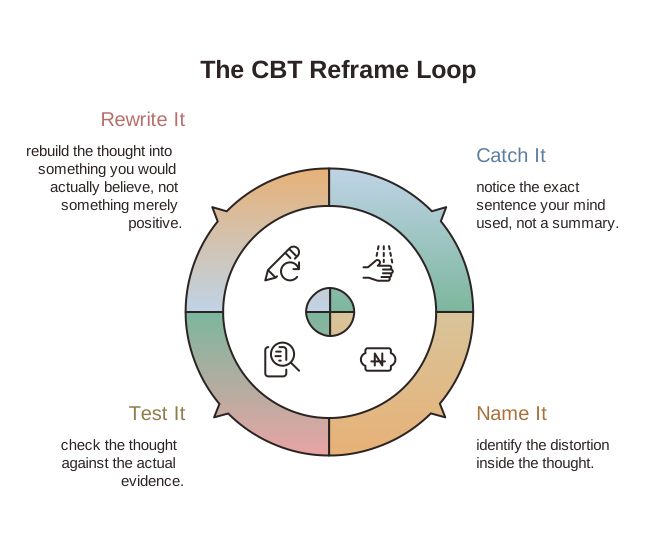
Cognitive behavioral therapy starts from a different premise: the goal is not a happier thought. It's a more accurate one. Accuracy is what your brain will actually accept — and only accepted thoughts change the pattern.
The working loop, on a real thought:
Catch it, verbatim. "I sounded so stupid in that meeting." Not a summary — the actual sentence your brain used.
Name the distortion. This one is mind-reading: you're reporting other people's opinions of you without having access to them.
Test it. What's the evidence? Did anyone react badly? Or is this your interpretation, presented to you as fact?
Rewrite it — believably. "I contributed. I don't know how it landed, and I can ask for feedback if it matters." Notice what that isn't: it isn't positive. It's fair. And fair survives contact with your own skepticism at 11pm, which is the only test that counts.
The one-question quality check
Every reframe you write has to pass a single filter: would you believe it if a friend said it to you? "You're amazing and nothing went wrong" fails — you'd roll your eyes. "You said one awkward thing in a forty-minute conversation; that's normal" passes. The difference between those two sentences is the difference between positivity and reframing, and it's the whole reason one of them works.
This is the exact loop MindLift is built around — you type the thought attacking you, and it walks you through the evidence to a reframe you'd actually believe, in about 60 seconds. Free to start. But the technique works on paper too. What matters is that you stop trying to think positive and start thinking accurately.
Frequently asked questions
Why does positive thinking not work for me?
Probably because your brain is doing its job. Research by Wood and colleagues (2009) found that repeating positive self-statements like "I am lovable" made people with low self-esteem feel worse, not better — the gap between the statement and what they believed generated contradicting thoughts. A thought only changes your patterns if some part of you accepts it as true. That is why CBT reframing aims for accurate, not positive.
What is the difference between positive thinking and cognitive reframing?
Positive thinking pastes a new thought over the old one ("everything will be fine"). Cognitive reframing examines the old thought for accuracy: what is the evidence, what pattern is distorting it, and what would a fair reading of the situation say? The output is often neutral or mixed — "this is hard AND I have handled hard before" — which is exactly why it holds up when your brain pushes back.
Is toxic positivity a real psychological concept?
The term is informal, but the mechanisms behind it are well documented: thought suppression rebounds (Wegner et al., 1987), unbelievable self-statements backfire for the people who need them most (Wood et al., 2009), and indulging in positive fantasies can reduce real-world effort (Oettingen & Mayer, 2002). "Toxic positivity" is the everyday name for demanding a feeling instead of examining a thought.
What should I do instead of forcing positive thoughts?
Work with the thought instead of against it. Write it down exactly as it appears. Name the pattern distorting it — catastrophizing, mind-reading, all-or-nothing. Then test it: what evidence supports it, what evidence does not, and what would you tell a friend who said it? The rewrite you land on should be believable enough that your own brain does not object. That is one reframe, and the skill compounds with repetition.
Like what you're reading?
Continue your wellness journey
Reframe negative thoughts in 60 seconds — free to start in the MindLift app.


Free to start · premium optional