
Turn this into a daily habit — free to start in the MindLift app:
You answered the last question. You got your result: The Caregiver. You read the description and nodded at every line. You screenshotted it, sent it to your best friend with “this is literally me,” and felt seen for about an hour.
Then the next morning, someone asked you for a favor you didn’t have time for, and you said yes anyway.
The quiz wasn’t wrong. It’s just that knowing your pattern and changing your pattern are two different skills. Archetype quizzes are good at the first. This article is about the second.
What your archetype actually tells you
Carl Jung described archetypes as recurring patterns that show up in stories, myths, and dreams across cultures: the hero, the caregiver, the rebel, the wise old guide. The 12-archetype model most online quizzes use came later. It was popularized by writers like Carol S. Pearson and Margaret Mark, who built on Jung’s ideas to describe common ways people move through life.
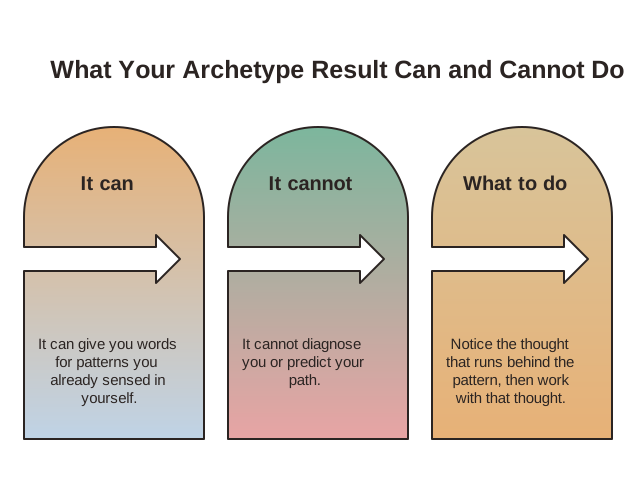
It’s worth being honest about what that means. Archetypes aren’t a diagnosis, and they aren’t validated the way clinical psychology assessments are. Part of why results feel so accurate is the Barnum effect: we tend to read general descriptions as personal ones[1].
That doesn’t make your result useless. It makes it a mirror, not a map. It gives you language for something you already sensed about yourself: I take care of everyone. I always need to know more first. I don’t like being told what to do.
And here’s the useful part. Behind almost every archetype sits a habit of thinking. It’s a sentence that runs automatically when things get stressful. That sentence is what actually drives how you feel and what you do next. And unlike your archetype, it’s something you can work with.
Every archetype has a thought loop
A thought loop goes like this:
Something happens, an automatic thought fires, you feel something, you act on it, and the result seems to “prove” the thought.
- Something happens
- An automatic thought fires
- You feel something
- You act on it
- The result seems to “prove” the thought
Step 5 feeds back into step 1.
In cognitive behavioral therapy (CBT), the bent parts of those automatic thoughts are called cognitive distortions. These are predictable thinking errors that everyone makes, especially under pressure. Each archetype tends to lean on one or two.
Find yours below. Not sure which one you are? Take the 12 archetypes test first, then come back to your section.
The Caregiver
Mind readingThe thought: “If I say no, they’ll be upset with me.”
The distortion: Mind reading. You assume you know what others will think and feel.
The loop: You say yes, you feel drained, you resent it quietly, and you never learn that most people handle a “no” just fine.
A more accurate thought: “They might be a little disappointed. That’s okay. I can care about them and still have limits.”
The Sage
RuminationThe thought: “I need more information before I can decide.”
The pattern: Rumination, or analysis paralysis. Thinking starts to feel like doing.
The loop: More research makes the decision feel bigger, so you research more.
A more accurate thought: “I have enough to make a good-enough choice. I can adjust as I learn.”
The Hero
All-or-nothing thinkingThe thought: “If I fail at this, I’m a failure.”
The distortion: All-or-nothing thinking
The loop: Every challenge becomes a test of your worth, so you either push until you burn out or avoid anything you might not win.
A more accurate thought: “This is one attempt, not a verdict on me.”
The Innocent
CatastrophizingThe thought: “If I bring it up, it’ll ruin everything.”
The distortion: Catastrophizing
The loop: You keep the peace, small problems grow, and the conversation you avoided gets harder.
A more accurate thought: “A calm, honest conversation is more likely to protect this than to break it.”
The Everyman
Mental filterThe thought: “Everyone else has it together. I’m the only one struggling.”
The distortion: Mental filter. You see other people’s highlights and your own behind-the-scenes.
The loop: You compare, you feel behind, you hide it, and so does everyone else.
A more accurate thought: “I’m comparing my inside to their outside. Most people are figuring it out too.”
The Explorer
Fortune tellingThe thought: “If I commit, I’ll be trapped.”
The distortion: Fortune telling. You predict a negative future as if it were fact.
The loop: You keep options open so long that nothing gets the chance to feel meaningful.
A more accurate thought: “Committing to this doesn’t close every other door. I can choose and still grow.”
The Rebel
OvergeneralizationThe thought: “Nobody ever listens to me.”
The distortion: Overgeneralization. One experience becomes “always” and “never.”
The loop: You push back hard, people get defensive, and it feels like proof.
A more accurate thought: “This person didn’t listen this time. Some people do. I can choose where to put my energy.”
The Lover
PersonalizationThe thought: “They haven’t texted back. I must have done something wrong.”
The distortion: Personalization. You assume you’re the cause of things that may have nothing to do with you.
The loop: You replay the conversation, over-explain, and feel more anxious.
A more accurate thought: “There are a dozen reasons people don’t reply right away. Most of them aren’t about me.”
The Creator
“Should” statementsThe thought: “It should be better than this.”
The distortion: “Should” statements. Rigid rules about how things must be.
The loop: Nothing feels ready, so nothing gets shared, and the pressure on the next project grows.
A more accurate thought: “Finished and shared teaches me more than perfect and hidden.”
The Jester
Disqualifying the positiveThe thought: “They only invite me because I make things fun.”
The distortion: Disqualifying the positive. You explain away the good stuff.
The loop: You perform, you can’t relax, and you never test whether people like the quieter you.
A more accurate thought: “People enjoy being around me, not just my jokes.”
The Magician
Emotional reasoningThe thought: “I feel like I’ve lost control, so it must be falling apart.”
The distortion: Emotional reasoning. Treating a feeling as evidence.
The loop: Anxiety feels like proof, so you try to control more, which raises the anxiety.
A more accurate thought: “Feeling out of control isn’t the same as being out of control. What’s actually happening?”
The Ruler
LabelingThe thought: “If I make one mistake, everyone will see I’m not good enough.”
The distortion: Labeling. One action turns into a judgment of who you are.
The loop: You double-check everything, struggle to delegate, and get exhausted keeping up appearances.
A more accurate thought: “A mistake is something I did, not something I am. Good leaders make and fix mistakes.”
If the Caregiver’s loop sounded familiar, the people-pleasing often starts long before any quiz. Read how family roles like the fixer and the peacemaker turn into thought patterns.
Why knowing isn’t enough
If reading your archetype’s thought loop made you wince a little, good. That’s awareness, and it’s the first step.
But here’s the catch. Your thought loop doesn’t show up while you’re reading an article. It shows up at 11pm when a message goes unanswered, in the meeting when someone asks for one more thing, or on the morning you’re supposed to hit “publish.” In those moments, the automatic thought is faster than your insight.
That’s why CBT focuses on practice, not just understanding. CBT is one of the most researched approaches in psychology[2]. It’s built on a simple idea: thoughts, feelings, and actions are linked, and when you change how you respond to a thought, the feeling and the action can shift too. Not by forcing yourself to “think positive,” but by checking the thought against reality, again and again, until the more accurate version starts to come more naturally.
Your archetype tells you which thoughts to watch for. Reframing is how you actually catch them.
How to reframe your archetype’s thought in 3 steps
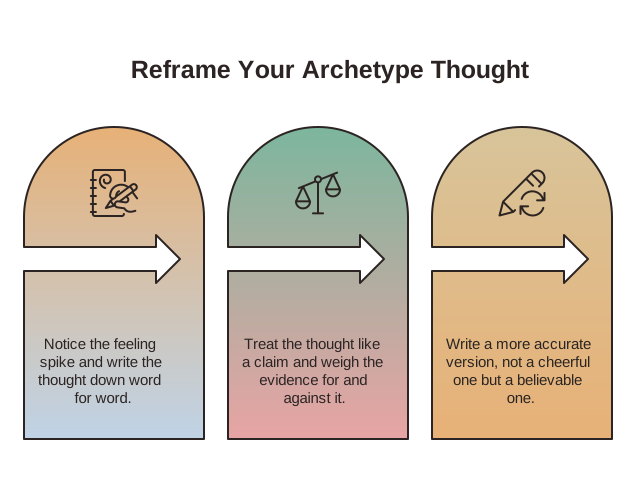
1. Catch it
Notice when the feeling spikes: tight chest, sudden guilt, the urge to over-explain. Then ask: What am I telling myself right now? Write the thought down word for word. Seeing it outside your head makes it smaller.
2. Question it
Treat the thought like a claim, not a fact:
- Is this a fact, or a prediction?
- What evidence do I have for it? Against it?
- What would I say to a friend who thought this?
- Which distortion does it look like? (Your archetype is a good first guess.)
3. Reframe it
Write a more accurate version. Not a cheerful one. A believable one. If the new thought feels fake, it won’t stick.
Here’s a full Caregiver example:
- Situation
- A coworker asks me to cover their shift on Saturday. I already have plans.
- Automatic thought
- “If I say no, they’ll think I’m selfish.”
- Feeling
- Guilt, 8/10.
- Question it
- I’m mind reading. Last time I said no to someone at work, they said “no worries.” I’d never call a friend selfish for keeping plans.
- Reframe
- “They might be a bit disappointed, but saying no to one shift doesn’t make me selfish. I’ve helped plenty of times.”
- Feeling after
- Guilt, 4/10. I said no kindly.
Guilt went from 8 to 4, not to zero. That’s normal. You’re not trying to delete the feeling. You’re making room to choose your response.
Where MindLift fits
Most of us don’t have a therapist on hand at 11pm, which is exactly when the thought loop shows up.
MindLift is a CBT reframing app built for that moment. You write the thought that’s bothering you, exactly as it sounds in your head. MindLift names the pattern behind it and gives you a more accurate way to see it, in about 60 seconds. Reframes come in three tones (Realist, Growth and Compassionate), so you can pick the one you can actually believe.
Save the reframes that land to your Favorites. The next time your archetype’s thought loop shows up in real life, the answer is already waiting.
So if your quiz result made you think “okay, that’s me, now what?”, this is the “now what.”
MindLift isn’t a replacement for therapy. If you’re struggling a lot, talking to a professional is always a good idea. For everyday overthinking, people-pleasing, and second-guessing, though, it gives you a place to practice.
Want the shorter version of each loop? Read your archetype’s signature thought, and how to reframe it.
Catch your archetype’s thought loop and reframe it in MindLift. Free to start, on iOS 15+, Android 8+ and the web.
Download MindLift for iOS and Android
Your archetype shows you the pattern. Reframing is how you change it.
Archetypes are a self-reflection framework, not a diagnosis. If a thought loop is affecting your daily life, consider talking to a licensed mental health professional. MindLift is a self-help tool and not a substitute for professional care.
Frequently asked questions
Are Jungian archetypes scientific?
Jung's archetypes are a framework for understanding recurring patterns in human stories and behavior. They aren't a validated psychological test. They're most useful as a lens for self-reflection, not as a fixed label.
Can my archetype change?
Many people find their result shifts depending on their life stage, stress level, or even mood on the day they take the quiz. That is a good reminder that archetypes describe patterns, not permanent traits.
What's the difference between an archetype and a personality type?
Personality models like the Big Five measure traits on a scale using research-tested questions. Archetypes are more story-based. They describe roles and motivations. Both can be useful for self-understanding in different ways.
How does CBT relate to archetypes?
Archetypes can help you notice your patterns. CBT gives you tools to change how you respond to the thoughts that drive those patterns. They work well together: one shows you where to look, and the other shows you what to do.
Is MindLift therapy?
No. MindLift uses CBT-based techniques to help you practice reframing everyday thoughts. It isn't a substitute for professional care.
Like what you're reading?
Accelerate your growth journey
Reframe the patterns that hold you back — and watch your Top Pattern change over time.


Free to start · premium optional