
Turn this into a daily habit — free to start in the MindLift app:
Two loops, one engine. One replays the meeting that already happened; the other pre-lives the meeting that hasn't. They feel identical from the inside — the same grip, the same refusal to land — but they point in opposite directions, and that difference decides which exit actually works.
What's the difference between rumination and worry?
Direction. Rumination is repetitive thinking aimed at the past ("why did that happen, what does it say about me"); worry is repetitive thinking aimed at the future ("what if it goes wrong"). Researchers group both under repetitive negative thinking because they share one engine — intrusive, hard to stop, unproductive — but the direction changes the exit: past-loops need closure, future-loops need contained planning.
Ehring & Watkins (2008)
The one-sentence difference
Rumination looks backward; worry looks forward. Rumination chews on events that already happened and what they mean — about the situation, and usually about you. Worry runs simulations of events that haven't happened yet and pre-loads the dread. If your loop's signature question is “why did that happen?”, you're ruminating. If it's “what if?”, you're worrying.
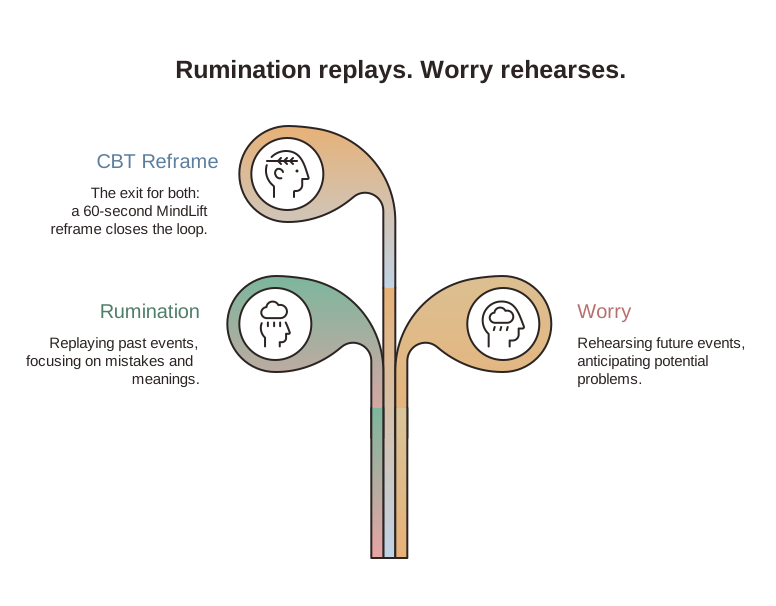
What they share: one engine
The research tradition treats the two as siblings under one name — repetitive negative thinking — because everything except the tense matches: the thinking is intrusive, difficult to disengage from, self-focused, and crucially, unproductive. Neither loop converges on an answer. Both impersonate useful cognition (rumination poses as learning from the past; worry poses as preparing for the future), and both fail the same audit: pass after pass, nothing new comes out. That shared engine is why the same person often runs both, and why the core interruption — covered in how to stop ruminating — transfers between them.
Side by side
| Rumination | Worry | |
|---|---|---|
| Direction | Past | Future |
| Core question | “Why did that happen? What does it mean?” | “What if it goes wrong?” |
| Dominant feeling | Regret, shame, heaviness | Dread, tension, restlessness |
| Impersonates | Learning, honesty, processing | Preparation, responsibility |
| Exit that works | Closure: written endpoint + credible reframe | Containment: scheduled worry time + one-sentence plan |
How is anxiety different from rumination and worry?
How is anxiety different from rumination and worry?
Anxiety is the emotional and bodily state — the bracing, the tension, the sense of threat. Rumination and worry are the thinking loops that feed it: rumination replays the past, worry rehearses the future, and both keep the alarm switched on. Calm the state, then reframe the thought running it.
Nolen-Hoeksema (2000); Borkovec et al. (1998)
It helps to keep one distinction straight: rumination and worry are processes — things your mind does — while anxiety is a state — something your body feels. The loops and the feeling reinforce each other, which is why untangling them changes what you reach for first.
| Rumination | Worry | Anxiety | |
|---|---|---|---|
| What it is | A thinking loop | A thinking loop | An emotional & bodily state |
| Time orientation | Past | Future | Present (felt now) |
| Core driver | “Why did that happen?” | “What if it goes wrong?” | A threat the body is bracing for |
| What helps first | Closure + reframe | Contained planning + reframe | Calm the body, then reframe the thought feeding it |
Why the direction changes the exit
A past-loop is holding something open that is, in reality, closed. What it needs is a closure ritual: the one-sentence version of what happened, the most credible reframe of it, written down — a receipt the loop can stop circling back for.
A future-loop is trying to control something that is, in reality, not yet controllable. What it needs is containment: a scheduled worry window so the topic has a home, plus a single-sentence plan for the one piece that is actionable (“if X happens, I'll do Y”). Worry treated as a scheduling problem shrinks; worry treated as a debate expands.
When you run both
Most heavy overthinkers do — the loop replays yesterday's meeting, then pivots seamlessly into rehearsing tomorrow's. That's still one engine, and the universal sequence still applies: name the loop, audit its output, reframe the repeating sentence. For where these two fit in the wider taxonomy of busy brains, see overthinking vs rumination and overthinking vs anxiety.
Find your loop's signature
Past-replayer, future-rehearser, self-prosecutor, or compulsive fixer — the free What Kind of Ruminator Are You? quiz sorts it in two minutes, no email, and points you at the interruption built for your loop. The full series lives at the rumination hub.
Frequently asked questions
What is the difference between rumination and worry?
Rumination is repetitive thinking aimed at the past — "why did that happen, what does it mean about me" — while worry is repetitive thinking aimed at the future — "what if it goes wrong." Researchers group both under repetitive negative thinking because they run on the same cognitive engine: intrusive, hard to disengage from, and unproductive. The direction determines which interruption works best.
Is rumination worse than worry?
Neither is "worse" — they tax you differently. Brooding rumination is the form most strongly linked to low mood and depression in the research, while chronic uncontrollable worry is the core feature of generalised anxiety. Which one dominates your loops shapes which interruption helps most, and many people run both.
Can you ruminate about the future?
Functionally, yes. The moment your future-thinking stops producing plans and starts re-running the same scene, it has become rumination regardless of tense. Direction matters less than whether the loop converges: planning narrows toward an action; rumination and worry orbit without landing.
How do I stop repetitive negative thinking?
The shared exit for both directions: notice and name the loop, test it for new output (repetitive negative thinking never produces any), and reframe the specific repeating sentence rather than suppressing it. Then apply the direction-specific tool — closure rituals and written endpoints for past-loops, scheduled worry time and single-sentence plans for future-loops.
Like what you're reading?
Stop the spiral in real time
MindLift gives you a gentle CBT-based reframe the moment your thoughts start looping.


Free to start · no account required
- Ehring, T., & Watkins, E. R. (2008). Repetitive Negative Thinking as a Transdiagnostic Process. International Journal of Cognitive Therapy, 1(3), 192–205. — DOI (opens in a new tab)
- Nolen-Hoeksema, S. (2000). The Role of Rumination in Depressive Disorders and Mixed Anxiety/Depressive Symptoms. Journal of Abnormal Psychology, 109(3), 504–511. — DOI (opens in a new tab)
- Borkovec, T. D., Ray, W. J., & Stöber, J. (1998). Worry: A Cognitive Phenomenon Intimately Linked to Affective, Physiological, and Interpersonal Behavioral Processes. Cognitive Therapy and Research, 22(6), 561–576. — DOI (opens in a new tab)
Mental Wellness Writers
The MindLift Wellness Team writes evidence-based content on CBT, self-talk, and everyday mental health tools.
Was this article helpful?