
Turn this into a daily habit — free to start in the MindLift app:
Anxious thoughts feel urgent and involuntary — like something happening to you rather than something you can do anything about. That feeling is accurate in one sense: the thought arrives automatically, without your permission. Where it's inaccurate is in the conclusion it implies — that you're therefore helpless.
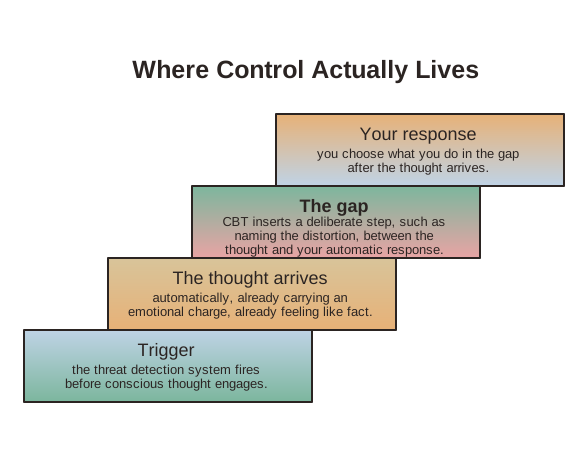
CBT doesn't try to stop thoughts from arriving. It changes what happens between the thought arriving and you acting on it. That gap — between the trigger and the response — is where control actually lives.
Why Anxious Thoughts Feel Uncontrollable
Anxious thoughts are generated by the brain's threat detection system before conscious thought engages. By the time you're aware of the thought, it's already there, already carrying an emotional charge, already feeling like fact.
The brain also has a negativity bias — it processes threatening information faster and more thoroughly than neutral information. An anxious thought isn't a random glitch; it's the system working as designed. The problem is that it often misfires, treating imagined threats or low-probability scenarios with the same urgency as real danger.
CBT techniques work by interrupting this automatic cycle — not by preventing the thought, but by inserting a deliberate step between the thought and your automatic response to it.
The Common Patterns Behind Anxious Thoughts
Most anxious thoughts fall into recognizable distortion categories:
- Catastrophizing — assuming the worst outcome is the most likely one
- Fortune-telling — treating a predicted future as if it's certain
- Mind-reading — assuming you know what others are thinking (negatively)
- All-or-nothing thinking — no middle ground between success and failure
- Overgeneralization — one bad event means everything is bad
- Emotional reasoning — "I feel anxious, therefore something is wrong"
- Personalization — taking excessive responsibility for events outside your control
Identifying which pattern a thought follows is the first step in the CBT process. It converts a vague, overwhelming experience into a specific, recognizable type — and with a type, you have a framework for responding.
“If I say this in the meeting, people will think I'm incompetent.”
Show the answer
Mind-reading. Assuming you know what others are thinking (negatively).
8 CBT Techniques for Controlling Anxious Thoughts
Thought Labeling
Best for: Any anxious thought — the fastest first step
When an anxious thought arrives, name the distortion type before engaging with its content. Say to yourself (or write): "That's catastrophizing" or "That's mind-reading."
Labeling activates the prefrontal cortex (rational thinking) and reduces amygdala activation (emotional reactivity). Research by Matthew Lieberman et al. found that affect labeling reduces emotional intensity in the moment.
Evidence Examination
Best for: Fortune-telling, catastrophizing, emotional reasoning
Write the anxious thought exactly as it is. Then list the actual evidence for and against it — not what you feel is true, but what you can observe or verify.
For each piece of "evidence for," ask: is this actually evidence, or is it another anxious interpretation?
Write a revised thought based on the actual evidence balance.
Decatastrophizing
Best for: Catastrophizing spirals, worst-case-scenario thinking
Identify the worst-case scenario you're imagining. Then ask three questions: (1) How likely is this actually? (2) If it did happen, could I cope? (3) What's the most realistic outcome?
The goal isn't to dismiss real concerns — it's to distinguish between "this could go wrong" (realistic) and "this will definitely be a disaster" (catastrophized).
The Worry Period
Best for: Pervasive, recurring anxiety that interrupts daily function
Schedule a fixed 15–20 minute worry period each day (same time, not before bed). When an anxious thought arrives outside that window, write it down and tell yourself: "I'll address this at the worry period."
This is containment scheduling — it validates the concern (you will address it) without letting it hijack your current activity. Over time, the brain learns the boundary.
The Double Standard Technique
Best for: Self-critical anxious thoughts, harsh self-judgment
Write what you're telling yourself. Then imagine a close friend came to you with the exact same situation and said those words about themselves. What would you actually say to them?
Apply that response to yourself. The standard you'd apply to someone you care about is usually significantly more reasonable than the standard you're applying to yourself.
Grounding (5-4-3-2-1)
Best for: Acute anxiety, panic, or physiological overwhelm — when the thought is accompanied by physical symptoms
Shift attention to sensory experience: name 5 things you can see, 4 you can touch (and feel them), 3 you can hear, 2 you can smell, 1 you can taste.
This interrupts the cognitive loop by redirecting attentional resources to present-moment sensory input. It does not restructure the thought — it reduces the physiological activation that makes the thought harder to examine rationally. Use it as a first step when anxiety is high, before cognitive restructuring.
The Behavioral Experiment
Best for: Avoidance-driven anxiety, mind-reading, fortune-telling about social situations
Identify the prediction your anxious thought is making ("if I say this in the meeting, people will think I'm incompetent"). Design a small, low-stakes test: make the comment in the next meeting and observe what actually happens.
Record the actual outcome. Compare it to the prediction. Most anxious predictions overestimate negative reactions and underestimate your ability to cope with them.
Cognitive Defusion
Best for: Entrenched, repetitive anxious thoughts that won't respond to direct examination
Add distancing language between yourself and the thought. Instead of "I'm going to fail this presentation," say "I'm having the thought that I'm going to fail this presentation."
This technique from Acceptance and Commitment Therapy (ACT) works when CBT's direct examination feels too close to the thought. It creates psychological distance without requiring you to refute the thought's content — useful when anxiety is acute and direct reasoning is difficult.
Which Technique to Use When
The right technique depends on where you are in the anxiety cycle:
- High physiological activation (racing heart, chest tightness): Start with grounding (5-4-3-2-1) or slow breathing. Cognitive work is harder when arousal is high.
- Thought just arrived and feels urgent: Thought labeling first. Name the distortion before engaging.
- Recurring thought you've examined before: Worry period + containment scheduling. You've already done the work; the problem is the recurrence, not the content.
- Self-critical spiral: Double standard technique — compare your self-treatment to how you'd treat someone you care about.
- Social anxiety / fear of judgment: Behavioral experiment. Test the prediction against reality rather than reasoning about it abstractly.
What Doesn't Work
Several intuitive responses to anxious thoughts tend to make things worse:
- Thought suppression: Actively trying not to think something ("don't think about it") reliably increases its frequency. Research by Daniel Wegner demonstrated this as the "rebound effect."
- Reassurance seeking: Repeatedly checking with others or looking up information provides temporary relief but maintains the anxiety loop long-term. It reinforces the belief that the only way to feel okay is to have certainty.
- Avoidance: Avoiding situations that trigger anxious thoughts provides immediate relief but prevents the brain from learning that the situation is manageable. It maintains and grows anxiety over time.
Building the Skill Over Time
Controlling anxious thoughts is a skill, not a switch. Early in the process, the techniques require conscious effort and feel slow. With consistent practice (one application per day when a thought arises), the response becomes faster and more automatic over time.
MindLift's Mini-Reframe applies this process in 60 seconds — you type the anxious thought and get a CBT-based response that names the pattern and reframes that specific thought in three tones: Realist, Growth, Compassionate.
Related Reading
- Overthinking vs Anxiety: What's the Difference
- Cognitive Reframing Techniques: 8 CBT Methods
- How to Stop Overthinking Immediately
- Thinking Traps and Cognitive Distortions
Frequently asked questions
Can you control anxious thoughts?
You cannot prevent anxious thoughts from arising — the brain generates them automatically based on past patterns and perceived threats. What you can control is your response to them: whether you engage with the thought as fact or examine it as a mental event. CBT teaches that response, and with practice it becomes increasingly automatic.
What is the fastest way to stop anxious thoughts?
Thought labeling is one of the quickest techniques: name the distortion ("that's catastrophizing") rather than engaging with its content. This interrupts the automatic believing cycle without requiring extended reflection. Diaphragmatic breathing (slow out-breath) simultaneously reduces the physiological arousal that fuels the thought. Together, they can bring some quick relief.
Why do anxious thoughts feel so believable?
Anxious thoughts feel believable because the brain generates them in the same mental "voice" as accurate thoughts. There is no built-in flag distinguishing a distorted thought from a realistic one. CBT addresses this by teaching you to evaluate thoughts based on evidence rather than how strongly they feel true. Emotional intensity is not a reliable indicator of accuracy.
What is the CBT technique for anxious thoughts?
The core CBT technique for anxious thoughts is cognitive restructuring: (1) identify the specific thought, (2) label the distortion type (catastrophizing, mind-reading, fortune-telling, etc.), (3) examine the evidence for and against, (4) generate a more accurate alternative. This process takes 2–5 minutes per thought and becomes faster with practice.
Like what you're reading?
Continue your wellness journey
Reframe negative thoughts in 60 seconds — free to start in the MindLift app.


Free to start · premium optional