
Turn this into a daily habit — free to start in the MindLift app:
You're standing in a dressing room, or scrolling past someone's beach photos, or just catching your reflection in a store window on a hot day — and the thought arrives before you've even decided to think it: I need to fix this before summer.
Nothing about your body changed in that moment. What changed is that it suddenly became visible, comparable, and — in your head — up for a verdict. That gap between "my body is the same as it was in March" and "I feel like I need to fix it right now" is the actual thing worth looking at. Not your body. The thought.
It's not your body — it's exposure and comparison
Two things happen at once every summer, and both are about visibility, not weight.
First: clothing gets smaller and thinner, which means the body that was quietly covered up for nine months is suddenly on display — at the pool, at the beach, in a swimsuit under fluorescent dressing-room light that flatters no one. That visibility gets processed by the brain as exposure, and exposure reads as threat, whether or not anything about the body itself has actually changed.
Second: summer is the most publicly photographed season of the year. More trips, more group photos, more posts. Which means the comparison data your brain has access to spikes right alongside the visibility — you're not just more seen, you're seeing more of everyone else too, in their most curated, filtered, best-lit form. Comparing your actual, un-retouched body to that feed isn't a fair measurement. It's not even the same category of information. But it doesn't feel that way at 11pm scrolling through someone's trip photos.
The three distortions doing the actual work
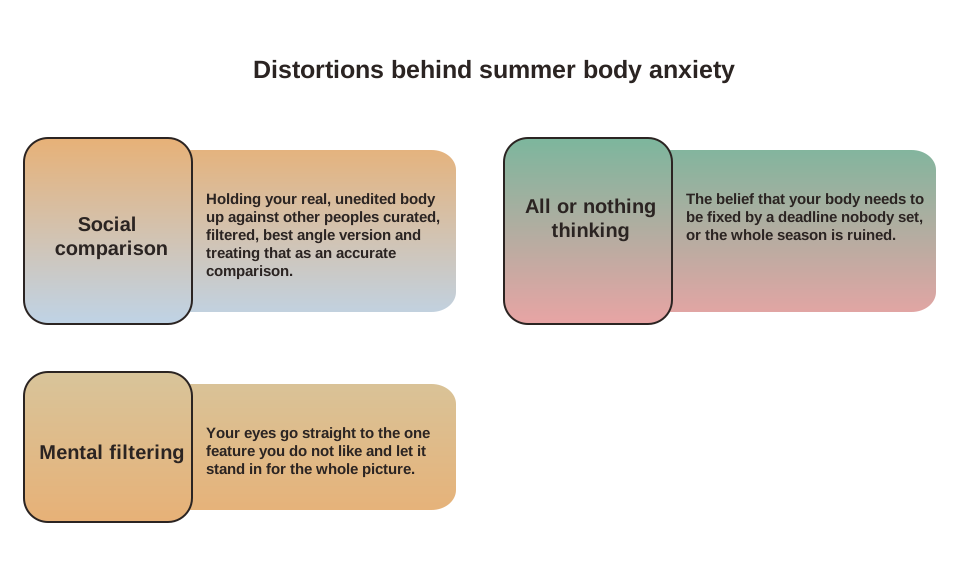
"Summer body anxiety" sounds like a body problem. Underneath it, it's three specific, nameable thinking patterns — cognitive distortions — doing the heavy lifting.
Social comparison. Holding your real body — the one you live in, see up close, and know every imperfection of — up against other people's curated, filtered, best-angle version, and treating that as an accurate comparison. It isn't. You're comparing raw footage to a highlight reel and scoring yourself against the difference.
All-or-nothing thinking. The belief that your body needs to be "fixed" by a specific date — usually some version of "before the trip," "before the wedding," "before summer starts" — or the whole season is ruined. That deadline doesn't exist anywhere except in your head. Nobody is checking. But it functions like a real one, with all the pressure of a real one.
Mental filtering. You catch your reflection and your eyes go straight to the one feature you don't like — filtering out everything else about how you look, how you feel, or what you're actually doing in that moment — and let that single detail represent the whole picture. One data point standing in for all of them.
None of these are facts about your body. They're patterns in how you're thinking about it — which means they're the kind of thing CBT is specifically built to interrupt.
The reframe that actually works
The fact is: summer is arriving, and you have a body. The thought — "that body needs to change first, by a deadline nobody set, to be allowed to enjoy it" — is not a fact. It's a thought wearing a fact's clothing. Reframing it means three specific moves, not just "thinking positive":
- Name the hidden assumption directly. "I need to lose weight before summer" assumes a body has to be earned before it's allowed in public. Say that assumption out loud and it gets a lot harder to accept quietly.
- Reconnect the thought to something you can actually do today. Not a fitness plan — the actual thing the thought is trying to stop you from doing. Wear the swimsuit. Go to the pool. Show up in the photo.
- Validate the discomfort without agreeing with the conclusion. It's real that dressing rooms and beach photos bring up something uncomfortable. That doesn't mean the thought's conclusion — that you need to change before you're allowed to participate — is true.
The goal isn't forcing yourself to feel neutral about your body by willpower. It's catching the thought before it gets to run the rest of your day unquestioned.


Why this is hard to do in the actual moment
All of this is easy to agree with in the abstract and much harder to apply standing in a dressing room with three minutes before you're supposed to meet someone, or scrolling a group chat planning a beach trip you already feel behind on. The thought doesn't wait for a convenient time to examine itself. It runs immediately, and by the time you'd have space to sit down and journal about it, it's already shaped your whole afternoon.
That's the actual gap — not knowing the reframe exists, but having something to do with the specific thought at the moment it's loudest. MindLift takes the exact sentence running through your head, in your own words, and returns three structured reframes in about 60 seconds: a Realist take that names the hidden assumption without softening it, a Growth reframe tied to something you can actually do next, and a Compassionate reframe that validates the feeling without validating the verdict. No workbook, no scheduled session — just something for the dressing room, the pool, the exact minute the thought shows up.
Feeling this kind of comparison spiral more broadly than just body image? The comparison trap runs the same way in other parts of life — same mechanism, different mirror.
There's no date on the calendar where your body becomes allowed in summer clothing. That deadline was never real — it was a thought, dressed up as a fact, and it only holds power for as long as it goes unexamined.
MindLift is a free-to-start app that gives you three structured, CBT-based reframes for any negative thought — in your own words, within 60 seconds. Try MindLift free →
Frequently asked questions
Why do I feel more anxious about my body in summer?
It's not that your body changed — it's that it became newly visible. Summer clothing, pools, and beaches remove the layers that quietly hide the body the rest of the year, and that sudden visibility gets read as exposure, not just weather. On top of that, summer is the most photographed, most publicly posted season, so social comparison — measuring your body against a curated, filtered feed of other people's — spikes right alongside the visibility. The anxiety is about being seen and compared, not about any real change in your body.
What is "summer body" anxiety, psychologically?
It runs on three overlapping cognitive distortions. Social comparison: holding your actual, un-filtered body up against other people's curated highlight reel and calling that a fair measurement. All-or-nothing thinking: the belief that your body has to be "fixed" by a specific date or the summer is ruined — a deadline that exists nowhere except in your head. And mental filtering: scanning your reflection and locking onto the one feature you don't like while filtering out everything else. None of these are facts about your body. They're thinking patterns about it.
Is "summer body" pressure just diet culture?
Largely, yes — the phrase itself normalizes the idea that a body needs to earn the right to be seen in summer clothing, which is diet culture's core message wearing a seasonal costume. But naming it "diet culture" alone doesn't make the anxious thought go away in the dressing room. That takes catching the specific thought — "I can't wear this until I lose weight" — and treating it as a thought to examine, not an instruction to follow.
How do I reframe "I need to lose weight before summer"?
Separate the thought from the fact. The fact is: summer is arriving and you have a body. The thought is: that body needs to change first, by an invented deadline, to be allowed to enjoy it. CBT reframing means naming that hidden assumption directly ("who decided a body needs to be earned?"), reconnecting the thought to something you can actually do today (wear the thing, go to the pool, take the photo), and validating that the discomfort is real without agreeing with the conclusion the thought jumped to. The goal isn't to feel neutral about your body by force — it's to stop treating a thought as a verdict.
Can a CBT app help with body image anxiety in the moment?
The moment this thought hits is rarely a good moment for a 20-minute workbook — it's a dressing room, a group chat about a beach trip, or three minutes before you're supposed to be at the pool. That's the gap a real-time reframe tool is built for. MindLift takes the exact thought in your own words — not a category, not a summary — and returns three structured reframes (Realist, Growth, Compassionate) in about 60 seconds, so the thought doesn't get to run the rest of your day.
Like what you're reading?
Continue your wellness journey
Reframe negative thoughts in 60 seconds — free to start in the MindLift app.
Free to start · no account required
Mental Wellness Writers
The MindLift Wellness Team writes evidence-based content on CBT, self-talk, and everyday mental health tools.
Was this article helpful?