
Turn this into a daily habit — free to start in the MindLift app:
Most advice about building self-esteem gets it backwards. It starts with mindset — think better thoughts, say nicer things to yourself, believe in your worth. As if the belief comes first and the evidence follows.
It doesn't. The belief follows the evidence. Self-esteem is built through what you do and how you interpret what happens — not through telling yourself you're worthy before you've done anything to make that claim feel true.
This is what CBT has been showing for decades: you can't think your way to higher self-esteem. You have to build it through action, examination, and consistent practice. This article explains what that actually looks like.
What Self-Esteem Actually Is
Self-esteem is your overall sense of worth as a person — not your confidence in specific skills, not your mood on a given day, but your baseline belief about whether you matter and whether you're fundamentally adequate.
Low self-esteem isn't a thought. It's a belief system — a collection of conclusions you've drawn about yourself, often early in life, that now operate automatically. When someone criticizes you and the criticism sticks far longer than the evidence warrants, that's the belief system running. When you deflect a compliment because it doesn't feel true, that's the belief system running. When you assume your success is a fluke but your failure is proof of something — that's the belief system running.
Belief systems don't change through positive affirmations. They change through new evidence and through systematic examination of whether the existing conclusions are actually accurate.
Why Positive Thinking Doesn't Work
The brain constantly evaluates new information against existing beliefs. When the existing belief is I'm not enough, an affirmation saying I am worthy triggers cognitive dissonance. The brain recognizes the mismatch and — most of the time — rejects the new statement rather than updating the belief.
This is why people can repeat affirmations for months and still feel unchanged. It's not that affirmations are useless — it's that they're being asked to do something they can't do alone. The belief needs to change from the inside: through evidence, through examination, through repeated experience that contradicts the original conclusion.
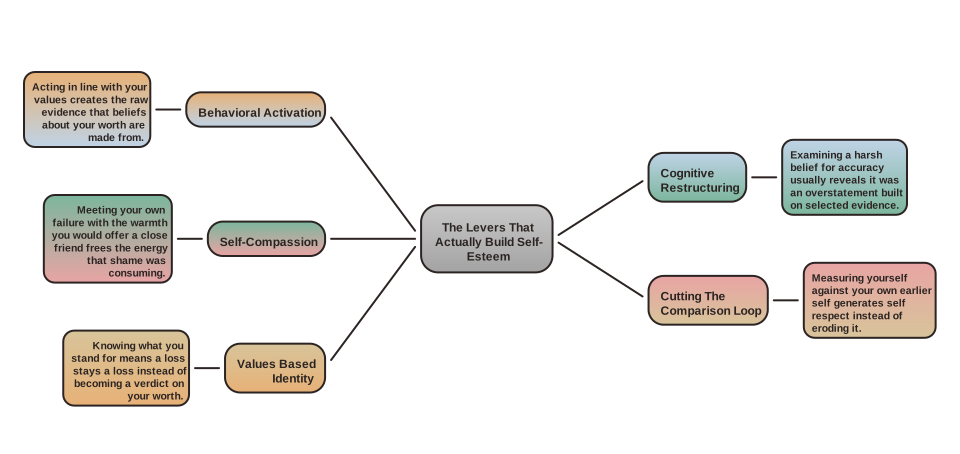
The Four Levers That Actually Build Self-Esteem
1. Behavioral activation — building evidence through action
The fastest lever isn't cognitive. It's behavioral. Self-esteem is built through doing things that align with your values — and noticing that you did them.
Not grand gestures. Small, consistent actions: keeping a commitment to yourself, speaking up when you'd usually stay quiet, finishing something you started, helping someone without needing recognition. These generate the raw material that beliefs are made from.
The key is deliberate attention. The brain tends to filter out confirming evidence when a negative belief is strong. You have to actively notice what you did and let it register. This is counterintuitive — it feels self-congratulatory — but it's how the evidence base actually expands.
Practically: keep a brief daily log. Not a gratitude journal, not a list of things you're grateful for — a record of things you did that mattered. I kept the commitment. I said the hard thing. I finished it when I wanted to quit. Three sentences, every day.
2. Cognitive restructuring — examining the beliefs
Behavioral activation builds new evidence. Cognitive restructuring examines whether the old beliefs were accurate in the first place.
The process: when a negative belief about yourself surfaces — I'm not capable, I don't deserve this, I always mess things up — write it down and examine it systematically. What's the evidence for it? What's the evidence against it? What thinking error is it using (catastrophizing, all-or-nothing, personalization)? What would a more accurate, balanced version look like?
This isn't about arguing yourself into optimism. It's about accuracy — and most low self-esteem beliefs, when examined carefully, turn out to be overstatements. They're based on selected evidence, filtered through a belief that was already looking for confirmation.
The cognitive restructuring worksheet walks through this process step by step. Use it on the beliefs that keep recurring — the ones that arrive automatically when you're criticized, when things go wrong, or when you're about to try something new.
3. Self-compassion — changing the relationship with failure
Low self-esteem is almost always accompanied by harsh self-criticism. When things go wrong, the internal response is disproportionate: not I made a mistake but I am a mistake. Not that didn't go well but I knew I'd ruin it.
Self-compassion doesn't mean excusing poor behavior or lowering standards. It means treating your own suffering with the same care you'd extend to a close friend in the same situation. If a friend told you they'd made the mistake you just made, you wouldn't respond the way your internal voice responds. You'd offer perspective, context, and warmth.
Research by Kristin Neff and others shows that self-compassion is associated with more resilience, not less accountability. People who are self-compassionate bounce back faster from failure — because they're not spending energy managing shame.
The practice: when you notice the harsh inner voice after a mistake, ask explicitly —What would I say to someone I love who just went through this? Then say that. Not the polished version. The actual thing.
4. Cutting the comparison loop
Self-esteem lives or dies by what you compare yourself to. Comparing your internal experience — your doubts, your struggles, your worst moments — to other people's external performance is the fastest way to undermine whatever self-esteem you have.
You're comparing your insides to their outsides. You can't win that comparison. No one can.
The replacement isn't to stop caring about growth — it's to compare yourself to your own earlier self. Am I more capable than I was six months ago? More honest? More aligned with my values? That's a comparison that generates self-respect rather than eroding it.
The Role of Identity
Self-esteem ultimately rests on identity — on who you believe yourself to be, independent of what you achieve or what others think of you.
One of the most durable sources of self-esteem is values-based identity: knowing what you stand for and acting in line with it. You can lose a job, end a relationship, fail an exam — and if you have a clear, stable sense of what kind of person you are and what matters to you, those losses don't reach the level of self-worth. They're painful, but they're losses, not verdicts.
Building values clarity is simple in principle: what qualities do you most want to embody? How are you living them right now? Where are the gaps? The behavioral activation practice above is most powerful when it's connected to those values — not just doing things, but doing things that matter.
What Doesn't Work (And Why)
Waiting for external validation. If self-esteem required consistent external validation to stay stable, no one would have it. External feedback is unpredictable. The goal is internal stability that doesn't rise and fall with praise and criticism.
Achievement without reflection. Achievement builds self-confidence in specific domains — but not self-esteem, unless you pause and let the evidence land. High achievers are often among the most prone to imposter syndrome precisely because they accumulate evidence of capability without ever internalizing it.
Avoiding the situations that trigger low self-esteem. Avoidance provides short-term relief and long-term maintenance of the belief. The situations you avoid are exactly the ones that contain the evidence that would challenge the belief.
How Long It Takes
It varies from person to person, and there is no fixed timeline. What consistent practice builds is not a complete transformation — it is a measurable change in how quickly negative beliefs get challenged and how much they dominate the internal experience.
The compounding is slow and not always visible. There will be weeks where it seems like nothing is happening. The progress is usually visible only in retrospect: comparing how you responded to criticism this month to how you responded six months ago.
Consistency matters more than intensity. Brief daily practices — the win log, the cognitive restructuring when a belief surfaces, the compassionate response to failure — accumulate into a different relationship with yourself. Long occasional sessions do not.
When to Get Professional Support
The tools in this article are effective for mild to moderate self-esteem patterns. For deep-rooted self-worth wounds — particularly those connected to early experiences of conditional love, neglect, or criticism; long-standing identity patterns; or chronic self-esteem that significantly impacts relationships and daily functioning — working with a CBT or schema therapist will take you significantly further.
The barrier for many people is the same belief that needs treating: I should be able to handle this myself. That belief is worth examining too.
If you are still working out whether this is you, the self-esteem hub lists the common signs. Two places low self-esteem hides in plain sight are close relationships and the way many men show it.
Frequently asked questions
How long does it take to build self-esteem?
It varies from person to person, and there is no fixed timeline. What consistent practice builds is not a complete transformation, but a measurable change in how quickly negative beliefs are challenged and how much they dominate. The neural pathways underlying self-worth change slowly. The compounding is real but requires patience and repetition over months rather than days.
Can you build self-esteem on your own?
To a meaningful degree, yes — especially for mild to moderate patterns. The tools in this article (behavioral activation, cognitive restructuring, self-compassion practice) have strong evidence bases and are designed for self-directed use. For deep-rooted self-worth wounds — particularly those connected to childhood experiences, trauma, or long-standing identity patterns — working with a CBT or schema therapist will take you significantly further.
What is the fastest way to build self-esteem?
The fastest lever isn't a technique — it's action. Doing something that aligns with your values, even when it's uncomfortable, generates evidence that you're capable. That evidence is what self-esteem is actually built from. The cognitive and emotional work matters, but it follows the behavioral work, not the other way around.
Is self-esteem the same as self-confidence?
No. Self-confidence is situational — it refers to belief in your ability to perform specific tasks. Self-esteem is deeper: your baseline sense of worth as a person, independent of performance. You can be highly confident in your professional skills while having very low self-esteem in relationships. Building self-esteem targets the deeper layer.
Why does positive self-talk not build self-esteem?
Because the brain evaluates affirmations against existing evidence. If the existing evidence supports 'I'm not enough,' a statement saying 'I am worthy' triggers cognitive dissonance — and the brain rejects it. What actually changes the belief is new behavioral evidence combined with examining the existing beliefs for accuracy. CBT-based approaches work because they examine whether the belief is true, not because they replace it with a better-sounding one.
Like what you're reading?
Continue your wellness journey
Reframe negative thoughts in 60 seconds — free to start in the MindLift app.


Free to start · premium optional