
Turn this into a daily habit — free to start in the MindLift app:
You got the job, the promotion, the grade. People treat you like you know what you're doing. And underneath all of it, some part of you is waiting. Waiting for the moment someone looks a little more closely and figures out that you've been faking it.
That feeling has a name. Imposter syndrome — or imposter phenomenon, as researchers Pauline Clance and Suzanne Imes originally called it in 1978 — is one of the most studied psychological patterns in high-achieving populations. Prevalence estimates vary widely: a 2020 systematic review found rates from 9% to 82%, depending largely on how it was measured.
What the research also shows: it's not evidence of incompetence. It's evidence of a specific, identifiable cognitive pattern that has almost nothing to do with your actual capability.
What's Actually Happening
Imposter syndrome isn't a personality type. It's a set of thinking errors that distort how you interpret evidence about your own competence.
The core pattern: selective attribution. When something goes well, you attribute it to external factors — luck, timing, a generous evaluator, catching someone on a good day. When something goes wrong, you attribute it to internal inadequacy: proof, finally, of what you've always suspected.
This asymmetric attribution means that success never updates the underlying belief. No matter how much positive evidence accumulates, it gets filed under "lucky so far" rather than "actually capable." The belief — I'm not as good as I appear — stays intact.
The second mechanism is mental filtering: the brain selectively attends to information that confirms the existing belief and filters out what contradicts it. Every near-miss, every slightly awkward moment, every piece of feedback that wasn't perfect gets retained and rehearsed. Every moment of genuine competence gets dismissed as circumstantial.
The result: a growing internal record of inadequacy that doesn't represent your actual track record — it represents what your brain chose to keep.
Why It Gets Worse With Success
One of the crueler features of imposter syndrome is that it often intensifies with achievement. The more successful you become, the higher the stakes of being "found out." More people are watching. The expectations are higher. The fall, when it comes, will be further.
This is why people who objectively have strong track records can experience intense imposter syndrome. The evidence of capability is real — but the belief that it's all contingent, all fragile, all about to collapse keeps pace with the evidence. Sometimes it accelerates.
The promotion doesn't fix it. The award doesn't fix it. The external validation lands briefly and then the "yes, but…" starts. Yes, but they don't know the real me. Yes, but this one was easy. Yes, but next time it'll be harder and they'll see.
The Thinking Errors Underneath It
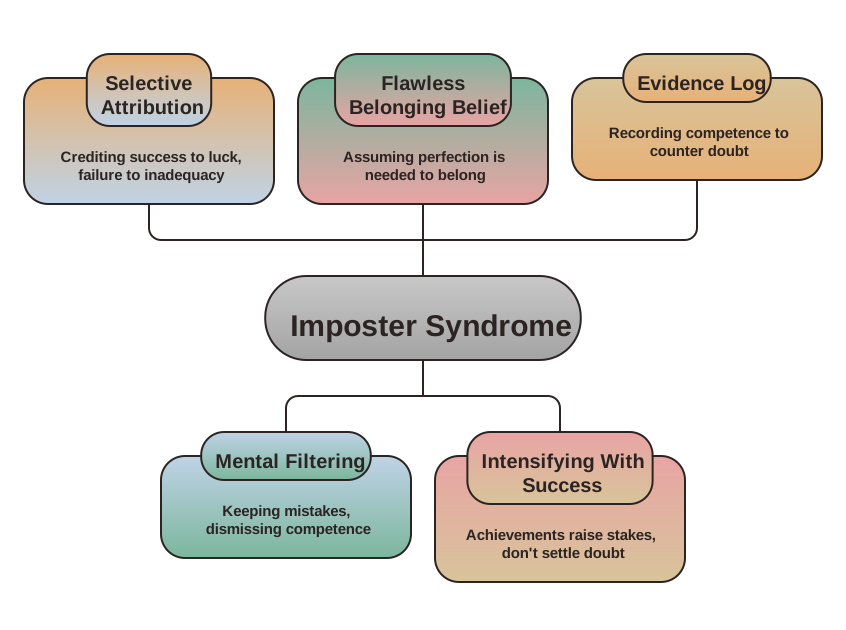
Attribution bias
The fundamental error: taking credit for failure but not for success. Success was luck. Failure was you. This is a direct inversion of reality for most people — most successes involve real skill and most failures involve factors outside your control. Imposter syndrome gets it backwards.
The "flawless belonging" belief
A hidden assumption drives much of imposter syndrome: to belong here, I need to be perfect. Everyone else is fully competent. Everyone else knows what they're doing. I'm the exception — the one who got in by mistake and hasn't been caught yet.
This belief is almost never examined. It's just felt. And it's almost always factually wrong. The colleagues who look fully competent are experiencing versions of the same uncertainty. The confidence you see is often performed.
Mental filtering on the evidence
Your internal evidence log is curated by the belief. It keeps every mistake, every gap, every moment of not knowing. It discards or minimises every success, every piece of genuine capability, every time someone sought you out specifically.
The log isn't a record of your actual competence. It's a confirmation of a conclusion that was already drawn.
What CBT Does Differently
Generic advice for imposter syndrome tends toward: remind yourself of your accomplishments, fake it till you make it, accept that everyone feels this way. These help briefly and then the feeling returns, because they don't address the underlying cognitive pattern.
CBT addresses the pattern directly. The process:
1. Name the attribution pattern
Start noticing when you attribute success to external factors. Write it down explicitly:I just attributed this to luck. Is luck actually a complete explanation? The goal isn't to flip to "it was entirely me." It's to develop an accurate attribution — one that acknowledges both your contribution and the role of circumstance.
What specifically did you do that contributed to this outcome? Not vaguely — specifically. Which skill, which decision, which preparation? That specificity is what builds an accurate evidence base rather than a false modesty reflex.
2. Build an evidence log
Not a gratitude journal. An evidence log — a running record of specific instances of competence. Not "I'm good at my job" but "I identified the problem in the brief that everyone else missed" and "I was the one they called when X happened."
The specificity matters. Imposter syndrome lives in vagueness — "I got lucky" is vague. A concrete record of specific capability is harder to dismiss.
Review the log when the fraud feeling is strong. The question isn't "do I feel capable?" The question is "what does the actual evidence say?"
3. Examine the "flawless belonging" belief
Write it down: To belong here, I need to be flawless. Then examine it the way you'd examine any cognitive distortion.
What's the evidence for this belief? Are the people around you flawless? Have you ever seen them struggle, not know something, make a mistake? Does their belonging appear contingent on perfection?
If belonging required flawlessness, virtually no one would belong anywhere. The belief applies a standard to yourself that you'd never apply to others — and wouldn't hold others to even if you did.
The cognitive restructuring worksheet is useful here: write the belief, examine the evidence for and against it, and construct a more accurate version. Not "I definitely belong and everything is fine" — "belonging doesn't require perfection, and the evidence that I'm competent is more than I typically give myself credit for."
4. Build tolerance for not knowing
Part of what sustains imposter syndrome is treating gaps in knowledge as existential threats. Not knowing something becomes evidence of the fraud rather than a normal part of working at the edge of your current capability.
Practicing saying "I don't know — let me find out" in low-stakes situations builds the tolerance that makes this feel less catastrophic in high-stakes ones. Competence includes knowing how to find out, not just knowing already.
What the Feeling Actually Means
The feeling of being a fraud is not evidence of fraud. It's evidence of a pattern.
The people who evaluate your work — who have access to actual information about your performance — consistently rate you as capable. The people who think you're faking it are you, operating with a biased evidence log and an asymmetric attribution habit.
That's not nothing. It's something to work with. The feeling is real, the experience is real, the anxiety is real — but the conclusion ("I'm a fraud") is a cognitive distortion, not a fact. And cognitive distortions respond to examination.
If you want to see which imposter syndrome patterns are showing up most strongly, the Imposter Syndrome Quiz identifies the specific shape of the pattern — attribution bias, mental filtering, the flawless-belonging belief — so the work can be targeted rather than general.
When to Seek More Support
For most people, imposter syndrome is a manageable pattern that responds to consistent CBT practice. For some, it's more entrenched — tied to early experiences of conditional approval, environments where failure was genuinely dangerous, or identity-level beliefs that are harder to shift through self-directed techniques alone.
If the pattern is significantly affecting your career choices (not applying for things, not speaking up in rooms where you should), your relationships, or your quality of life — working with a CBT therapist will accelerate the process considerably. The cognitive work is the same, but with a skilled guide it happens faster and goes deeper.
Frequently asked questions
What causes imposter syndrome?
Imposter syndrome typically develops in high-achieving environments where performance is heavily evaluated and the cost of failure feels high. It's more common among first-generation professionals, minorities navigating majority environments, and people who received conditional praise growing up (praised for outcomes rather than effort). The underlying mechanism: learning to attribute success to external factors rather than capability, because capability felt uncertain or conditional.
Is imposter syndrome the same as low self-esteem?
Not exactly. Low self-esteem is a global belief about your worth as a person. Imposter syndrome is more specific: it's about competence and belonging in achievement contexts. Someone can have solid self-esteem in relationships and personal life while experiencing strong imposter syndrome professionally. The overlap is the core belief — 'I'm not as capable as I appear' — which is a self-esteem belief specific to the domain of achievement.
Does imposter syndrome go away on its own?
Rarely, and often it worsens with success. Each new achievement raises the stakes — more people watching, more to lose when they 'figure it out.' Without deliberate work on the attribution pattern, more success typically means more intense imposter syndrome. The good news: it responds well to CBT approaches, particularly evidence examination and attribution retraining.
What is the difference between imposter syndrome and being genuinely out of your depth?
A crucial distinction. Being genuinely out of your depth means there's a real skill gap — and the appropriate response is to learn or ask for help. Imposter syndrome means you have the skills but attribute them to factors outside yourself. The test: Do people around you, who can actually evaluate your work, consistently rate you as capable? If yes, the gap is likely in how you're interpreting your own competence, not in the competence itself.
Like what you're reading?
Continue your wellness journey
Reframe negative thoughts in 60 seconds — free to start in the MindLift app.


Free to start · premium optional