
Turn this into a daily habit — free to start in the MindLift app:
Every January, the same thing happens. A new crop of wellness trends shows up in your feed, half of them backed by real research, half of them backed by a ring light and a good hook. By March you've bought the supplement, taped your mouth shut, or downloaded the app — and by June you can't remember why.
This isn't another trend roundup telling you to try everything. It's a sort: which of 2026's biggest wellness trends are backed by actual evidence, which are harmless placebo, and which are quietly making things worse. We looked at the research behind six of the trends dominating this year, in order from most hype to most substance.
Which 2026 wellness trends are actually backed by evidence?
Cortisol cocktails have no mechanism behind them — the HPA axis doesn't respond to a drink. Cold exposure has real short-term mood and soreness evidence, but not the immunity or fat-loss claims. Mouth taping has thin evidence and real risk for anyone with undiagnosed sleep apnea. Slow breathwork is genuinely well-supported. AI companion apps are optimised for engagement, not for helping you need them less. Cognitive reframing has the deepest research base of the six.
Hofmann et al. (2012); Zaccaro et al. (2018)
Cortisol cocktails and "cortisol face": mostly hype
If you've seen a "cortisol mocktail" recipe — usually coconut water, orange juice, and a pinch of salt — the pitch is that it lowers your stress hormone on contact. It doesn't work that way. Cortisol is regulated by your hypothalamic-pituitary-adrenal axis, a slow feedback loop that responds to sleep, chronic stress, and circadian rhythm, not to a drink you finish in ninety seconds. Rehydrating with electrolytes after a workout is genuinely useful. Believing it's "flushing cortisol" is not.
"Cortisol face" — the claim that puffiness or fullness in the face is a visible marker of high stress hormones — has even less behind it. Facial puffiness has a dozen more likely causes: sleep position, sodium intake, allergies, alcohol, normal fluid shifts. There's no validated way to diagnose cortisol levels by looking in a mirror, and the trend mostly succeeds at making people anxious about their own face, which is its own kind of stress.
What's actually true: chronic stress does affect cortisol regulation, and chronically elevated cortisol is linked to real health effects over time. But you address that with sleep, workload, and how you relate to stressful thoughts — not with a drink. If the thought itself is the thing generating the stress, that's a cognitive distortion problem, not a hydration problem. (For a trend that actually survives scrutiny, see the psychology of saying grace — a small gratitude ritual with real research behind it.)
Cold plunge and ice baths: real effect, overstated claims
Cold exposure is one of the few 2026 trends with genuine research behind part of its promise. In controlled work on immersion at 14°C, plasma noradrenaline rose by roughly 530% and dopamine by roughly 250% — which is likely why people describe feeling clear-headed and energized afterward. A later fMRI study of a single five-minute immersion found participants reported more positive affect afterward, alongside increased interaction between brain networks involved in attention, emotion and self-regulation. There's also decent evidence for reduced muscle soreness after intense exercise when cold is applied soon after.
Where it gets overstated: claims that cold plunging "boosts immunity," "burns significant fat," or "detoxes" the body aren't well supported. The metabolic effect of a few minutes in cold water is small next to diet and activity levels, and "detox" isn't something a sauna or an ice bath does for you — your liver and kidneys already handle that continuously.
Verdict: worth trying for the mood and recovery effect if you enjoy it and have no cardiovascular contraindications. Not a substitute for actual stress management, and not the metabolic miracle some accounts suggest.
Mouth taping: thin evidence, real risk for some people
Mouth taping — putting tape over your lips at night to force nasal breathing — has become one of the most viral sleep trends of the last two years, and it carried straight into 2026. The theory (nasal breathing filters air better and may support deeper sleep) has some plausibility. The evidence for the taping itself is thin. A 2025 systematic review pooled ten studies covering 213 patients and found any meaningful benefit was confined to mild obstructive sleep apnea — the two studies showing significant improvement only included people with an AHI under 15.
The bigger issue is who it's risky for. That same review flagged a potentially serious risk of harm — including asphyxiation in the presence of nasal obstruction — for people practising the trend indiscriminately. If you have undiagnosed sleep apnea or blocked nasal passages, taping away your backup airway overnight is not a neutral experiment. This is a trend where the downside for the wrong person is worse than the theoretical upside for anyone.
Verdict: skip it, or at minimum talk to a doctor first if you have any breathing or sleep-disordered symptoms. Working on nasal hygiene and sleep position gets you most of the plausible benefit without the risk.
Somatic breathwork: the trend with the most consistent evidence
Somatic practices — breathwork, body scans, progressive muscle relaxation — have moved from niche to mainstream in 2026, and this is one case where the hype and the research actually line up. A systematic review of slow breathing found consistent psycho-physiological correlates: increased vagal activity, shifts in heart rate variability, and — on the psychological side — increased comfort and relaxation alongside reduced arousal and anxiety symptoms.
The catch is technique and consistency. A single breathwork session at a retreat is unlikely to produce lasting change. The benefit comes from regular practice — a few minutes of slow exhale-focused breathing, done consistently, rather than an occasional intense session.
Verdict: genuinely science-backed, and one of the few trends worth building a habit around rather than trying once. Worth knowing its limit, though: breathing changes the state you're in. It doesn't change the thought that put you there.
AI companion apps: comfort now, dependency later
This is the trend worth being most careful about. AI companion and "AI best friend" apps expanded fast through 2026, offering constant availability, unconditional validation, and a relationship that never pushes back. For people dealing with loneliness, the appeal is obvious.
The concern isn't that these apps feel good — it's what they're optimised for. Most are built to maximise engagement and session length, not to help you need them less. A companion app that always agrees with you, remembers everything, and is available at 3am can start to feel more reliable than the harder, more honest relationships in your actual life. This isn't speculative any more: a 12-month longitudinal study following more than 2,000 adults across four countries found that increased social chatbot use predicted increased loneliness over time, and that feeling less socially connected predicted more chatbot use in turn. The loop runs both ways. The risk isn't that the app fails to comfort you — it's emotional dependency that transfers no skill back to the person.
It's the same trap as reassurance-seeking: the relief is real, it just doesn't compound. This is a useful contrast for what mental fitness tech should actually be doing. A tool that keeps you talking to it isn't the same as a tool that helps you need it less.
Real-time cognitive reframing: the trend backed by the deepest research
Sitting underneath the noisier 2026 trends is a much older, much better-evidenced idea: cognitive behavioural therapy, and specifically cognitive reframing — catching a distorted thought and actively restructuring it. A review of meta-analyses found CBT's evidence base strongest for anxiety disorders and related conditions, and it remains one of the most consistently supported approaches in clinical psychology. A separate meta-analytic review looked at cognitive restructuring specifically — the reframing mechanism itself, rather than CBT as a whole — and found it an effective method for depression and anxiety, at least as effective as behavioural components like exposure.
What's new in 2026 isn't the science — it's the delivery. The gap CBT has always had is timing: a hard thought at 11pm on a Tuesday doesn't wait for your next session, and journaling about it just replays the pain without restructuring it. That's the specific gap MindLift is built for. You type the actual thought in your own words, and within 60 seconds you get three structured reframes — Realist, Growth, and Compassionate — each tagged with the cognitive distortion underneath it, so you're not told to "think positive," you see exactly where the thought bent away from reality. Unlike a companion app, the goal isn't to keep the conversation going. It's mental first aid for the 167 hours a week you're not in a therapist's office — something you use in the moment and then close.
That distinction — tools that build a skill versus tools that build a habit of coming back — is the clearest line between the wellness trends worth your time in 2026 and the ones that are just well-marketed. If you want the templates without the app, the reframe templates cover the same three angles on paper.
The takeaway
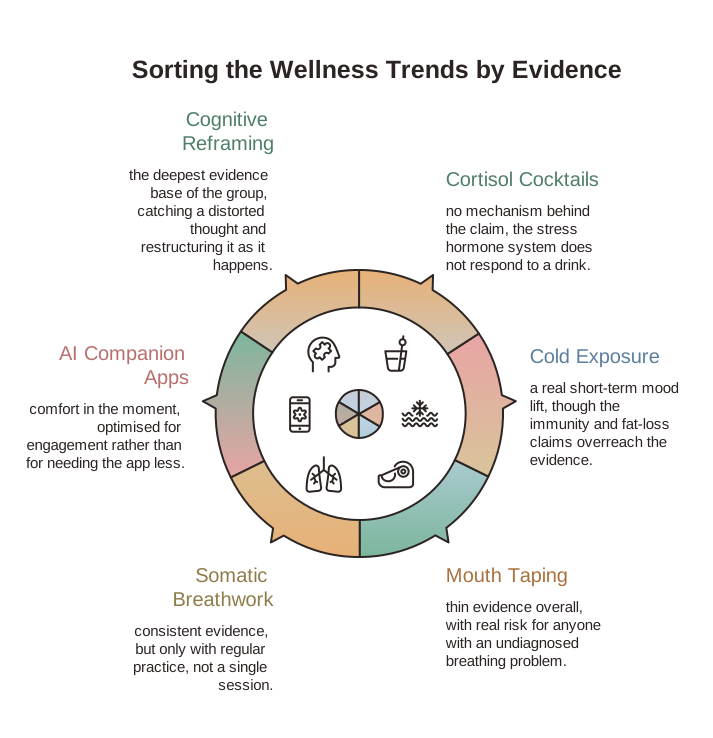
Most 2026 wellness trends fall somewhere between harmless placebo and mildly risky. A small number are worth your time. Breathwork earns its place. Cold exposure earns a narrower one than it claims. The rest mostly earn attention.
If you want to spend your energy on the trend with the deepest evidence base — reframing the actual thoughts causing the stress, rather than managing its symptoms — that's what MindLift is built for. Free to start.
Frequently asked questions
Are any 2026 wellness trends actually backed by science?
Yes — slow breathwork and cold exposure both have real evidence behind part of their promise, though narrower than advertised. Cognitive reframing and CBT-based practices have the deepest and longest-running research base of anything on this list, with decades of controlled trials behind them.
Do cortisol cocktails actually lower cortisol?
No. Cortisol is regulated by the hypothalamic-pituitary-adrenal axis — a slow feedback loop responding to sleep, chronic stress and circadian rhythm, not to a drink you finish in ninety seconds. Rehydrating with electrolytes after a workout is genuinely useful; believing it flushes cortisol is not. Chronic stress does affect cortisol regulation, but you address that through sleep, workload, and how you relate to stressful thoughts.
Is mouth taping safe to try?
Not for everyone. If you have any history of sleep apnea, nasal congestion, or breathing difficulties, skip it or check with a doctor first. The risk is not symmetrical with the unproven benefit: restricting your mouth as an overnight airway option can make things meaningfully worse for the wrong person. Nasal hygiene and sleep position get you most of the plausible benefit without the risk.
Why do unproven trends like cortisol cocktails spread so fast?
They're simple, visual, and offer an easy fix for something actually caused by slower, harder-to-fix factors like chronic stress and sleep. A drink recipe is more shareable than "manage your workload and sleep more consistently."
What is the difference between an AI companion app and a CBT app?
A companion app is generally designed to maximise how much you talk to it — engagement and session length are the success metrics. A CBT-based tool is designed to help you catch and restructure a specific thought and then move on. The metric that matters is whether the distortion gets caught, not how long you stay in the app.
What is the single most evidence-backed wellness habit for 2026?
Catching and restructuring distorted thoughts in the moment they happen. It is less viral than a cold plunge, but cognitive behavioural therapy has the strongest research base of anything covered here.
Like what you're reading?
Continue your wellness journey
Reframe negative thoughts in 60 seconds — free to start in the MindLift app.


Free to start · premium optional