
Turn this into a daily habit — free to start in the MindLift app:
It's 11:40pm. You sent one slightly-off email eight hours ago, and you are still there, rewriting it in your head.
Why did I say "just checking in" — that sounds passive aggressive. They probably think I'm annoying. I should've called instead. I always do this. You're not solving anything. You're not even thinking about the email anymore, really. You're just… looping. Idiot. Why do you always do this.
If you've been there, you've met what psychologist Ethan Kross calls "chatter" — the version of your inner voice that stops being useful and starts being a problem. Kross runs the Emotion & Self Control Laboratory at the University of Michigan and has spent two decades studying the voice in our heads. In his book Chatter, he lays out something that sounds almost too simple: the goal isn't to silence that voice. It's to change how it talks to you — from a critic into a coach.
That distinction matters more than it sounds like it should. Here's the mechanism behind it, and what actually works to shift it.
What "chatter" actually is (and why it's not a personal failing)
Chatter is the unhelpful mode of your inner voice: rumination, worry, or self-criticism running on a loop without resolving. It isn't a character flaw — it's a process that occupies working-memory bandwidth, which is why a spiral leaves you with less attention for everything else.
Everyone narrates their own life internally — it's how you rehearse a hard conversation before you have it, or talk yourself through a tough workout. That inner voice is a genuinely useful tool. It becomes a problem in three specific, identifiable patterns — and most people run one of them far more than the other two (the inner critic type quiz sorts out which):
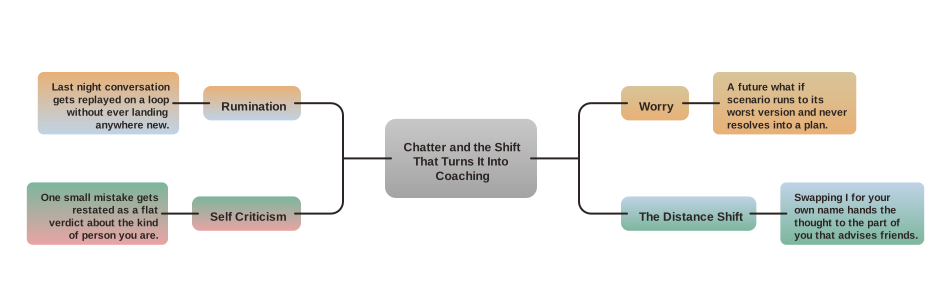
- Rumination — replaying something that already happened, on a loop, without landing anywhere new. Not processing. Just repeating. (If that's your default mode, our rumination hub and the rumination-type quiz break down which loop you tend to run.)
- Worry — running future "what if" scenarios, usually toward the worst-case version, without any of them resolving into a plan.
- Self-criticism — the flat, harsh judgment. Not "that email could've been clearer" but "you're bad at this." (There's a whole taxonomy of these; we catalogued the common phrasings in negative self-talk examples.)
The reason this feels so exhausting isn't dramatic — it's mechanical. Your working memory has a limited amount of bandwidth, and chatter occupies it. That's why you can be mid-conversation with someone and realize you haven't heard the last thirty seconds, because part of your mind is still replaying the email. The chatter isn't a character flaw. It's a resource-hogging process, and it happens to run in the background whether or not you invited it.
That reframe alone tends to do something useful: it moves the problem from "something is wrong with me" to "this is a mechanism, and mechanisms can be worked with." Which is the whole opening for what comes next.
Why "just stop thinking about it" doesn't work
If willpower solved this, it would've solved it years ago. The instruction to "just stop" fails for a structural reason: you're using the exact same overloaded system — your own first-person perspective — to try to regulate itself. It's like trying to proofread your own writing five minutes after you wrote it. You're too close to it to see it clearly.
This is the paradox of introspection: the tool that lets you solve problems is the same tool that gets you stuck in them, and from the inside, it's hard to tell which mode you're in.
You can't proofread your own thoughts from the inside. Distance is the edit.
Why willpower fails against chatter: the system doing the regulating is the system that's stuck.
The one shift: distanced self-talk
The technique with the most consistent research behind it is something Kross calls distanced self-talk, and it's disarmingly simple: talk to yourself the way you'd talk to a friend, using your own name or "you" instead of "I."
Not "I can't believe I said that," but "Sasha, that email was fine. You've sent worse and it was fine."
The shift in pronoun isn't a gimmick — it creates just enough psychological distance for you to access the advice-giving, coaching part of your mind instead of the panicked, too-close-to-it part. It's the same reason it's dramatically easier to spot the obvious solution to a friend's problem than to your own identical problem. Third-person framing borrows that outside vantage point and turns it on yourself. (We go deeper on the research behind that asymmetry in why you're so much harder on yourself than on anyone else.)
This is, functionally, the difference between an inner critic and an inner coach. A critic talks at you, in first person, with judgment. A coach talks to you, with a little distance, and actual usable advice. Same voice. Different vantage point.
Lifelines for when you're already in the rabbit hole
Distanced self-talk works best as prevention. But some nights you're already three loops deep before you remember any technique exists. For that, a few other tools help pull you back out:
Mental time travel. Ask yourself how much this will matter in a year. Not to minimize it — to get temporal distance the same way distanced self-talk gets you interpersonal distance. Chatter collapses your sense of time; this reopens it.
Chatter advisors. People who do two things in the right order: validate first, advise second. Someone who jumps straight to "well, you could've just called" without first acknowledging that you feel bad tends to make chatter worse, not better — even with good intentions. The order is the whole trick.
Environmental resets. Time in nature — a walk, trees, open sky — can calm rumination. It's not about the exercise; it's that vast, open environments produce a "self-shrinking" effect that puts your looping thought back into proportion. (More options in how to stop ruminating.)
Rituals. Small, structured, repeatable actions — the same warmup before every game, the same routine before a hard conversation — give your mind a predictable container to move through instead of spiraling in an open one.
Each of these works. None of them are available at 11:40pm when the loop starts and you're alone with your phone and the sent email still open in another tab.
The real gap isn't the technique — it's doing it alone, in the moment
Here's the honest problem with all of the above: distanced self-talk is a skill, and skills are hardest to execute in exactly the moment you need them most. Talking to yourself in third person while you're already spiraling requires a level of self-awareness that the spiral itself tends to eat first. It's not that the technique doesn't work. It's that doing it solo, from inside the chatter, is genuinely hard — the same way it's hard to stretch a muscle that's already cramping.
That's the gap MindLift was built to sit inside.
You type the actual thought — not a cleaned-up version, the real one, "I'm an idiot, I always do this" — and in about 60 seconds you get it handed back to you from outside your own head: reframed three ways, with the distortion behind it named — catastrophizing, mind-reading, or all-or-nothing thinking. The three reframe cards each take a different angle: Realist strips the thought back to what's actually examinable, Growth finds the smallest next step, and Compassionate meets the feeling underneath without judgment. That's distanced self-talk with the distance already built in — because someone else's structure is doing the third-person work your own mind can't do while it's mid-spiral.
It's not a meditation app asking you to already be calm before you open it. It's not a journal that keeps you circling the same thought in your own words. It's mental first aid for the 167 hours a week you're not in a therapist's office — free to start, with premium available, and built for the exact 11:40pm moment this article started with. It supports professional care rather than replacing it.
The next time the loop starts, don't wait for it to pass on its own. Say your own name first — then say the thing you'd say to a friend. And if the voice is louder than your ability to do that, hand it to something that can do the distancing for you.
Frequently asked questions
Is "chatter" the same thing as anxiety?
Not exactly. Chatter is the mechanism — the specific loop of rumination, worry, or self-criticism. Anxiety can be one output of chronic chatter, but chatter itself is better understood as a pattern of thought, not a diagnosis.
Does distanced self-talk actually work, or is it just positive thinking?
It's different from positive thinking because it doesn't ask you to believe something rosier — it asks you to shift vantage point. You can use distanced self-talk to tell yourself an honest, even hard truth. The point isn't optimism; it's clarity.
How long does it take to see a difference?
Most people notice the effect the first time they successfully use third-person framing mid-spiral — it's less a habit you build over months and more a switch you learn to flip. The harder part is remembering to flip it when you're already deep in the loop, which is the exact problem real-time tools are meant to solve.
What's the difference between an inner critic and an inner coach?
Same inner voice, different framing. A critic narrates in first person and stops at judgment. A coach uses a little distance and ends at a next step. The shift is structural, not a personality change.
Like what you're reading?
Continue your wellness journey
Reframe negative thoughts in 60 seconds — free to start in the MindLift app.


Free to start · premium optional