
Turn this into a daily habit — free to start in the MindLift app:
The Bottom Line
Feeling stuck at work is usually a perception problem, not a reality. Three common negative thoughts—'I'm not making progress,' 'Everyone else is doing better,' and 'I keep failing'—can be reframed using cognitive techniques to recognize hidden progress and build resilience.
Feeling stuck at work is more common than we like to admit. Here are 3 common negative thoughts and how to replace them with empowering alternatives.
1. "I'm not making any progress."
Progress isn't always loud. Small steps still count.
Small, steady steps are often easier to sustain than dramatic leaps.
When you're deep in a project or going through a challenging season at work, progress can feel invisible. But the brain's negativity bias makes setbacks memorable while overlooking quiet wins.
Reframe: "I can't see all the progress I'm making right now. Small steps still count, and I've taken some today."
2. "Everyone else is doing better than me."
Comparison is one of the most common workplace cognitive distortions. When you compare your insides to other people's outsides, you're comparing your struggles to their highlight reel.
Comparing yourself to colleagues can feel like a threat, and stress can make problem-solving harder, not easier.
Reframe: "I'm comparing my whole experience to someone else's visible output. I don't know their full story — and they don't know mine."
3. "I keep failing at this."
All-or-nothing thinking turns setbacks into identity statements. "I failed at this task" becomes "I keep failing" — which becomes "I'm a failure." Each step in that chain is a cognitive distortion.
CBT teaches us to separate behavior from identity, and outcomes from character. You didn't fail — a specific approach didn't work. That's data, not destiny.
Reframe: "This approach didn't work. That tells me something useful. I can try differently next time."
Why These 3 Distortions Are So Common at Work
Workplaces are particularly fertile ground for cognitive distortions — and not by accident. Three structural features make it almost inevitable:
Visibility. Performance is observable. You're seen making mistakes, being passed over, or falling behind. The comparison surface area is enormous — and your brain's threat-detection system was built for precisely that kind of social monitoring.
Ambiguity. Most workplace feedback is indirect or delayed. You don't know if your presentation landed well, whether your manager is satisfied, or how your output compares. The brain fills that uncertainty with pattern-matching — and negative patterns get more weight because they feel more "useful" for self-protection.
Identity investment. For many people, professional identity is closely tied to self-worth. This means failures at work don't feel like failures at tasks — they feel like failures as people. That's the jump from "this approach didn't work" to "I keep failing," and it happens in milliseconds.
The workplace doesn't create cognitive distortions — it activates ones that were already there.
Understanding the environment helps you stop blaming yourself for thought patterns that are a predictable response to real structural pressure.
A Quick Self-Check: Are You in a Thought Loop?
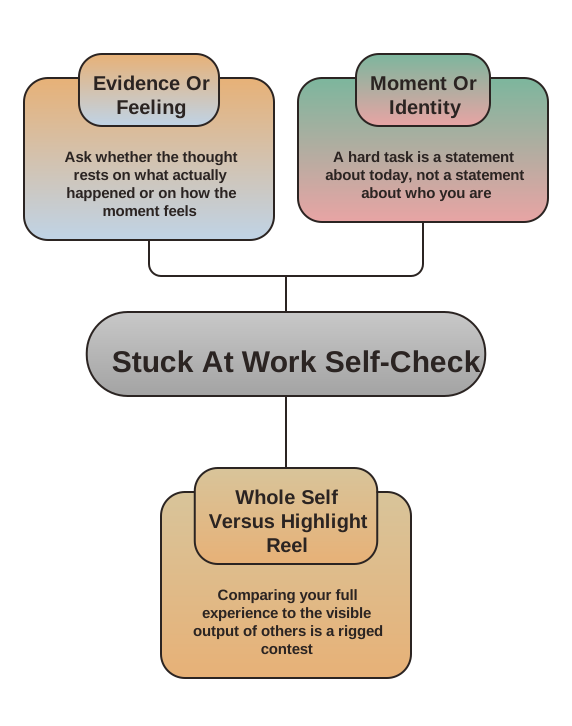
Before trying to reframe anything, it helps to recognize when you're actually caught in a distortion versus when you're making a reasonable assessment. Here's a 3-question check you can run in about 30 seconds:
- Is this thought based on evidence, or on how I feel? ("I haven't seen results" vs. "I feel like I'm failing.") Feelings are real — but they're not always facts.
- Am I comparing my full experience to someone else's visible output? If yes, you're almost certainly missing the parts of their story that look like yours.
- Is this a statement about a moment or a statement about who I am? "This task is hard" and "I am bad at this" are different claims with very different consequences.
If any of these reveal a distortion — that's the reframe entry point. Not a command to "think positive," but a recognition that the thought has moved from data to story.
Building a Reframing Habit at Work
Reframing isn't something you do once. It's a practice — and like most practices, it becomes easier when it's anchored to something you already do.
A few approaches that work in real workplace contexts:
- End-of-day micro-review: Spend 90 seconds before you close your laptop identifying one thing that went better than the story you told about it. Not celebrating — just correcting the record.
- The "what did I actually do?" question: When you feel like you made no progress, list three things you did, however small. The goal isn't gratitude — it's accuracy.
- Name the distortion before reframing it: "That's comparison thinking" or "that's all-or-nothing thinking" gives the thought a label. Labels create distance. Distance reduces urgency.
- Keep the reframe short: Long, elaborate counter-arguments are easy to dismiss under stress. A short sentence — "this approach didn't work; I can try differently" — is harder to argue with and easier to return to.
The goal isn't to become someone who never has negative workplace thoughts. It's to reduce the time between having one and recognizing it for what it is.
Frequently asked questions
How do I know if negative thoughts are affecting my work performance?
Signs include procrastination, avoiding challenges, feeling overwhelmed by tasks, comparing yourself constantly to others, and experiencing chronic stress or anxiety at work.
How do I reframe negative thoughts at work?
Identify the negative thought, question its accuracy, then replace it with a balanced alternative. For example, 'I'm not making any progress' becomes 'Progress isn't always loud. Small steps still count.'
Why do I feel stuck at work?
Feeling stuck often stems from cognitive distortions like all-or-nothing thinking, comparing yourself to others, or discounting small wins. These thought patterns mask real progress you've been making.
Like what you're reading?
Continue your wellness journey
Reframe negative thoughts in 60 seconds — free to start in the MindLift app.


Free to start · premium optional