
Turn this into a daily habit — free to start in the MindLift app:
You said "no worries, whatever works for you" again. You meant to speak up in the meeting and didn't. Someone asked where you wanted to eat and you heard yourself say "I don't mind" before you'd even checked whether you minded.
None of these felt like a big deal. That's the point. Self-abandonment almost never announces itself. It just quietly files another piece of evidence that your preferences are negotiable — and then you wonder, weeks later, why you feel less sure of yourself and can't point to a single reason.
There's a reason. It's just smaller and more repetitive than the story you've been telling yourself about "just not being a confident person."
What self-abandonment actually is
Self-abandonment is the habit of overriding your own signals — needs, opinions, gut reactions, limits — to keep other people comfortable or to avoid the friction of being fully yourself.
It's rarely dramatic. It looks like:
- agreeing out loud while disagreeing internally, and not noticing the gap
- apologising for things that aren't yours to apologise for
- talking yourself out of a feeling before you've felt it ("it's fine, it's not a big deal")
- saying yes with your mouth while your body is clearly saying no
- editing your opinion down to the version least likely to cause a reaction
Most people who do this constantly don't experience themselves as people-pleasers. They experience themselves as easy-going, low-maintenance, considerate. Those are the same behaviours wearing a nicer outfit.
Naming it matters, because you can't reframe a pattern you've labelled as a personality trait. "I'm just shy" is a dead end. "I keep abandoning myself in rooms with authority figures" is something you can actually work with.
Why it specifically destroys confidence
Here's the part almost nobody connects.
Confidence isn't a mood you summon before you walk into a room. It's a track record. It's the accumulated evidence that when it matters, you'll back yourself. You feel confident to the degree that some part of you has watched you show up for you before and expects you to do it again.
Self-abandonment attacks that record at the source.
Psychologists have a well-supported idea called self-perception theory — the finding that we infer our own attitudes and beliefs partly by observing our own behaviour, the same way we'd read someone else. You don't just decide who you are and act accordingly. You watch what you do and conclude who you must be.
So follow the loop. Every time you watch yourself go quiet, defer, shrink, or override a real preference, some part of you is taking notes: apparently my needs come last. Apparently I'm not someone worth backing. You are, without meaning to, teaching yourself that you are not reliable to yourself.
You are, without meaning to, teaching yourself that you are not reliable to yourself.
Self-perception theory: every small deferral is another entry in the record your confidence is reading from.
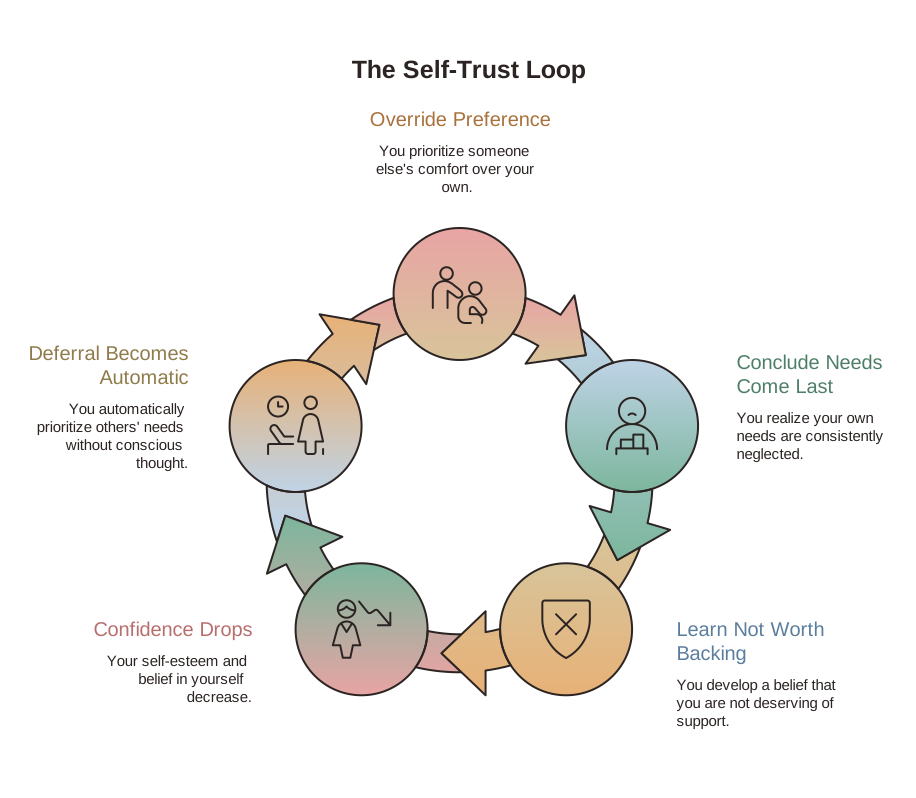
That's the erosion. Not one big failure of nerve — thousands of tiny withdrawals from an account you didn't know you were keeping. This is also why "just be more confident" advice bounces off: it's aimed at the feeling, when the problem is the ledger underneath it.
The distortions running the loop
Self-abandonment doesn't run on nothing. It runs on a handful of predictable thinking errors that make betraying yourself feel like the responsible, kind, or safe thing to do.
If you learn to spot these in the moment, the whole pattern gets a lot less automatic:
- Mind reading — "They'll think I'm difficult if I say what I want." You've decided what's in someone's head and then rearranged your behaviour around a guess.
- Emotional reasoning — "I feel guilty for saying no, so saying no must be wrong." A feeling gets treated as a fact about reality.
- "Should" statements — "I should be more accommodating." A rule you'd never impose on a friend, enforced ruthlessly against yourself.
- Discounting your own signal — "It's not a big deal" as an automatic reflex, applied before you've actually checked whether it was a big deal.
None of these are character flaws. They're overlearned shortcuts. And the first repair isn't a grand act of assertiveness — it's simply catching the thought while it's happening, before it becomes another deferral.
What actually rebuilds it
The counterintuitive part: the action comes before the confidence, not after.
Most people are waiting to feel sure before they hold a position, ask for the thing, or let a preference be visible. But if confidence is a track record of backing yourself, then it can only be built in the exact moments you'd normally abandon yourself — which means you'll be doing it before it feels comfortable. That's not a sign you're doing it wrong. That's the whole mechanism.
The reps are small and boring:
- Noticing "I don't mind" leaving your mouth and quietly asking yourself whether that's true.
- Letting a preference exist out loud even when it's mildly inconvenient for someone.
- Catching the guilt spike after a boundary and not immediately obeying it.
The hard part isn't knowing this. It's that self-abandonment happens fast — in the two seconds between someone asking and you answering. By the time you're journaling about it that night, the moment's long gone. You need something at the point of the spiral, not hours later.
This is exactly the gap MindLift was built for. You type the thought as it's actually running — "if I say no she'll be annoyed with me" — and within about a minute you get three grounded reframes back, each tagged with the distortion driving it (that one's mind reading), all built from your own words rather than someone else's affirmation. It's not a mood-fixer and it's not therapy. Think of it as mental first aid for the 167 hours a week you're not in a therapist's office — the ordinary moments where the choice to back yourself or abandon yourself actually gets made.
You don't rebuild self-trust in a breakthrough. You rebuild it one caught thought at a time.
The one thing to take with you
You are not an inherently unconfident person. You're someone who's been quietly voting against yourself in small rooms, and then reading the tally as a personality.
The vote is reversible. Not by feeling braver first, but by catching one thought — the next time "I don't mind" tries to leave your mouth — and asking whether it's actually true.
Catch the next thought as it happens. Try MindLift — one thought in, three grounded reframes back.
Frequently asked questions
Is self-abandonment the same as being selfless or kind?
No — and the difference is whether you're in the room. Genuine generosity includes your own needs in the equation. Self-abandonment removes you from it entirely, which isn't sustainable kindness; it's a slow disappearance dressed up as virtue.
How do I know if I'm doing it?
A quick tell: notice how often you say "I don't mind," "it's fine," or "whatever works" before you've actually checked whether you mind. Reflexive agreement is usually a deferral, not a preference.
Can I fix this without therapy?
Therapy is genuinely valuable, especially if this is rooted in early attachment patterns. But the pattern itself lives in tiny everyday moments between sessions — which is where a lot of the repair has to happen too. In-the-moment tools and a therapist aren't competitors; they cover different hours.
Why does saying no make me feel guilty even when I'm right?
That's emotional reasoning — your brain treating the guilt spike as proof you did something wrong. The guilt is a conditioned alarm, not a verdict. It tends to quiet down the more times you don't obey it.
Like what you're reading?
Continue your wellness journey
Reframe negative thoughts in 60 seconds — free to start in the MindLift app.


Free to start · premium optional