
Turn this into a daily habit — free to start in the MindLift app:
You finally get into bed. The lights are off. The room is quiet. And suddenly your brain decides it's the perfect time to replay every awkward conversation, analyze tomorrow's problems, and imagine worst-case scenarios that haven't happened.
If you've ever wondered "Why do I overthink at night?", you're not alone. For many people, nighttime is when racing thoughts become the loudest. The distractions of the day disappear, leaving you alone with your thoughts. What starts as problem-solving often turns into endless mental loops that steal sleep and increase anxiety.
The good news? You don't need to stop thinking entirely. You just need to stop feeding the spiral. In this guide, you'll learn why overthinking gets worse at night and how to break the cycle using evidence-based techniques inspired by Cognitive Behavioral Therapy (CBT).
Why Do We Overthink More at Night?
Your brain isn't broken. There's a reason nighttime thinking feels so intense.
During the day, your attention is occupied by work, conversations, notifications, errands, and responsibilities. At night, those distractions disappear. The brain naturally turns inward.
Research in cognitive psychology shows that when we're tired, stressed, or emotionally activated, we're more likely to engage in rumination: repetitive thinking that focuses on problems without finding solutions. CBT identifies rumination as one of the key processes that maintains anxiety and low mood. The result? Instead of solving problems, your brain keeps circling them.
Tiredness also weakens the brakes. In one brain-imaging study, a single night without sleep left the amygdala (the brain's alarm system) reacting about 60% more strongly to upsetting images, with weaker links to the prefrontal areas that normally calm it down (Yoo et al., 2007). A 2021 set of meta-analyses found the same pattern across many studies: sleep loss worsens mood and makes emotions harder to regulate (Tomaso et al., 2021). That is why a small worry at 11pm can feel like a crisis at 2am.
Signs You're Overthinking Instead of Problem-Solving
Healthy reflection sounds like:
- "What can I learn from this?"
- "What's one step I can take tomorrow?"
- "Is there anything I can control?"
Overthinking sounds like:
- "What if everything goes wrong?"
- "Why did I say that?"
- "What if they think badly of me?"
- "I need to figure this out right now."
Notice the difference? Problem-solving moves forward. Overthinking moves in circles.
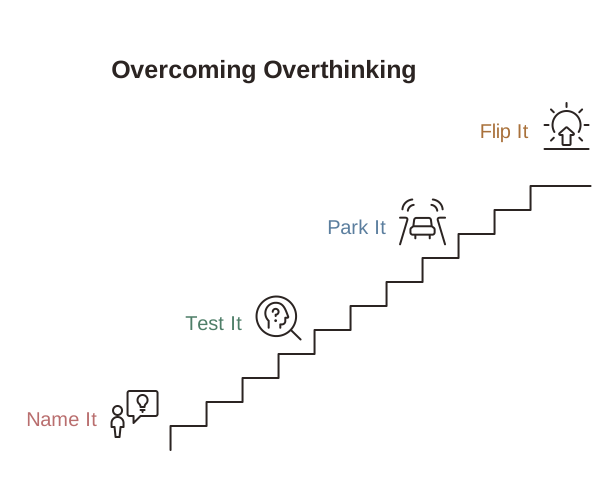
1. Name the Thought Pattern
One of the simplest CBT techniques is identifying the type of thought you're having. Many nighttime thoughts are examples of cognitive distortions:
- Catastrophizing — "Tomorrow will be a disaster"
- Mind-reading — "They must think I'm incompetent"
- Fortune-telling — "I know this won't work"
- Emotional reasoning — "I feel worried, so something must be wrong"
- All-or-nothing thinking — "If I fail once, I'm a failure"
These thinking traps are well-documented in CBT literature and often feel convincing because they appear automatically. Try asking: "What kind of thinking trap is this?" The moment you label the thought, you create distance from it.
2. Ask: Is This a Thought or a Fact?
One reason overthinking feels so powerful is that thoughts often masquerade as facts.
Thought: "Everyone thinks I messed up."
Fact: "I don't actually know what everyone thinks."
Thought: "I'll never figure this out."
Fact: "I haven't figured it out yet."
CBT teaches that thoughts influence emotions, but thoughts themselves are not evidence. Learning to examine them reduces their emotional impact.
3. Schedule Tomorrow's Worry Time
This sounds strange, but it works. Instead of arguing with your thoughts, tell your brain: "I'll think about this tomorrow at 10:00 AM."
Many worries feel urgent simply because they're demanding attention right now. Creating a dedicated "worry appointment" teaches your brain that the issue isn't being ignored — it's just being postponed. Most people discover that by the time tomorrow arrives, many of the worries no longer feel important.
4. Stop Trying to Solve Life at Midnight
Nighttime brains are notoriously unreliable. When you're tired:
- Problems look bigger
- Confidence feels lower
- Uncertainty feels threatening
- Emotional reactions become stronger
A useful rule: never make major life decisions after 10 PM. The same situation often looks completely different after sleep.
5. Use a Brain Dump
Your brain keeps repeating thoughts because it's trying not to forget them. Writing them down tells your mind: "This is stored. You don't have to keep holding it."
Before bed, spend 5 minutes writing:
- What happened today
- What you're worried about
- What needs attention tomorrow
Don't organize it. Don't edit it. Just unload it. Many people notice immediate relief because the brain no longer needs to rehearse the information.
6. Replace "What If?" With "What Then?"
Overthinking loves uncertainty. For example:
Instead of: "What if I fail?"
Ask: "What then?"
You'd learn. You'd adjust. You'd recover.
Anxiety often exaggerates threats while ignoring your ability to cope. CBT focuses not only on reducing threat estimates but also on increasing confidence in your capacity to handle challenges.
7. Give Your Inner Voice a Different Job
Research on self-talk suggests that the way we talk to ourselves influences how we respond to stress, setbacks, and uncertainty. Many people unknowingly use their inner voice as a critic:
- "What's wrong with me?"
- "Why can't I stop thinking?"
- "I should be asleep by now."
Try shifting toward a coach-like voice:
- Instead of "I need to stop overthinking" → "My brain is trying to protect me right now."
- Instead of "I'm doing this again" → "I can let this thought pass."
The goal isn't blind positivity. It's realistic self-support.
8. Don't Fight Every Thought
One of the biggest mistakes people make is trying to force thoughts away. Ironically, the harder you push, the stronger they return — a well-documented phenomenon called the rebound effect in thought suppression research.
A more effective approach:
Not: "I must get rid of this thought."
Just: "I notice that thought."
Mindfulness-based approaches teach people to observe thoughts without immediately reacting to them, which often reduces their intensity over time.
9. Create a Nighttime Mental Reset
Instead of scrolling social media or reading stressful news before bed, create a simple reset ritual. Consistency matters more than perfection — your brain learns through repetition.
Try:
- Dim lights 60 minutes before sleep
- Put your phone away
- Read something calming
- Practice slow breathing
- Listen to relaxing audio
- Review one helpful thought
As neuroscientists often summarize: neurons that fire together wire together. The thoughts you repeatedly practice become easier to access in the future.
A Simple Reframe for Tonight
When you notice yourself spiraling tonight, try one of these:
- "Not every thought needs solving tonight."
- "I can think about this tomorrow with a rested brain."
- "This is a thought, not an emergency."
Sometimes the goal isn't finding the perfect answer. It's giving yourself permission to stop searching.
How MindLift Can Help
If overthinking is something you struggle with regularly, it can be hard to remember helpful perspectives in the moment. That's why we built MindLift — to interrupt negative thought loops using short CBT-inspired reframes designed for real-life situations.
Instead of generic positive affirmations, MindLift helps you practice more believable thoughts like:
- "Not every thought needs solving."
- "I don't have to chase every thought."
- "I can come back to this tomorrow."
- "Uncertainty doesn't mean danger."
The more often you practice healthier thought patterns, the easier they become to access when you need them.
Final Thoughts
Overthinking at night isn't a sign that something is wrong with you. It's usually a sign that your brain is trying too hard to protect you. The solution isn't to force your thoughts away — it's to change how you respond to them.
Tonight, try one small shift: notice the thought, name it, question it, then let it go. Your brain doesn't need another midnight debate. It might just need permission to rest.
Related Reading
- How to Stop Overthinking Immediately: 7 CBT Techniques
- Cognitive Reframing: 8 CBT Methods That Actually Work
- Overthinking vs Anxiety: The Difference and Why It Matters
- The Complete Guide to Stopping Overthinking
Frequently asked questions
Why do I overthink so much at night?
At night, daytime distractions disappear and the brain naturally turns inward. When you're tired or emotionally activated, you're more susceptible to rumination — the repetitive, circular thinking that characterises overthinking. There's nothing wrong with your brain; it's running a pattern that feels protective but isn't productive.
How do I stop racing thoughts before sleep?
A brain dump (5 minutes of unfiltered writing before bed) tells your brain the information is stored, so it stops rehearsing it. Combine this with scheduling worries to a specific time tomorrow and a consistent wind-down ritual. For thoughts that won't stop, the 'What then?' technique and thought labeling can interrupt the loop in under a minute.
Is nighttime overthinking a sign of anxiety?
Nighttime rumination is common and doesn't automatically indicate an anxiety disorder. However, if racing thoughts regularly disrupt your sleep, cause significant distress, or feel uncontrollable, speaking to a mental health professional is worthwhile. CBT-based tools — including the techniques in this article — are among the most evidence-based approaches for both overthinking and anxiety.
Can CBT help with overthinking at night?
Yes. CBT (Cognitive Behavioral Therapy) directly targets rumination by teaching you to identify thinking patterns, question their accuracy, and generate more balanced alternatives. Techniques like thought labeling, cognitive restructuring, and worry scheduling have strong research support for reducing nighttime overthinking and improving sleep quality.
What should I do when I wake up overthinking at 3am?
Don't force sleep — that adds pressure. Instead: name the thought type (catastrophizing? mind-reading?), ask if it's a thought or a fact, remind yourself your brain is less reliable when tired, and schedule the worry for morning. If you can't settle, a brief brain dump and slow breathing often release the loop faster than lying still and fighting the thought.
Like what you're reading?
Stop the spiral in real time
MindLift gives you a gentle CBT-based reframe the moment your thoughts start looping.


Free to start · premium optional