
Turn this into a daily habit — free to start in the MindLift app:
Two people replay the same failed project. Six months later, one has changed how they work and mostly stopped thinking about it. The other still visits it at 2am, and it still means the same thing it meant on day one: something is wrong with me. Same event, same amount of thinking about it. What differed was the kind of thinking — and psychology has precise names for the two kinds.
What's the difference between brooding and reflection?
Both are self-focused thinking, split apart in a landmark 2003 analysis of rumination. Brooding is passive comparison of your situation to an unreached standard ("why do I always do this") — it predicts worsening mood over time. Reflection (reflective pondering) is purposeful analysis aimed at understanding and adjusting ("what happened, what next") — it can support real problem-solving. The question shape, the emotional trajectory, and whether anything ships are the three tells.
Treynor, Gonzalez & Nolen-Hoeksema (2003)
The research split
For years, rumination research had a puzzle: thinking about yourself and your problems seemed to make some people worse and other people wiser. In 2003, Treynor, Gonzalez and Nolen-Hoeksema took the standard rumination questionnaire apart and found it was measuring two different behaviors. Brooding: a passive, comparative dwelling on your situation versus some standard you haven't met. Reflective pondering: a purposeful turning inward to analyse what happened and what to do about it.
The two moved in opposite directions. Brooding predicted more depression over time. Reflection, on balance, didn't — and could serve actual problem-solving. Not all self-focused thinking is rumination. It depends entirely on which of these two engines is running.
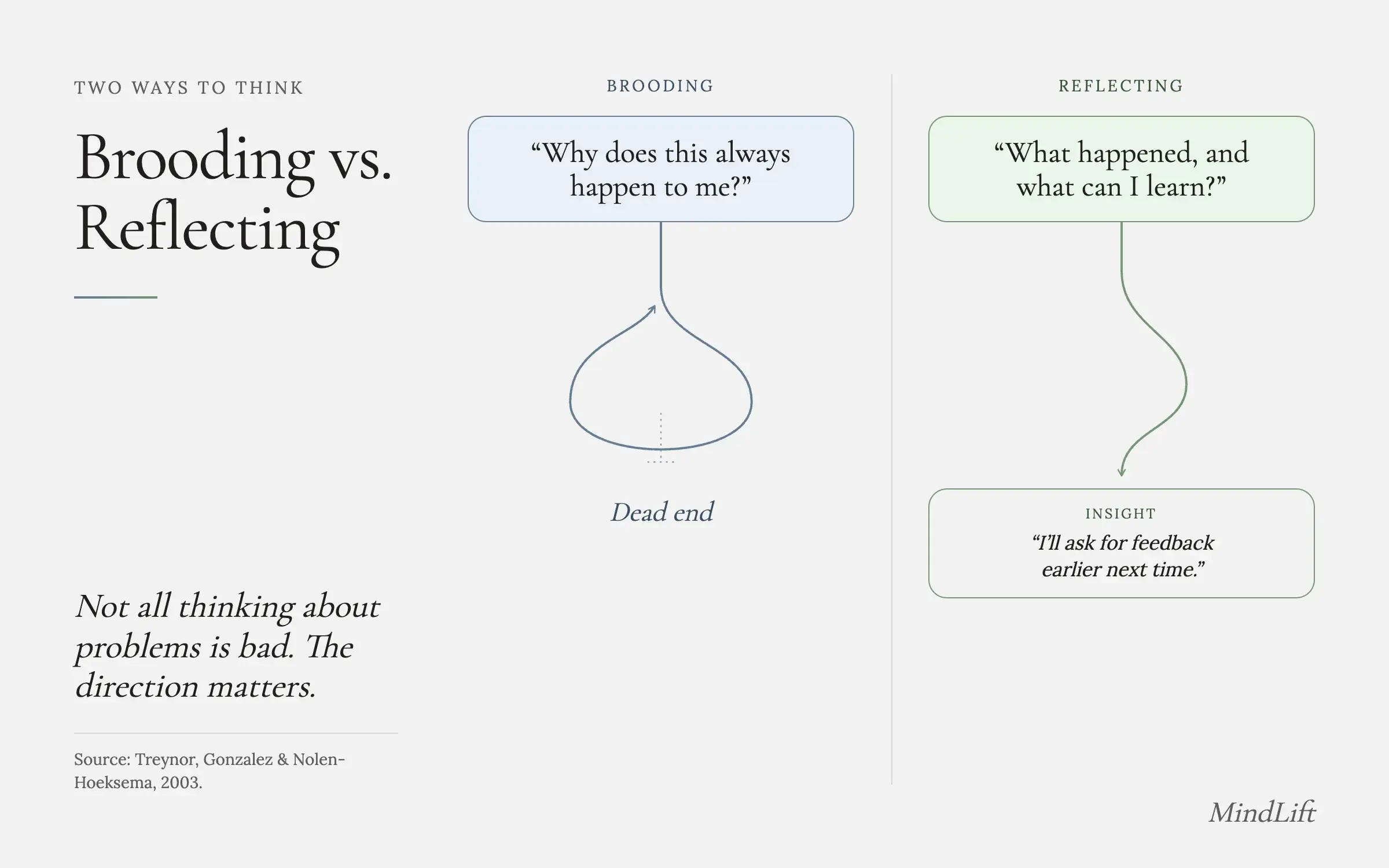
Why brooding masquerades as honesty
Brooding survives on a moral trick: it presents itself as being honest with yourself. Interrupting it feels like self-flattery — like refusing to face what you did. So conscientious people brood the most, believing the discomfort is proof of integrity.
But watch what each one actually does with the facts. Honesty describes what happened: “I missed the deadline, and it cost the team.” Brooding sentences you for it: “I always do this. This is who I am.” The first is an account; the second is a verdict — and an accurate account never requires a character verdict. The harshest available reading of yourself is not automatically the truest one. It's just the loudest, for reasons closer to how rumination works than to how truth works.
The three tells
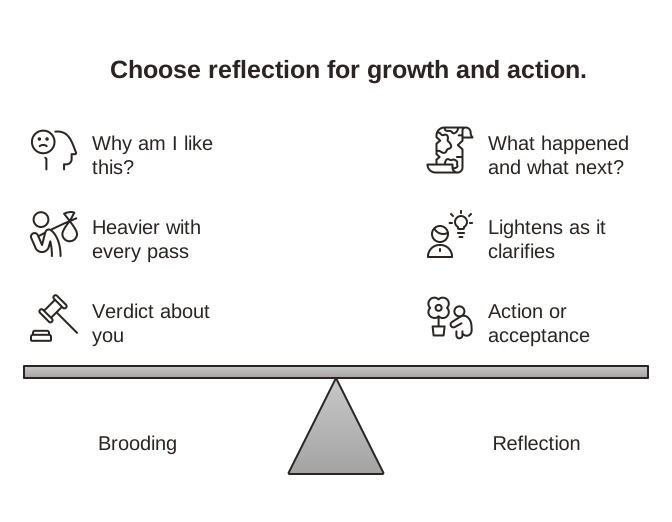
1. The question shape. Brooding asks why-about-me questions with no landing strip: “Why am I like this? Why does this always happen to me?” Reflection asks what questions with one: “What happened? What did the situation need? What next?” If your question can't be answered even in principle, it isn't inquiry — it's liturgy.
2. The emotional trajectory. Reflection is often uncomfortable, but the discomfort resolves as understanding arrives — the session ends lighter than it began. Brooding ends where it started or lower, every time. Track how you feel at minute one versus minute twenty; the slope tells you which engine was running.
3. The output test. Reflection ships something — a decision, an adjustment, an apology, a boundary. Brooding ships nothing, ever, because verdicts about your character are not actionable. Same audit as any rumination loop: no new output, no justification for another pass.
| Brooding | Reflection | |
|---|---|---|
| What it is | Passive comparison of your situation to a standard you haven't met | Purposeful analysis of what happened and what to do about it |
| The question shape | “Why am I like this? Why does this always happen?” — no answer, even in principle | “What happened? What did the situation need? What next?” — answerable |
| The emotional trajectory | Ends where it started, or lower, every time | Uncomfortable, but the discomfort resolves as understanding arrives |
| The output test | Ships nothing — a verdict about your character isn't actionable | Ships something: a decision, an adjustment, an apology, a boundary |
| Where it leads (Treynor et al., 2003) | Predicted more depression over time | On balance didn't — and can serve real problem-solving |
Converting brooding into reflection
The good news: brooding and reflection use the same raw material, so you don't have to stop thinking about the event. You have to re-point the thinking.
Swap the question. Every time you catch “why am I like this?”, replace it — physically, out loud if needed — with “what did this situation need?” The first question has no answer. The second usually has a short one, and answering it is the entire useful content of the episode.
Give it a written endpoint. One sentence, starting with: “What I take from this is…” Writing it is the difference between a review and a loop — reviews have last pages.
Time-box it. Reflection that respects a container is reflection. Thinking that refuses one — that insists it needs the whole evening, again — has told you what it is. Interrupt it like any loop, without guilt. You already did the honest part.
If your loops keep reaching verdicts
Brooding is the signature of one specific rumination style — the Verdict-Seeker, whose every loop ends at “what does this say about me?” The free What Kind of Ruminator Are You? quiz checks in two minutes whether that's your pattern or whether you run one of the other three loops — and the rumination hub has the exit ramp for each. For the broader skill of studying yourself without prosecuting yourself, see self-awareness exercises.
Frequently asked questions
What is the difference between brooding and reflection?
Both are self-focused thinking, but they behave differently. Brooding passively compares your situation to an unreached standard — "why do I always do this" — while reflection purposefully analyses what happened in order to understand and adjust — "what happened, and what next." In the research, brooding predicts worsening mood over time, while reflection can support real problem-solving.
Is self-reflection ever bad for you?
Reflection tips into brooding when it stops producing next steps and starts producing verdicts. The practice of examining yourself isn't the risk — the question shape is. 'What could I do differently?' moves you forward; 'what does this say about me?' opens a trial that has no verdict and therefore never ends.
Why does brooding feel like being honest with myself?
Brooding borrows the moral authority of self-honesty — refusing it feels like letting yourself off the hook. But honesty describes what happened; brooding sentences you for it. An accurate account of events never requires a character verdict, and the harshest reading of yourself is not automatically the truest one.
How do I turn brooding into useful reflection?
Three moves: swap "why am I like this" for "what did this situation need"; give the thinking a written endpoint — one sentence beginning "what I take from this is…"; and time-box it. If the thinking refuses an endpoint, treat it as rumination and interrupt it rather than continue it.
Like what you're reading?
Continue your wellness journey
Reframe negative thoughts in 60 seconds — free to start in the MindLift app.


Free to start · no account required
- Treynor, W., Gonzalez, R., & Nolen-Hoeksema, S. (2003). Rumination Reconsidered: A Psychometric Analysis. Cognitive Therapy and Research, 27(3), 247–259. — DOI (opens in a new tab)
Mental Wellness Researchers
Part of the MindLift team dedicated to translating psychological research into practical tools for everyday mental wellness.
Was this article helpful?