
Turn this into a daily habit — free to start in the MindLift app:
Negative self-talk is easier to recognize when you see it written out. Most people have 3–4 recurring patterns that show up across different situations — the same inner voice, different words, same underlying logic.
Below are 40 examples organized by thought type, each paired with a CBT-based reframe. The goal isn't to replace the thought with something positive — it's to find something more accurate.
Category 1: Self-Criticism ("I am...")
Self-criticism frames a mistake or behavior as a permanent identity trait. "I made a mistake" becomes "I am a mistake." This category is the most damaging because it attacks the self rather than the event.
"I'm so stupid."
Type: Overgeneralization + labeling
Reframe: "I made an error in judgment this time. That doesn't define my overall intelligence."
"I can't do anything right."
Type: All-or-nothing + overgeneralization
Reframe: "I struggle with some things. I also do a number of things competently — even today."
"I'm such a failure."
Type: Labeling + overgeneralization
Reframe: "I failed at this specific thing. My identity is not defined by one outcome."
"I'm not good enough."
Type: Emotional reasoning + labeling
Reframe: "'Good enough' for what, exactly? I may not meet my own perfectionist standard, which is different from being objectively insufficient."
"I'm too sensitive."
Type: Labeling + should statement
Reframe: "I felt something strongly. That is not a defect. The question is whether this reaction is proportionate to what happened."
"I'm a terrible friend."
Type: Labeling + overgeneralization
Reframe: "I missed something that mattered to a friend. I can name what I'd do differently and tell them, which is what a good friend does."
"I'm lazy."
Type: Labeling
Reframe: "I didn't do the thing today. Was it laziness, or was I tired, overwhelmed or unsure where to start? Each of those has a different fix."
Category 2: Catastrophizing ("This will...")
Catastrophizing predicts the worst possible outcome and treats it as the most likely one. It often generates anxiety out of proportion to actual risk.
"This is going to be a disaster."
Type: Catastrophizing + fortune-telling
Reframe: "I don't actually know how this will go. I'm predicting failure when the realistic outcome is probably somewhere in the middle."
"Everything is falling apart."
Type: Catastrophizing + overgeneralization
Reframe: "Some things are going wrong. Not everything. What specifically is the problem I need to address?"
"I'll never recover from this."
Type: Catastrophizing + fortune-telling
Reframe: "Recovery from hard situations is something I have done before. This one will be difficult, but 'never' isn't accurate."
"This will ruin my reputation forever."
Type: Catastrophizing + magnification
Reframe: "This might affect how some people see me in the short term. It is unlikely to be permanent or universal."
"If I fail this, my life is over."
Type: Catastrophizing + all-or-nothing
Reframe: "This matters to me, and I'm afraid of failing it. That's different from my entire life being over if I do."
"If I say no, they'll never ask me again."
Type: Catastrophizing + fortune-telling
Reframe: "One no is rarely the end of anything. If it were, that would tell me something about the relationship, not about me."
"This headache is probably something serious."
Type: Catastrophizing
Reframe: "Most headaches have ordinary causes. If this one is unusual for me or keeps getting worse, I can get it checked instead of guessing."
Category 3: Mind-Reading ("They think...")
Mind-reading assumes you know what others are thinking, usually assuming the worst. It generates social anxiety by treating interpretation as fact.
"Everyone can tell I'm anxious."
Type: Mind-reading + magnification
Reframe: "I feel anxious, and some of that may show. But others are typically less focused on me than I assume."
"They think I'm incompetent."
Type: Mind-reading
Reframe: "I don't actually know what they think. I'm projecting my self-criticism onto them."
"She was annoyed by what I said."
Type: Mind-reading + emotional reasoning
Reframe: "Her expression could mean many things. I'm reading one interpretation. I could check — or I could let it go."
"No one wants to hear what I have to say."
Type: Mind-reading + overgeneralization
Reframe: "Some people aren't interested. Others are. I don't have evidence that no one is."
"They're judging me right now."
Type: Mind-reading + personalization
Reframe: "People are typically focused on themselves. When I feel judged, it's often my own self-criticism I'm hearing, not an actual external judgment."
"They only invited me to be polite."
Type: Mind-reading + discounting the positive
Reframe: "I don't know why they invited me. Taking the invitation at face value is as reasonable as any other guess."
"My boss thinks I'm not pulling my weight."
Type: Mind-reading
Reframe: "Has my boss said or done anything that shows this? If I'm unsure, I can ask for feedback instead of filling in the answer myself."
Category 4: All-or-Nothing ("Always / Never")
All-or-nothing thinking sees situations in extremes: perfect or failure, always or never, everything or nothing. The middle ground disappears.
"I always mess things up."
Type: All-or-nothing + overgeneralization
Reframe: "I make mistakes sometimes. Not always. What did I handle well recently?"
"Nothing ever works out for me."
Type: All-or-nothing + overgeneralization
Reframe: "Some things haven't worked. Others have. 'Nothing' and 'ever' are words worth examining."
"Either I do it perfectly or I shouldn't do it at all."
Type: All-or-nothing
Reframe: "Most valuable things are done imperfectly, especially at first. Imperfect action is almost always better than no action."
"I either win or I'm a total failure."
Type: All-or-nothing
Reframe: "There are many outcomes between winning and failure. Where does this one actually fall on that spectrum?"
"If they don't respond quickly, they must hate me."
Type: All-or-nothing + mind-reading + catastrophizing
Reframe: "There are dozens of reasons someone might not respond quickly. 'Hate' is one of the least likely."
"I ate badly at lunch, so the whole day is ruined."
Type: All-or-nothing
Reframe: "One meal is one meal. The rest of the day is still open."
"If I can't do the full workout, there's no point."
Type: All-or-nothing
Reframe: "Ten minutes still counts. Partial is not the same as nothing."
Category 5: Personalization ("It's my fault...")
Personalization takes responsibility for events and outcomes that are outside your control or that involve multiple factors.
"The meeting went badly because of me."
Type: Personalization
Reframe: "I was one variable in that meeting. What else contributed? What portion is actually attributable to me?"
"My friend seems upset — I must have done something."
Type: Personalization + mind-reading
Reframe: "She might be upset about something completely unrelated to me. I'm making myself the center of her experience."
"If I were better, this wouldn't have happened."
Type: Personalization + should
Reframe: "This happened because of multiple factors. I may have contributed, but I am not the sole cause."
"It's my fault they're unhappy."
Type: Personalization
Reframe: "Other people's emotional states are influenced by many things. I may have played a role, but their happiness is not my sole responsibility."
"The party was boring because I was there."
Type: Personalization
Reframe: "A party's mood depends on many people, the place and the night. I was one guest, not the host of everyone's evening."
"My kid is struggling at school, so I've failed as a parent."
Type: Personalization + labeling
Reframe: "Many things shape how a child does at school. My part is to notice and help, not to carry the whole cause."
Category 6: "Should" Statements
'Should' statements create rigid internal rules. When violated, they generate guilt, shame, or resentment — depending on whether the 'should' is directed inward or outward.
"I should have handled that better."
Type: Should statement
Reframe: "I handled it the way I did with what I had at the time. What would I do differently next time?"
"I shouldn't feel this way."
Type: Should statement + emotional reasoning
Reframe: "Feelings don't respond to 'should.' What I feel is what I feel. What do I want to do with it?"
"I should be further along by now."
Type: Should statement + comparison
Reframe: "According to whose timeline? 'Should be further along' compared to what — an imagined version of my life or an actual external standard?"
"I should be able to handle this on my own."
Type: Should statement
Reframe: "Many things are easier with support. Needing help is not weakness; it's how most hard things get done."
"People should treat me better."
Type: Should statement (directed outward)
Reframe: "I would prefer they treat me differently. I can't control their behavior, but I can decide what I'll tolerate and what I'll do about it."
"I should be over this by now."
Type: Should statement
Reframe: "There's no deadline for getting over something. That I'm still affected tells me it mattered."
How to Use These Examples
When a harsh thought arrives, the first question is: what type of thought is this? Once you've labeled it (self-criticism, catastrophizing, mind-reading, all-or-nothing, personalization, should), you have a category — and with a category, you have a framework for the reframe.
The reframe doesn't need to be perfect. It needs to be more accurate than the original thought and believable enough that you can actually hold it.
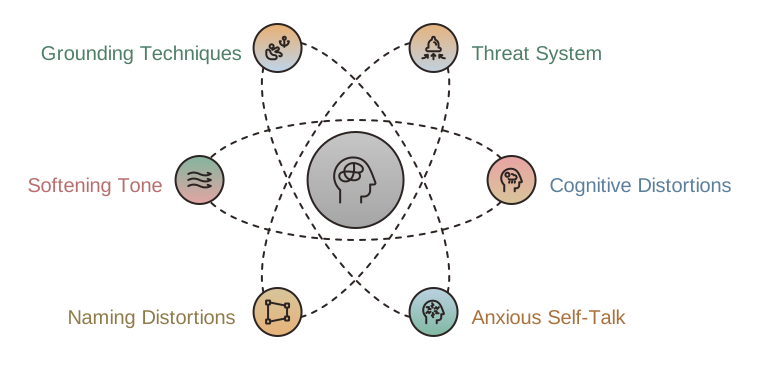
MindLift's Mini-Reframe does this in 60 seconds — you type the thought, and it walks you through a CBT-based reframe for that specific thought.
Related Reading
- Cognitive Reframing Techniques: 8 CBT Methods
- How to Stop Overthinking Immediately
- Thinking Traps and Cognitive Distortions
- From Inner Critic to Inner Coach
Frequently asked questions
What is negative self-talk?
Negative self-talk is the internal commentary that narrates your experiences in a harsh, distorted, or self-undermining way. It includes self-criticism ("I'm so stupid"), catastrophizing ("this will ruin everything"), and mind-reading ("they think I'm incompetent"). It is normal — most people experience it — but it varies significantly in frequency and intensity.
What are examples of negative self-talk?
"I always mess things up." "Everyone can see how anxious I am." "I should have handled that better." "This will never get better." "I'm not smart enough for this." "They think I'm boring." These are common examples across the main categories of self-critical thought.
How do you stop negative self-talk?
You can't eliminate negative self-talk entirely, but you can reduce its automatic believability. The most effective approach from CBT: (1) name the thought type (distortion label), (2) examine the evidence for and against it, (3) generate a more accurate alternative. This process — done consistently — builds a new default response over time.
Is negative self-talk the same as the inner critic?
The inner critic is a psychological concept that describes the internalized voice of self-judgment. Negative self-talk is the content that voice produces. The inner critic is the source; negative self-talk is the output. Both terms are often used interchangeably in self-help contexts.
Like what you're reading?
Continue your wellness journey
Reframe negative thoughts in 60 seconds — free to start in the MindLift app.


Free to start · premium optional