
Turn this into a daily habit — free to start in the MindLift app:
You've downloaded the app. You've done the breathing exercise. You've sat through the guided body scan with a soothing voice telling you to notice sensations "without judgment." And twenty minutes later, you're back in the exact same loop you were in before you opened the app — just now with the added frustration of feeling like meditation "doesn't work for you."
It's not that mindfulness doesn't work. Mindfulness Based Stress Reduction (MBSR) is one of the most well-researched stress interventions that exists. The problem is narrower and more specific than "mindfulness is broken": most mindfulness apps have taken the aesthetic of MBSR — the calm narrator, the ambient music, the 20-minute sit — without the part that actually helps an overthinker in the middle of a spiral. And if you're someone whose stress shows up as racing thoughts at 11pm, not a general sense of not being relaxed enough, that gap matters a lot.
What Mindfulness Based Stress Reduction Actually Is
MBSR was developed by Jon Kabat-Zinn in the late 1970s as a structured, secular program combining meditation and body awareness to help people manage chronic pain, anxiety, and stress. The original format is an 8-week course: weekly group sessions, daily home practice, and a full-day retreat, built around a few core skills — body scanning, sitting meditation, and gentle yoga, all in service of one underlying goal.
That goal is not relaxation. It's noticing.
The actual mechanism behind MBSR is teaching you to observe a thought or sensation as it's happening, instead of being fused with it — swept along by it without realizing you're inside it. In clinical terms, this is sometimes called decentering: recognizing "I am having the thought that I'm failing" instead of simply thinking "I am failing." That distinction is small on paper and enormous in practice. It's the difference between a thought running you and you noticing a thought run.
This is genuinely useful. It's also, notably, not the same thing as calm. You can decenter from a thought while still feeling terrible. MBSR was never actually selling stillness — it was selling awareness. Somewhere between the research and the App Store, that distinction got lost.
Where the App Version Gets It Wrong
Most consumer mindfulness apps inherited MBSR's tools — breathing, body scans, ambient narration — without inheriting the one condition that makes those tools work: you have to already have a baseline of calm to use them.
A body scan assumes you can lie still for ten minutes. A breathing exercise assumes your thoughts will slow down if your breath does. Both are true — eventually, for a lot of people, in a lot of situations. But if you're an overthinker whose stress presents as a specific, running thought ("I shouldn't have sent that message," "everyone thinks I'm annoying," "I'm behind and it's too late to fix it"), stillness isn't the prerequisite you're missing. It's the thing you can't access because the thought is still running.
This is the actual failure mode of the meditation-app category: it asks you to arrive calm enough to meditate. Overthinkers rarely have that. What they have is a specific sentence in their head, repeating, at a specific moment — usually not a moment where a 20-minute guided session is realistic. You're not going to lie down and do a body scan in a work bathroom stall or at a stoplight or three minutes before a meeting starts. But that's exactly when the thought is loudest.
Journaling has a related but different problem. It asks you to sit with the thought, often for a while, before anything resembling relief arrives. For some people that's useful processing. For an overthinker already stuck in a loop, extended dwelling can just add more time inside the loop, not less.
What Actually Interrupts a Running Thought
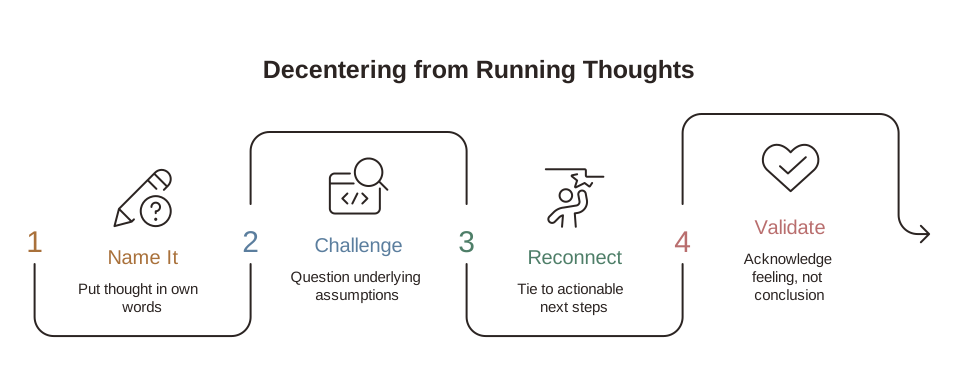
If decentering — noticing the thought instead of being fused with it — is the real mechanism MBSR is built on, the more useful question isn't "how do I get calm enough to meditate." It's "how do I decenter from a specific thought in the next 60 seconds, standing up, mid-day, without a narrator or a candle."
That's a different tool than a meditation app. It looks less like stillness and more like a structured reframe: naming the thought in your own words, then examining it from three angles that mirror what decentering is actually supposed to do —
- Challenging the assumption underneath the thought, directly, without softening it into something more comfortable
- Reconnecting the thought to something you're actually capable of doing next, in your own words, not a generic affirmation
- Validating that the feeling makes sense given the situation, without validating the distorted conclusion the thought jumped to
This is the same underlying skill MBSR is teaching — separating yourself from the thought long enough to see it clearly — just built for the moment the thought actually happens, not for a scheduled 20-minute session later.
This is the exact gap MindLift was built to fill. You type the thought exactly as it's running through your head — not a summary, not a category, the actual sentence — and within 60 seconds you get three structured reframes built around it: a Realist take that challenges the hidden assumption without softening it, a Growth reframe in your own words tied to what you actually said, and a Compassionate reframe that validates you without validating the spiral. No candle, no 20-minute prerequisite, no need to already be calm. It's mental first aid for the 167 hours a week you're not in a therapist's office, built around the same decentering principle MBSR is actually based on — just deployable in the minute you need it, not the minute you have free.


Where MBSR Still Wins
None of this makes MBSR obsolete — it makes it incomplete as a stress toolkit on its own, at least for people whose stress lives mostly in racing thoughts rather than physical tension. The 8-week format, done properly with a trained instructor, builds a durable baseline skill: over months, people who complete MBSR programs generally do get better at noticing their thoughts before the spiral fully forms, not just interrupting it after.
That's a slow, structural change. It's genuinely worth pursuing if you have the time and access to a program. But it doesn't replace what you need at 11pm when the thought is already loud, or in the bathroom stall three minutes before a meeting. Those two things — the long-term practice and the in-the-moment interruption — aren't competing. One builds the skill over months. The other gives you something to do with a specific thought right now, tonight, before the long-term skill has had time to build.
Not sure which automatic reaction runs first for you? Take the free What's Your Stress Response Pattern? quiz — it names the pattern in 90 seconds, no email required.
Most people trying to manage overthinking need both, not a choice between them. Few overthinkers have failed at mindfulness. Most have just been handed the version of it that requires the one thing they don't have in the moment they need it most: stillness. What they actually need is a way to decenter from the exact thought that's running, right now, standing up.
Sources
- Jon Kabat-Zinn founded MBSR in 1979 at the University of Massachusetts Medical School Stress Reduction Clinic, originally to help chronically ill patients cope with pain — Wikipedia: Jon Kabat-Zinn
- MBSR is a standardized eight-week program of weekly group sessions (~2.5–3 hours each) plus an orientation session and a full-day retreat; mindfulness meditation cultivates attention skills, develops emotional regulation, and significantly reduces rumination and worry — Wikipedia: Mindfulness-Based Stress Reduction
- Program format and origins: eight-week course plus orientation and full-day retreat, teaching mindfulness and meditation techniques for stress and pain reduction — Mindful Leader: Why Was MBSR Created?
- MBSR was originally called the Stress Reduction and Relaxation Program before being renamed, shifting emphasis away from its Buddhist foundations to be secular and accessible to people of all belief systems — PositivePsychology.com: The Ultimate MBSR Guide
- Decentering — observing thoughts as mental events rather than facts — as a mechanism of mindfulness-based approaches: Segal, Z. V., Williams, J. M. G., & Teasdale, J. D., Mindfulness-Based Cognitive Therapy for Depression (Guilford Press)
MindLift is a free-to-start app that gives you three structured, CBT-based reframes for any negative thought — in your own words, within 60 seconds. Try MindLift free →
Frequently asked questions
What is Mindfulness Based Stress Reduction (MBSR)?
MBSR is a structured, secular 8-week program developed by Jon Kabat-Zinn in the late 1970s. It combines body scanning, sitting meditation, and gentle yoga — weekly group sessions, daily home practice, and a full-day retreat. Its core mechanism isn't relaxation but 'decentering': learning to observe a thought as it happens ('I am having the thought that I'm failing') instead of being fused with it ('I am failing').
Why don't mindfulness apps work for overthinkers?
Most consumer apps inherited MBSR's tools — breathing exercises, body scans, ambient narration — but those tools assume a baseline of calm you can't access mid-spiral. A body scan requires lying still for ten minutes; an overthinker's stress is a specific running thought at a specific moment, usually one where a 20-minute guided session isn't realistic. The app asks you to arrive calm enough to meditate, which is exactly what a spiral prevents.
Is MBSR better than CBT for overthinking?
They target different timescales. MBSR, done properly over 8 weeks, builds a durable long-term skill of noticing thoughts before spirals fully form. CBT-style structured reframing works on the specific thought that's running right now — challenging its hidden assumption, reconnecting it to a next action, and validating the feeling without validating the distorted conclusion. Most people managing overthinking benefit from both, not a choice between them.
How do I stop an overthinking spiral in the moment without meditating?
Use the decentering skill directly on the thought: name the exact sentence running through your head, then examine it from three angles — challenge the assumption underneath it, connect it to something concrete you can do next, and acknowledge the feeling makes sense without accepting the conclusion. This takes about 60 seconds, works standing up, and doesn't require prior calm — which is why it fits the moments meditation apps don't.
Like what you're reading?
Stop the spiral in real time
MindLift gives you a gentle CBT-based reframe the moment your thoughts start looping.
Free to start · no account required
CBT & Self-Talk Researchers
MindLift content is grounded in cognitive behavioral therapy principles and designed to help you shift harsh self-talk in real time. Our guides focus on practical, evidence-based techniques you can use in the moment.
Was this article helpful?