
Turn this into a daily habit — free to start in the MindLift app:
Most people, at some point, try to change their life by changing the setting. A new job. A new city. A new relationship. Sometimes it helps — for a while. And then, a few weeks or months in, a familiar feeling shows up in the new place, wearing the new job's clothes or the new city's weather. The scenery changed. The software didn't.
Why the big changes don't stick
The instinct makes sense. If the current situation feels bad, the situation looks like the problem. So you change the inputs — the job, the address, the person across the table — and wait for the output to improve.
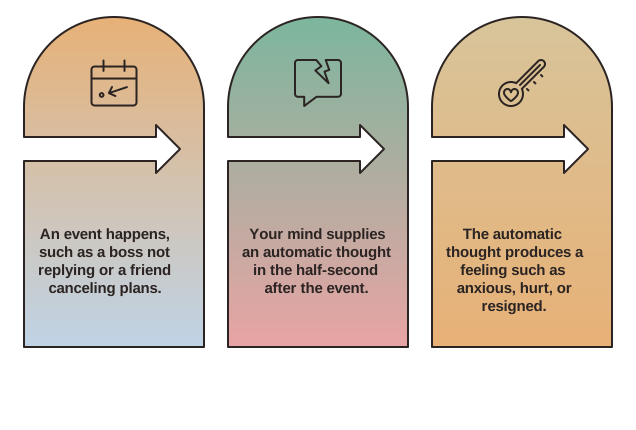
But feelings aren't a direct response to inputs. They're a response to how you interpret the inputs, and that interpretation happens fast — in the half-second or so between something happening and you feeling something about it. In that gap, your mind supplies a sentence, and the sentence is what you actually react to.
Your boss doesn't reply to your email. In the gap: she's annoyed with me. Then the feeling arrives — a knot of anxiety that colors the rest of your afternoon.
A friend cancels plans. In the gap: I'm too much. Then hurt, and a small, quiet decision to text less next time.
One thing goes wrong in a day that was already hard. In the gap: of course it does. Then resignation, which somehow makes the next three things go wrong too.
None of those sentences were facts. All of them felt like facts. And none of them had anything to do with the job, the city, or the relationship — they showed up in the old context and they'll show up in the new one, because the gap travels with you.
The daily habit nobody names
When people talk about habits, they usually mean the visible ones — nail-biting, doomscrolling, the third coffee at 3pm. The sentence in the gap doesn't get filed under "habit" because it doesn't look like one. There's no ritual to it, no obvious trigger-and-reward loop you can point to. It's just a thought.
But it meets every definition of a habit that matters. It's automatic — you don't decide to think it, it arrives before you've had a chance to. It's repeated — not once a week, but dozens of times a day, in response to emails, glances, silences, delays, and minor disappointments. And it's largely invisible, which is exactly what makes it powerful. You don't experience it as a thought you're having. You experience it as the day being bad.
Set that habit's weather next to nail-biting or a fourth coffee and it's clear which one is actually running the show. The sentence in the gap doesn't just cost you a moment of discomfort — it sets the emotional temperature for everything that follows it.
Why this one is harder to catch than a bad habit
Nail-biting announces itself. You can see your hand moving toward your mouth. The daily thought habit doesn't announce itself, because it wears the costume of truth. It doesn't feel like a guess or a pattern — it feels like an accurate read on what just happened.
Facts don't usually need to convince you that fast.
The speed and certainty of an automatic thought is itself a clue that it's a distortion, not a conclusion you reasoned your way to.
CBT has names for the most common shapes this sentence takes. Catastrophizing jumps from a delayed reply to a worst-case outcome. Mind reading assumes you know exactly what someone else is thinking, usually something unflattering about you, with no evidence beyond a feeling. All-or-nothing thinking turns a single setback into a verdict — one thing going wrong becomes proof that everything will.
A real conclusion is usually built slowly, out of evidence you can point to. These sentences arrive instantly, fully formed, and certain of themselves. That speed is the tell. Facts don't usually need to convince you that fast — a rushed, absolute certainty is often the automatic thought habit at work, not your judgment. If you want the fuller list of the thought patterns worth learning to spot, or the quieter ones most people miss in cognitive distortions you don't know you have, both are worth the ten minutes.
What actually changing it looks like
It's worth being specific about what this isn't, because the wrong version of "work on your thoughts" gets recommended constantly and rarely works.
It's not affirmations. Repeating a nicer sentence over the automatic one doesn't interrupt the habit — it just adds a second sentence that competes with the first, usually losing, because the automatic thought arrived first and felt true.
It's not after-the-fact journaling, either — at least not on its own. Writing about the thought that hour, day, or week later is useful for noticing patterns, but it happens too far downstream to change how the original moment felt. By the time you're writing, the feeling has already done its work.
And it's not something you can fully outsource to a weekly therapy hour, as valuable as that hour is. Therapy is an hour. The thought habit runs for the other 167. A once-a-week conversation can teach you the skill, but the skill has to be used in the actual half-second gap, which happens on a Tuesday afternoon at your desk, not in a session on Thursday.
What actually changes the habit is catching the sentence when it happens — not the story about the event, the exact sentence — and looking at it directly, in your own words, close to the moment it showed up. Not a generic reframe pulled from a list. The specific thing you told yourself, examined while it's still warm.
That's the gap MindLift is built to sit in. Type the exact thought — "she's annoyed with me," "I'm too much," "of course it does" — and MindLift gives you three reframes in 60 seconds: a Realist one that challenges the evidence, a Growth one that recontextualizes what it means, and a Compassionate one that responds the way a good friend would. It also names the distortion, so the pattern stops being invisible. It's free to start, on iOS and Android, and it's built for the moment the sentence shows up, not the debrief afterward.
If you'd rather start on paper, the reframe toolkit walks through the same distortions in worksheet form — useful for the first few weeks while you're still learning to spot the sentence in real time.
It compounds like everything else does
None of this happens in one sitting. Catching the sentence once doesn't undo years of it running on autopilot. But it compounds the same way the habit itself compounded — quietly, through repetition, until noticing becomes the automatic part instead of believing.
That's also why the job, the city, and the relationship were never going to be enough on their own. They can genuinely help — new environments do remove real sources of stress. But if the sentence in the gap doesn't change, the new job gets its own version of "she's annoyed with me," the new city gets its own version of "I'm too much," and the new relationship gets its own version of "of course it does."
You don't need a different life to feel different. You need a different second thought.
For one reframe a week delivered straight to your inbox, The Sunday Reframe is built around exactly this — small, specific shifts instead of a new life to try on.
Frequently asked questions
Is it really just one habit that changes everything?
Not one habit in the sense of a single fix-all. It's one category of habit — the automatic thought that fires between an event and a feeling — that shapes far more of your day than any external circumstance does. Change the job, the city, or the relationship and that thought habit comes with you. Change the thought habit and it changes how every circumstance feels, including the ones you haven't gotten to yet.
How long before this actually changes something?
You'll likely notice the catch happening faster within a couple of weeks of paying attention — that's just what happens when you start naming a pattern that used to run silently. Changing the pattern's grip on your mood takes longer and isn't linear. This is a practice, not a switch, and progress usually looks like shorter spirals and quicker recoveries before it looks like the thought disappearing entirely.
Isn't this just positive thinking with extra steps?
No — positive thinking asks you to swap a negative thought for a nicer one regardless of whether the nicer one is true. This is about accuracy, not optimism. The goal isn't to insist your boss loves your work; it's to notice that "she's annoyed with me" is a guess dressed up as a fact, and to test it before you spend the rest of the day reacting to it.
What if I can't tell what my automatic thought even is?
Start with the feeling instead — it's usually easier to spot. When you notice you're anxious, hurt, or resigned, ask what you just told yourself in the second before that feeling showed up. It's often a single sentence, and it usually surfaces fast once you go looking for it right after the feeling instead of hours later.
Like what you're reading?
Continue your wellness journey
Reframe negative thoughts in 60 seconds — free to start in the MindLift app.


Free to start · no account required
CBT & Self-Talk Researchers
MindLift content is grounded in cognitive behavioral therapy principles and designed to help you shift harsh self-talk in real time. Our guides focus on practical, evidence-based techniques you can use in the moment.
Was this article helpful?